Spring Special Sale - 70% Discount Offer - Ends in 0d 00h 00m 00s - Coupon code: spcl70

Practice Free CPHRM Certified Professional in Health Care Risk Management (CPHRM) Exam Questions Answers With Explanation

We at Crack4sure are committed to giving students who are preparing for the ASHRM CPHRM Exam the most current and reliable questions . To help people study, we've made some of our Certified Professional in Health Care Risk Management (CPHRM) exam materials available for free to everyone. You can take the Free CPHRM Practice Test as many times as you want. The answers to the practice questions are given, and each answer is explained.

Question # 6

An organization's CEO has requested that the risk manager develop policies and procedures for the risk management department. The risk manager should consider developing policies for all of the following EXCEPT

A.

coordination of responses to subpoenas.

B.

departmental accountability for occurrence reporting.

C.

risk management reporting process to the governing body.

D.

responses to freedom of information requests.

Question # 7

Which type of information was associated with the former HIPDB (now within NPDB) but not the original NPDB focus?

A.

Fraud/abuse-related actions and exclusions involving providers/suppliers (HIPDB purpose)

B.

Restaurant health inspections

C.

Public voter registration files

D.

School disciplinary actions

Question # 8

When considering the proper insurance to purchase for an organization and its practitioners, a risk manager should understand which of the following about specific types of coverage?

A.

Occurrence coverage provides coverage for incidents that occur prior to initiation date of the policy as long as the event is reported to the insurer before signing.

B.

Occurrence coverage provides coverage for incidents that occur while the policy is in effect.

C.

With claims-made coverage, the retroactive date does not impact the coverage of the insured.

D.

With claims-made coverage, the nose period has no significance to the coverage of the insured.

Question # 9

Generally, an incident is defined as:

A.

Any happening not consistent with routine care/operations (including near-misses)

B.

Only events that cause death

C.

Only patient complaints

D.

Only billing disputes

Question # 10

The set of values, norms, guiding beliefs, and understandings that is shared by members of a healthcare organization and is taught to new members is

A.

organizational culture.

B.

corporate vision.

C.

managerial ethics.

D.

strategic mission.

Question # 11

Which of the following risk management documents in a policy and procedure manual should be approved by an organization's board of directors?

A.

philosophy regarding medical error management

B.

risk management department's annual budget

C.

risk analysis

D.

departmental personnel job descriptions

Question # 12

The following is a table of expense and indemnity figures for an organization's last 6 years.

CPHRM question answer

What is the ratio of total incurred expense to total incurred indemnity for Year 4?

A.

0.15

B.

0.18

C.

3.23

D.

0.20

Question # 13

When CPOE is implemented, there is almost always a decline in:

A.

Medication errors related to prescribing/transcription

B.

Nurse staffing requirements

C.

Patient acuity

D.

The need for clinical decision-making

Question # 14

A hospital's Ethics Committee is seeking advice on a case involving the elective sterilization of an adolescent patient who is developmentally disabled. One of the parents is refusing consent. The risk manager should evaluate which of the following?

    who has consent authority

    competency level of the patient

    diagnosis of the patient

    state statutes and laws

A.

1, 2, and 3 only

B.

1, 2, and 4 only

C.

1, 3, and 4 only

D.

2, 3, and 4 only

Question # 15

A hospital risk manager has been called to the Neonatal Intensive Care Unit to discuss a 25-week premature infant whose parents are refusing a planned blood transfusion due to their religious beliefs. After gathering information on the infant’s condition and hearing the parents and the healthcare professionals disagree on the best interests of the infant, the risk manager should

A.

arrange for an ethics committee consultation to meet the parents and discuss the issue.

B.

prohibit the blood transfusion, respecting the parents’ rights as substitute decision-makers for the infant.

C.

advise the care team to proceed with the blood transfusion.

D.

contact legal counsel to arrange for an emergency court hearing to obtain a court order from the state to intervene.

Question # 16

If an at-risk patient is left unattended and has an adverse response to medication, this is best classified as:

A.

An active error at the sharp end (frontline lapse)

B.

A harmless variance

C.

A marketing defect

D.

A financial risk transfer

Question # 17

A 22-year-old man has been treated at a hospital for a psychiatric condition. His mother requests that a copy of the patient's medical record be released to her. The risk manager's advice to the medical records department should be to

A.

contact the hospital's legal counsel to authorize the release of the medical record.

B.

check with the psychiatrist for a recommendation to release the medical record.

C.

verify that a specific release of information form has been signed by the patient and then release the medical record.

D.

request evidence that the mother is the guardian of the patient and then release the medical record.

Question # 18

In enterprise risk management, which of the following are external factors that may affect risk?
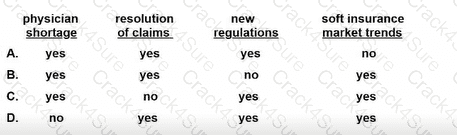
CPHRM question answer

A.

Option A

B.

Option B

C.

Option C

D.

Option D

Question # 19

Which of the following is an essential component of a risk management policy and procedure manual?

A.

department organizational chart

B.

medical staff bylaws

C.

actuarial report

D.

loss run report

Question # 20

When conducting a safety audit in an Emergency Department, what does an administrator need to obtain first?

A.

A written set of safety standards/criteria for the audit

B.

A marketing plan

C.

A list of staff birthdays

D.

A patient satisfaction script

Question # 21

An emergency department physician has evaluated and stabilized a patient who needs a sign language interpreter. The on-call physician is consulted for admission. Which of the following regulatory laws are most relevant?

A.

ADA and EMTALA/COBRA

B.

HCQIA and ADA

C.

EMTALA/COBRA and HIPAA

D.

HIPAA and HCQIA

Question # 22

An HMO advertises it is “the best” and its physicians can manage any illness/injury. A patient relies on this and is injured. The patient might sue the HMO for:

A.

Apparent agency / negligent misrepresentation / vicarious liability (depending on facts and jurisdiction)

B.

Only weather damage

C.

Only EMTALA penalties

D.

Only OSHA violations

Question # 23

In a failure mode and effects analysis, the risk priority number is calculated by

A.

adding the severity and occurrence scores.

B.

multiplying the severity and detection scores.

C.

adding the severity, occurrence, and detection scores.

D.

multiplying the severity, occurrence, and detection scores.

Question # 24

An interrogatory requests insurance policy information. A risk manager should

A.

provide the specifically requested information.

B.

provide excess limits as well as primary limits.

C.

attach a certificate of insurance.

D.

object to the interrogatory.

Question # 25

Which of the following is a program of the Food and Drug Administration FDA post market surveillance system for medical devices that requires healthcare facilities to report patient deaths or injuries related to a medical device?

A.

Safe Medical Devices Act SMDA

B.

Emergency Medical Treatment and Active Labor Act EMTALA

C.

Occupational Safety and Health Act of 1970 OSHA

D.

Patient Safety Organization PSO

Question # 26

A root cause analysis of inpatient suicides would be most likely to discover problems with:

A.

The physical environment (e.g., ligature points, visibility)

B.

Billing documentation

C.

Dietary preferences

D.

Parking access

Question # 27

The first layer of insurance that will respond to a specific type of loss or exposure is called

A.

baseline.

B.

foundation.

C.

primary.

D.

frontline.

Question # 28

Which of the following concerns meets the CMS Hospital Conditions of Participation 42 CFR §482.12 classification as a grievance?

A.

a verbal complaint that cannot be solved by current staff, and the resolution of which is postponed for later

B.

a patient calling regarding a billing issue requesting for adjustment to the charges

C.

information obtained with a patient satisfaction survey

D.

post-hospital verbal communication regarding a care issue that could have been handled by the staff during visit but was not reported

Question # 29

An appropriate way to complete the verification read-back of a complete order, as required by The Joint Commission National Patient Safety Goals, is to have the person receiving the order

A.

write the information down before reading it back.

B.

immediately repeat the information.

C.

have a witness verify that the information is repeated back correctly.

D.

document the date and time the order was received.

Question # 30

Supervisors who conduct job interviews may ask which of the following questions?

A.

Are you currently taking a prescription medication?

B.

Do you plan to have children?

C.

Can you meet the organization's attendance requirement?

D.

Are you a citizen of the United States?

Question # 31

The source of many medication errors is:

A.

Verbal/telephone orders (when avoidable and not properly verified)

B.

Patient wristbands

C.

Elevator delays

D.

Radiology scheduling

Question # 32

A clear directive to a nurse is:

A.

“Be careful.”

B.

“Monitor the infusion pump’s operation at defined intervals and document checks.”

C.

“Do your best.”

D.

“If you have time, look at it.”

Question # 33

Information from the Data Bank (NPDB; includes former HIPDB content) can be requested by:

A.

Any member of the public

B.

Professional societies with formal peer review (as permitted)

C.

Social media investigators

D.

Patients requesting a clinician’s full file

Question # 34

Root Cause Analyses most often reveal that mistakes are a result of:

A.

A series of small events and system flaws aligning

B.

A single reckless person in most cases

C.

Random chance with no patterns

D.

Only equipment malfunction

Question # 35

The Patient Safety and Quality Improvement Act of 2005 includes provisions to

    amend the Public Health Service Act to establish procedures for the voluntary confidential reporting of medical errors.

    enable the creation of patient safety organizations PSOs.

    require mandatory reporting to PSOs.

    classify patient safety work product reported to PSOs as privileged and confidential.

A.

1, 2, and 3 only

B.

1, 2, and 4 only

C.

1, 3, and 4 only

D.

2, 3, and 4 only

CPHRM PDF

$33

$109.99

3 Months Free Update

  • Printable Format
  • Value of Money
  • 100% Pass Assurance
  • Verified Answers
  • Researched by Industry Experts
  • Based on Real Exams Scenarios
  • 100% Real Questions

CPHRM PDF + Testing Engine

$52.8

$175.99

3 Months Free Update

  • Exam Name: Certified Professional in Health Care Risk Management (CPHRM)
  • Last Update: Feb 14, 2026
  • Questions and Answers: 119
  • Free Real Questions Demo
  • Recommended by Industry Experts
  • Best Economical Package
  • Immediate Access

CPHRM Engine

$39.6

$131.99

3 Months Free Update

  • Best Testing Engine
  • One Click installation
  • Recommended by Teachers
  • Easy to use
  • 3 Modes of Learning
  • State of Art Technology
  • 100% Real Questions included