Weekend Special Sale - 75% Discount Offer - Ends in 0d 00h 00m 00s - Coupon code: 75special

Practice Free CCAR-P Claude Certified Architect - Professional Exam Questions Answers With Explanation

We at Crack4sure are committed to giving students who are preparing for the Anthropic CCAR-P Exam the most current and reliable questions . To help people study, we've made some of our Claude Certified Architect - Professional exam materials available for free to everyone. You can take the Free CCAR-P Practice Test as many times as you want. The answers to the practice questions are given, and each answer is explained.

Question # 6

You are reviewing a peer’s draft system prompt that contains contradictory instructions: one section says never to speculate beyond the supplied source, while another says to confidently fill in any gaps.

Which response is most appropriate?

A.

Add a priority instruction directing the model to evaluate all instructions and apply whichever appears most contextually appropriate on each request.

B.

Remove or rewrite the gap-filling instruction so the prompt consistently constrains the model to source-supported content.

C.

Increase temperature so output randomness masks the contradiction.

D.

Keep both instructions and rely on the model to decide which one to follow on each request.

Question # 7

You are supporting an engineer whose newly added MCP server does not appear in their Claude Code session.

Which diagnostic step should be tried first?

A.

Disable every MCP server in the configuration to isolate the issue, removing all tool access rather than confirming whether the new server is registered.

B.

Switch the team to a different Claude product family unrelated to the existing workflow, abandoning the current configuration rather than diagnosing the registration issue.

C.

Verify the MCP server is registered using the listing command, then reconnect the session if needed, since configuration changes typically require a restart to take effect.

D.

Reinstall the developer’s operating system from scratch, discarding all local configuration and tool state before attempting any targeted diagnostic steps.

Question # 8

A Claude architect is auditing configuration scope assignments.

Which two statements correctly identify an appropriate use of user-scope configuration versus other scopes? (Select two.)

A.

Persisting personal editor theme preferences that follow an engineer across projects.

B.

Saving a preferred Claude response language that applies to all repositories the engineer uses.

C.

Enforcing a company-wide policy that disables a feature for all engineers.

D.

Defining MCP server endpoints shared by all contributors to a specific repository.

E.

Storing API authentication keys so they are not committed to version control.

Question # 9

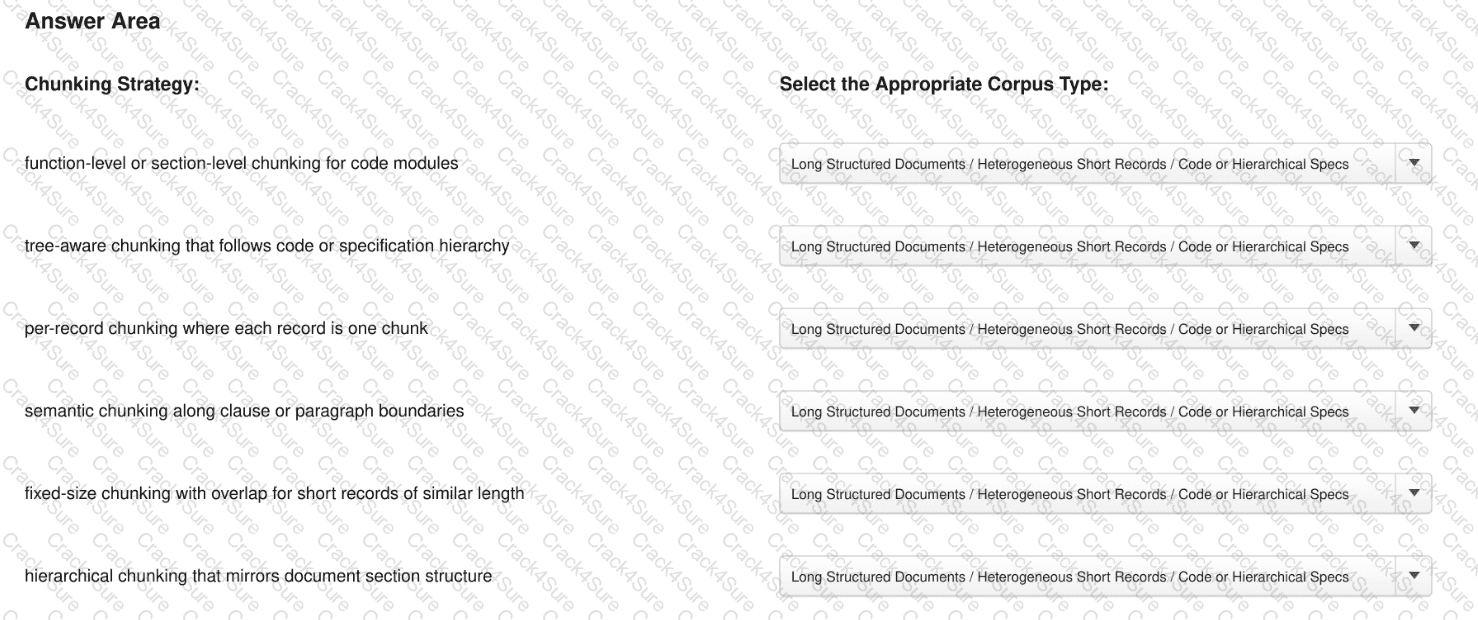
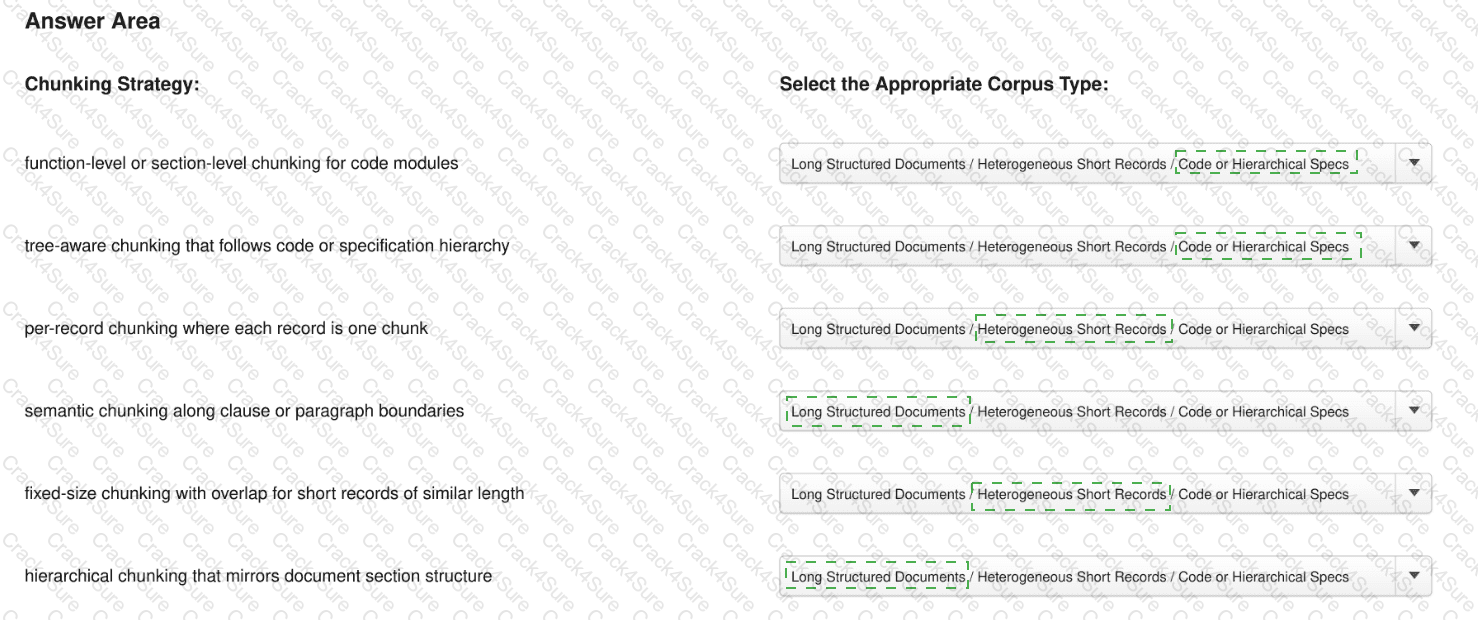
You are classifying chunking strategies by the corpus type each is best suited to.

For each chunking strategy, select the appropriate corpus type: “Long Structured Documents,” “Heterogeneous Short Records,” or “Code or Hierarchical Specifications.”

CCAR-P question answer

Question # 10

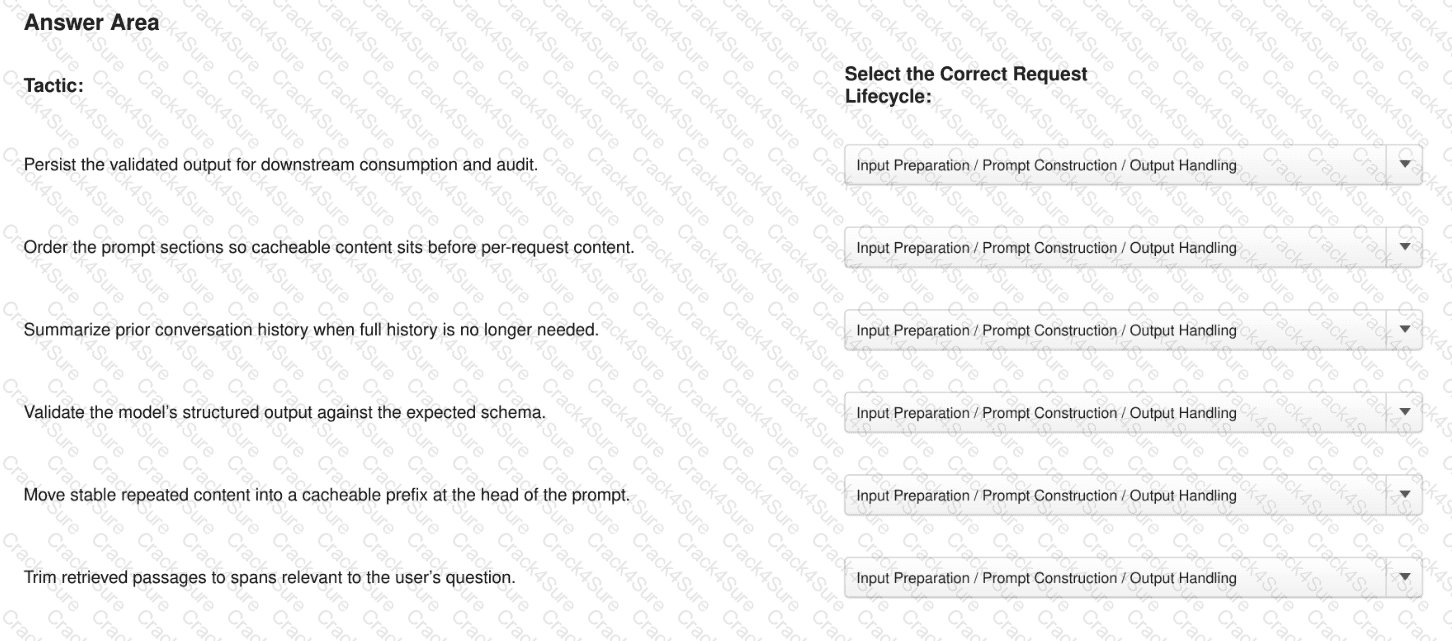
You must present an architectural recommendation to deploy a Claude-based contract review assistant to a steering committee that includes the CFO, the general counsel, and the CIO. Each stakeholder cares about different aspects of the decision.

How should you structure the recommendation document?

A.

Lead with the technical architecture diagram and the full component list before any other section.

B.

Lead with detailed cost projections across the full multi-year horizon before the rationale section.

C.

Present the same dense narrative throughout with no stakeholder differentiation in any section.

D.

Lead with the architectural decision, then address each stakeholder’s primary concerns directly.

Question # 11

The platform team at Trenova Systems, Inc. needs to reduce per-query cost and p95 latency for a high-volume Claude pipeline without degrading output quality on the core use case.

Which two optimizations directly target both cost and latency simultaneously? (Select two.)

A.

Enable prompt caching on the static system-prompt prefix to reduce billable input tokens on repeated calls.

B.

Route straightforward query types to a smaller, faster Claude model and reserve the full model for complex cases.

C.

Increase max_tokens to reduce the frequency of truncated responses requiring follow-up calls.

D.

Add a retrieval step that fetches the full source corpus into the context window before generation.

E.

Expand the system prompt to include additional few-shot examples on every request.

Question # 12

You are selecting a protocol for a single low-latency stateless tool call from a Claude-based assistant to an internal pricing service that already exposes a stable HTTP API.

Which integration mechanism is the most appropriate?

A.

A direct API call to the existing endpoint with the appropriate scoped credentials.

B.

A long-lived stateful session protocol for a stateless single-call interaction.

C.

A bespoke streaming protocol layered over an unrelated asynchronous message bus.

D.

An agent-to-agent handoff that introduces another Claude-based agent in front of the pricing service.

Question # 13

A technical team is cataloguing risks specific to Claude’s use in a document-grounded Q & A system.

Which two items represent failure modes intrinsic to LLM-based systems rather than generic software defects? (Select two.)

A.

An expired TLS certificate blocks outbound API calls to Claude.

B.

A database connection timeout causes retrieval to return an empty result set.

C.

The model refuses a legitimate query because surface features trigger an overly broad safety pattern.

D.

A misconfigured load balancer routes requests to a deprecated API version.

E.

The model generates a plausible-sounding answer unsupported by any retrieved document.

Question # 14

You are compiling a diagnostic toolkit for Claude Code operational issues.

Which two diagnostic actions belong in the toolkit? (Select two.)

Each correct answer presents a complete solution.

A.

Increase the model sampling temperature so that intermittent issues surface more frequently for analysis.

B.

File a support ticket with vendor support before any local reproduction or evidence collection.

C.

Reproduce the issue with a minimal reproduction case that isolates one variable at a time.

D.

Roll back to the previous Claude Code version immediately to confirm whether the issue is version specific.

E.

List the configured Model Context Protocol (MCP) servers and inspect server status to identify connection failures.

Question # 15

You are compiling guardrail tactics for a customer-facing assistant.

Which two tactics belong on the guardrail list?

Each correct answer presents a complete solution.

A.

Embed approved override phrases that let trusted users relax guardrails on demand.

B.

Lower sampling temperature globally to reduce the chance of off-policy completions.

C.

Validate the model output against a structured schema before downstream actions are taken.

D.

Layer prompt-level guardrails with runtime content checks rather than relying on either alone.

E.

Rely on a single hardened system prompt that enumerates every disallowed behavior.

Question # 16

You are rolling out a standardized Claude Code configuration to an engineering team and must complete the planning steps before piloting the configuration.

Which two steps must be completed BEFORE piloting the configuration with a small group of engineers? (Select two.)

Each correct answer presents part of the solution.

A.

Define the project-scope baseline covering Model Context Protocol (MCP) servers, permission rules, and subagents.

B.

Onboard every engineer in the organization to the new configuration through mandatory training sessions.

C.

Roll out the stabilized configuration to additional teams with documentation and a defined support channel.

D.

Identify the team workflows, security boundaries, and which decisions belong to managed configuration versus project scope.

E.

Iterate the configuration based on the pilot findings and stabilize the baseline before broader rollout.

Question # 17

You are defining when to introduce a project subagent versus relying on Claude Code's general capabilities.

Which scenario most directly justifies a dedicated subagent?

A.

The team has a recurring specialized task, such as database schema review, that requires a focused system prompt, narrow tool permissions, and a specific model selection across many sessions.

B.

The team has a one-time ad hoc question that will not recur and does not require a focused system prompt, narrow tool permissions, or dedicated model selection.

C.

The team has no recurring specialized tasks and uses Claude Code only for isolated general-purpose work that does not justify a dedicated system prompt or tool scope.

D.

The team wants every Claude Code interaction to use the same generic system prompt with no task-specific specialization, narrow tool permissions, or dedicated model selection.

Question # 18

A senior architect is managing stakeholder expectations for a Claude-based reporting assistant midway through development. Stakeholders have escalating concerns about response latency.

Which two actions most directly address stakeholder expectation alignment in this situation? (Select two.)

A.

Present measured p50 and p95 latency baselines against the agreed SLA thresholds so stakeholders have accurate data.

B.

Pause all development and reallocate engineering resources entirely to latency optimization.

C.

Communicate that latency concerns are a known LLM limitation and outside the architecture team’s control.

D.

Replace the current Claude model with a third-party model that may offer lower latency without evaluation.

E.

Revise the SLA definition collaboratively with stakeholders if current targets are not achievable given production constraints.

Question # 19

A security audit uncovers two issues: (1) all end users share a single API key, and (2) tool calls are executed without logging the initiating user.

Which two mitigations directly address these specific findings? (Select two.)

A.

Validate structured outputs against a schema before downstream actions are executed.

B.

Enforce RBAC at the retrieval layer before content enters the model context.

C.

Move credentials out of the prompt context and resolve them from a server-side secret store.

D.

Add actor attribution to tool-call logs so each call records the initiating user identity.

E.

Replace the shared API key with per-user OAuth tokens carrying scope-restricted permissions.

Question # 20

A Claude Architect is reviewing a post-deployment performance report for an AI-assisted legal-document summarization system. The report includes these observations:

    Average summarization time decreased from 47 minutes to 6 minutes per document.

    Associates spend less time on summaries, but overall billable output has not measurably changed.

    Infrastructure costs increased by 22% because redundant retry logic generated additional API calls.

    Some summaries require attorney correction, adding an average of 8 minutes of review per document.

Which analysis correctly attributes each observation to the appropriate business-value pillar?

A.

Observations 1 and 2 both indicate efficiency gains; Observation 3 is a solution-cost issue; Observation 4 is a performance-SLA issue.

B.

Observation 1 is a transformation outcome; Observation 2 is an efficiency gain; Observation 3 is a performance-SLA degradation; Observation 4 is a solution-cost issue.

C.

Observations 1 and 4 together indicate a net performance-SLA improvement; Observation 2 is a transformation gap; Observation 3 is a productivity drain from over-engineering.

D.

Observation 1 indicates an efficiency gain; Observation 2 shows that productivity has not yet been realized; Observation 3 is a solution-cost issue; Observation 4 is an efficiency loss that partially offsets Observation 1.

Question # 21

You are reviewing an integration specification for security gaps.

Which two findings constitute valid security gaps in the specification? (Select two.)

Each correct answer presents a complete solution.

A.

Tool calls execute server-side under a least-privilege service principal scoped to the requested action.

B.

Service credentials are placed in the prompt context, where they can leak into logs and traces.

C.

Role-based access control is enforced only at the response-rendering layer after the model accesses restricted data.

D.

Per-user OAuth tokens are exchanged with scope-restricted permissions and refreshed within the active session.

E.

Tool inputs and outputs are encrypted in transit using transport-layer security between services.

Question # 22

A managed agent deployment for claims triage has grown from 6 tools to 34 tools over 18 months as product teams added capabilities. Triage accuracy has declined from 91 percent to 78 percent, and average tool-selection latency has increased by 2.3 seconds. A junior engineer has proposed adding a tool-router agent in front of the current agent to filter the tool list per request.

Which two findings should you present to justify capability decomposition before adding the router? (Select two.)

Each correct answer presents part of the solution.

A.

Tool descriptions overlap across multiple claim categories within the agent’s tool set.

B.

Several tools have not been invoked across the most recent 90 days of traffic.

C.

The 34 tools serve four distinct claim-workflow domains within the triage scope.

D.

The router pattern is well documented across publicly available agent literature.

E.

The proposed router introduces an additional model call on every incoming request.

Question # 23

A Claude-based research assistant begins producing responses that confidently contradict its retrieved source documents despite no change to the retrieval pipeline.

Which two diagnostic actions most directly identify the root cause of this behavior? (Select two.)

A.

Increase the context-window size to allow more retrieved chunks per query.

B.

Switch the retrieval index to a denser embedding model to improve chunk-relevance scores.

C.

Determine whether the failure reproduces on the previous model version to test for a model mismatch.

D.

Reduce the temperature setting to lower response variance across all query types.

E.

Inspect the system-prompt grounding instructions to determine whether citation constraints remain intact.

Question # 24

When communicating an architectural decision to a security and compliance reviewer, which content set is most aligned with that audience’s primary concerns?

A.

Feature delivery schedule, roadmap dependencies, and scope boundaries for the product manager.

B.

Implementation timeline, component interfaces, and deployment sequence for the engineering team.

C.

Threat model, control mappings, residual-risk acceptance criteria, and audit traceability.

D.

Decision rationale, business outcomes, and high-level risk summary for executive review.

Question # 25

You are evaluating an evaluation set used to score a Claude-based hiring-support tool. The set is drawn from one geographic region and one tenure band.

Which response is most appropriate?

A.

Discard all quantitative evaluation and replace it with qualitative impressions collected from a small, convenience-selected group that may not represent the tool’s full user population.

B.

Expand the evaluation set to cover the geographic regions and tenure bands the tool will serve, and rescore the system on the expanded set before broader release.

C.

Reduce the evaluation set further to a single demographic subgroup to simplify score interpretation, narrowing coverage rather than expanding it to match the intended user population.

D.

Continue using the narrow evaluation set drawn from one region and one tenure band because the existing benchmark scores are already high on that subset.

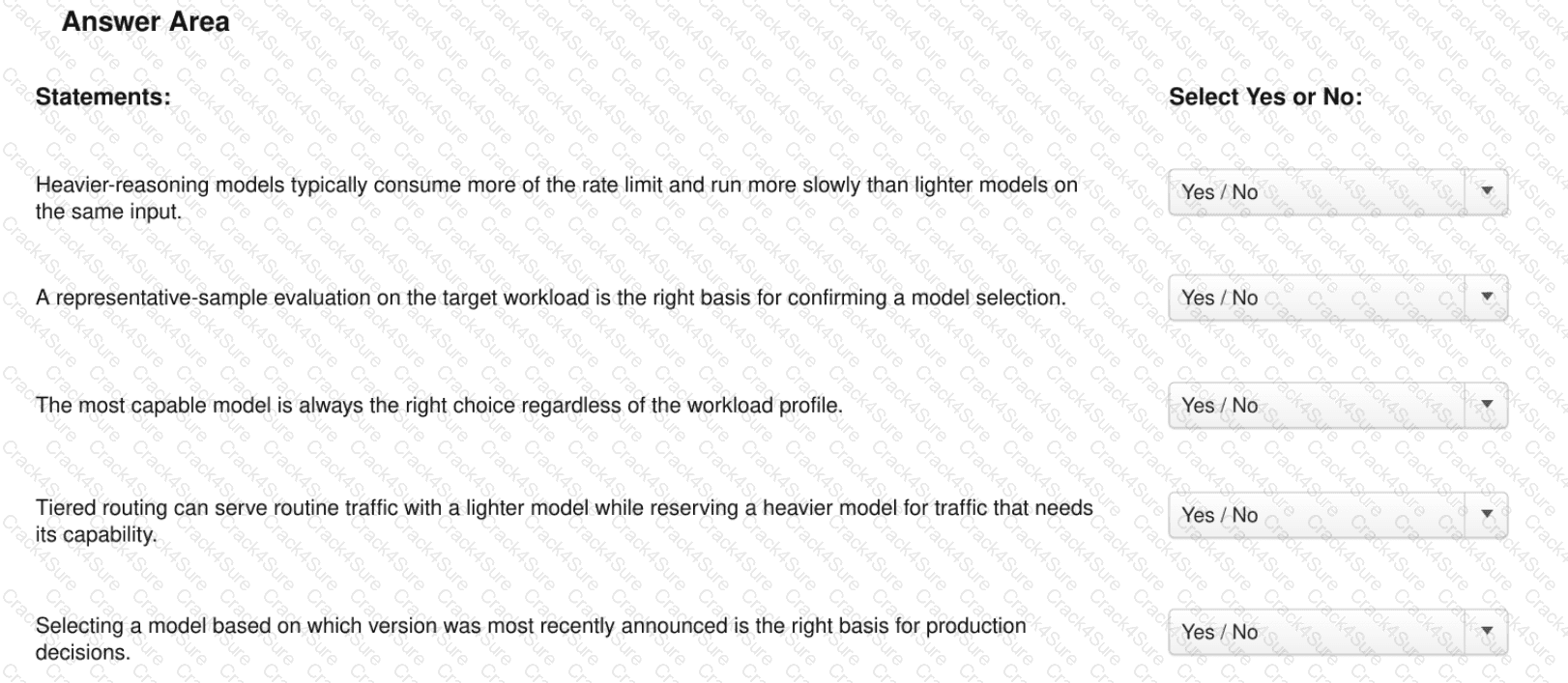
Question # 26

You are reviewing a peer’s end-to-end design for a Claude-based platform expected to scale to thousands of concurrent users.

For each statement, indicate Yes if it reflects sound architectural practice. Otherwise, select No.

CCAR-P question answer

Question # 27

A research summarization assistant has been deployed for six months. A user has flagged that a generated summary contained a fabricated citation. The product team has asked whether the incident requires architectural action or whether it is an isolated case.

Which two Diligence-competency actions should you take? (Select two.)

Each correct answer presents part of the solution.

A.

Sample recent summaries to estimate the fabrication frequency across the population.

B.

Disable the assistant immediately for all current users without any prior diagnostic analysis.

C.

Review whether citation-grounding controls exist anywhere in the current generation pipeline.

D.

Communicate to users that the assistant does not fabricate output as a matter of design.

E.

Treat the incident as an anecdotal isolated case and take no further investigative action.

Question # 28

A loan pre-qualification assistant shows 94 percent approval recommendations that match the human underwriter decision. The fairness team has reviewed approval rate parity across protected groups and reported no significant difference. A board member has asked whether this evidence is sufficient to declare the assistant fair.

Which two Discernment-competency findings should you report? (Select two.)

Each correct answer presents part of the solution.

A.

Approval rate parity does not by itself assess error rate parity across protected groups.

B.

Match with human underwriters does not establish freedom from underwriter-introduced bias.

C.

The 94 percent match rate is sufficient evidence of fairness for the assistant’s decisions.

D.

The fairness team’s review process likely missed at least some of the protected groups studied.

E.

A larger sample is needed before any meaningful fairness claim can be made about the model.

Question # 29

A solutions architect is analyzing stakeholder feedback collected after the first quarter of a Claude-powered procurement automation deployment. The feedback includes four statements: (1) “Our procurement team is processing 3x more purchase orders per analyst per day.” (2) “We have eliminated the manual data entry role entirely and redeployed those staff to vendor relationship management.” (3) “The API integration costs are running 40% over the projected per-transaction budget.” (4) “Response latency during end-of-month batch runs is averaging 11 seconds, against our committed 5-second SLA.”

Which of the following correctly identifies the primary business value pillar each stakeholder statement represents?

A.

Statement 1: Efficiency; Statement 2: Transformation; Statement 3: Solution Cost; Statement 4: Performance SLA

B.

Statement 1: Productivity; Statement 2: Efficiency; Statement 3: Solution Cost; Statement 4: Performance SLA

C.

Statement 1: Transformation; Statement 2: Productivity; Statement 3: Solution Cost; Statement 4: Efficiency

D.

Statement 1: Efficiency; Statement 2: Productivity; Statement 3: Performance SLA; Statement 4: Solution Cost

Question # 30

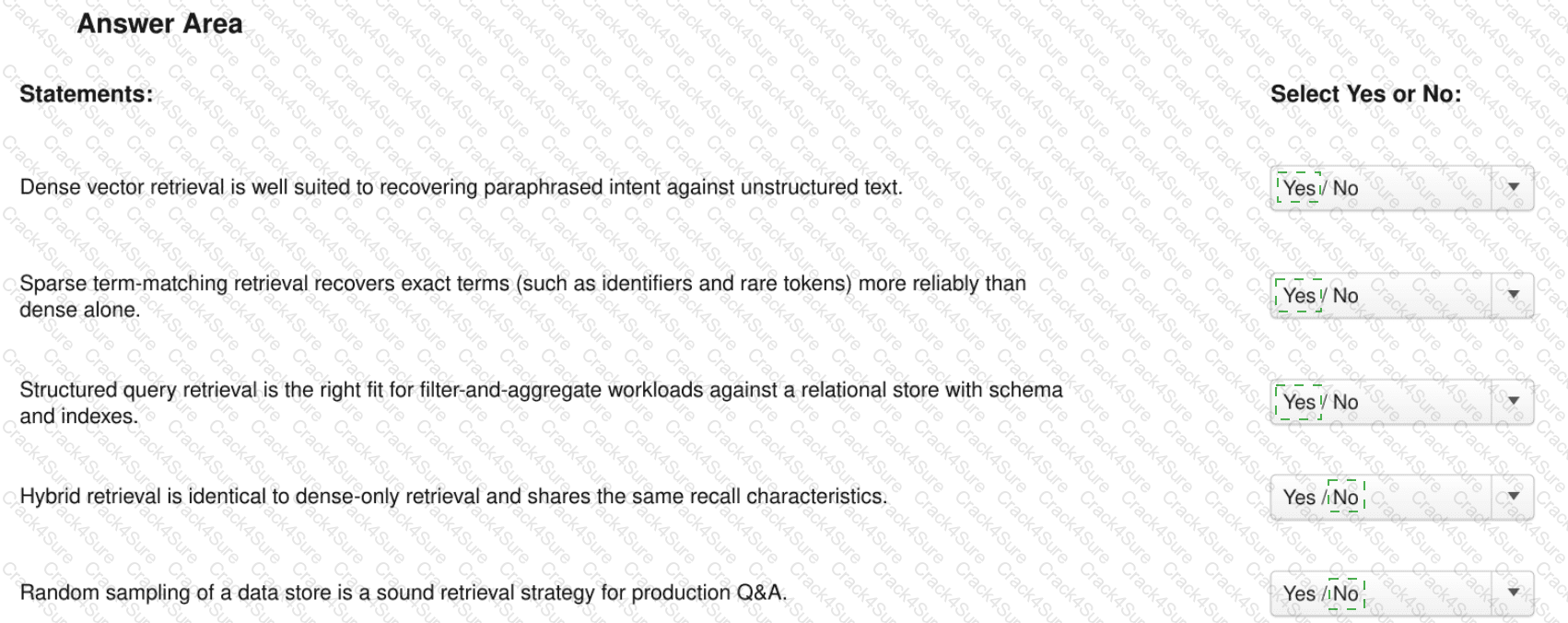
You are evaluating retrieval-strategy claims used by a peer team.

For each claim, select yes if the statement is generally accurate. Otherwise, select no.
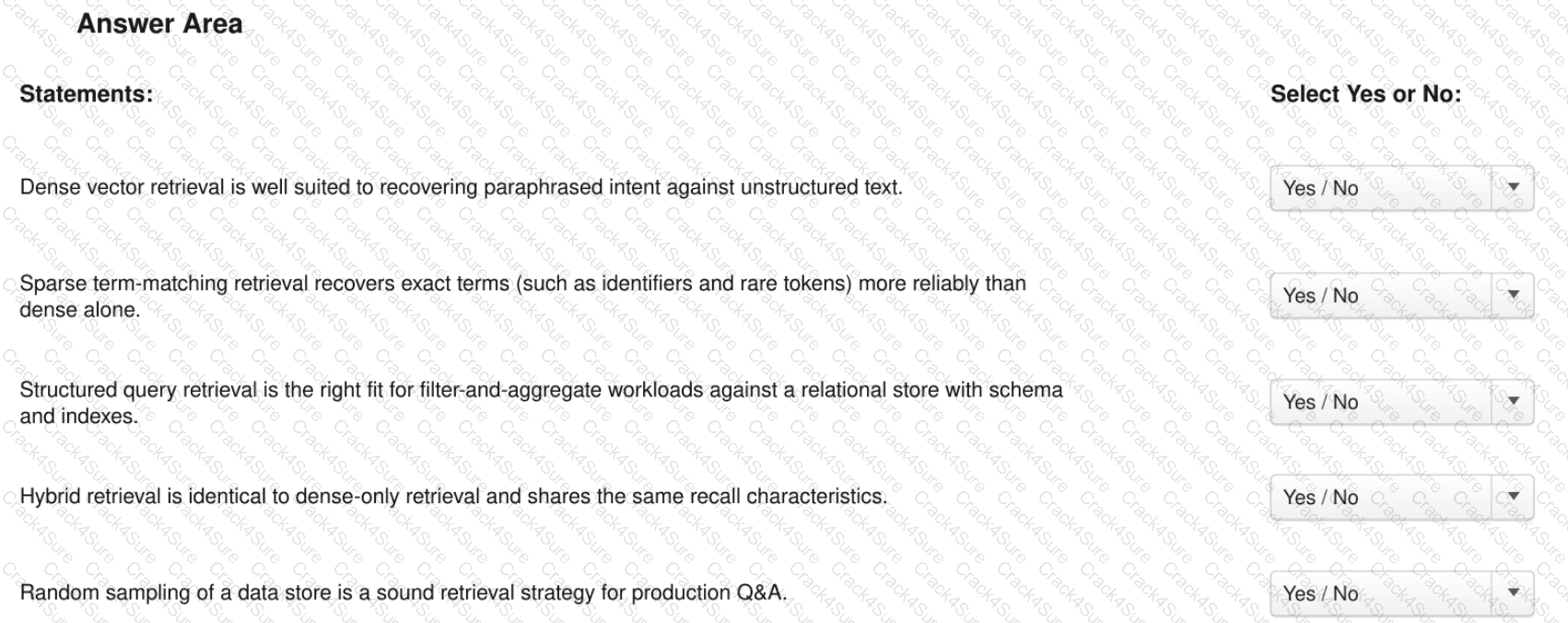
CCAR-P question answer

Question # 31

An architect is reviewing a Claude-based candidate-screening tool prior to deployment. A stakeholder asserts that because the model was not trained on company data, no bias evaluation is necessary.

Which two responses most accurately challenge this assertion? (Select two.)

A.

Transparency obligations are satisfied by disclosing that an AI system is in use, without further evaluation.

B.

Fairness testing is required only when the training dataset is known to contain protected-class labels.

C.

The model may carry demographic biases from pretraining that manifest in screening outcomes regardless of fine-tuning.

D.

The system should be evaluated on outcome-disparity metrics across protected groups before deployment.

E.

Bias evaluation is unnecessary when the model provider has published a responsible-use policy.

Question # 32

A Claude architect observes that after a recent model-version upgrade, grounded responses began including claims not supported by the retrieved source documents.

Which mitigation is most directly targeted at this failure mode?

A.

Constrain responses to source-supported content, require citations, and add a verification step.

B.

Score each new model version against a stable adversarial evaluation set.

C.

Replace the shared API key with per-user OAuth tokens to restrict data access.

D.

Treat retrieved data as untrusted and apply input classifiers at ingestion time.

Question # 33

You are integrating human review into a high-volume classification pipeline where reviewing every output is infeasible.

Which sampling strategy best balances throughput with quality oversight?

A.

No sampling, relying entirely on user complaints to reveal quality and safety problems after they affect users.

B.

Risk-stratified sampling that reviews all low-confidence and high-impact outputs and a smaller random sample of high-confidence routine outputs.

C.

Inverse sampling that reviews only high-confidence routine outputs and skips low-confidence and high-impact outputs.

D.

Universal review of every output regardless of confidence or throughput impact.

Question # 34

You are listing characteristics of robust guardrail design for an enterprise deployment.

Which two characteristics belong on the list? (Select two.)

Each correct answer presents a complete solution.

A.

Centralized log retention for guardrail violations with quarterly review by the security team.

B.

Per-role tool allow-lists enforced at the orchestration layer before any tool call executes.

C.

User feedback channels that route reported guardrail failures into the product backlog for triage.

D.

Periodic refresh of the system prompt wording to keep refusal language current and clear.

E.

Adversarial-input coverage in the evaluation set with regression tracking on guardrail performance.

CCAR-P PDF

$27.5

$109.99

3 Months Free Update

  • Printable Format
  • Value of Money
  • 100% Pass Assurance
  • Verified Answers
  • Researched by Industry Experts
  • Based on Real Exams Scenarios
  • 100% Real Questions

CCAR-P PDF + Testing Engine

$44

$175.99

3 Months Free Update

  • Exam Name: Claude Certified Architect - Professional
  • Last Update: Aug 23, 2026
  • Questions and Answers: 114
  • Free Real Questions Demo
  • Recommended by Industry Experts
  • Best Economical Package
  • Immediate Access

CCAR-P Engine

$33

$131.99

3 Months Free Update

  • Best Testing Engine
  • One Click installation
  • Recommended by Teachers
  • Easy to use
  • 3 Modes of Learning
  • State of Art Technology
  • 100% Real Questions included