Summer Special Sale - 70% Discount Offer - Ends in 0d 00h 00m 00s - Coupon code: spcl70

Practice Free AFP-Exam-1 Applied Financial Planning Certification Exam 1 (AFP) Exam Questions Answers With Explanation

We at Crack4sure are committed to giving students who are preparing for the CSI AFP-Exam-1 Exam the most current and reliable questions . To help people study, we've made some of our Applied Financial Planning Certification Exam 1 (AFP) exam materials available for free to everyone. You can take the Free AFP-Exam-1 Practice Test as many times as you want. The answers to the practice questions are given, and each answer is explained.

Question # 6

Jimi and Macy, both age 26, consider themselves risk averse. After reviewing their budget with their financial planner, they discovered that they have a negative cash flow every couple of months due to their discretionary spending habits. What would be an appropriate strategy for their financial planner to recommend to the couple to manage their negative cash flow?

A.

Setup individual personal line of credit and pre-authorized contribution in individual non-registered account.

B.

Setup joint TFSA and pre-authorized contribution.

C.

Setup individual TFSA and pre-authorized contribution.

D.

Setup joint personal line of credit and pre-authorized contribution in a joint non-registered account.

Question # 7

Which assets will flow through an estate?

A.

Assets which the owners are registered as joint tenants with rights of survivorship.

B.

Assets which the owners are registered as tenancy in common.

C.

Assets held in an inter vivos trust.

D.

Business assets covered by a buy-sell agreement.

Question # 8

Jackson, a wealth advisor, is helping Terry, a self-employed IT professional, determine his net income. The goal is to develop a budget and savings strategy for the year ahead Terry has provided the information below:
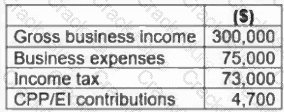
AFP-Exam-1 question answer

What is Terry’s net business income?

A.

$152,000

B.

$147,300

C.

$225,000

D.

$220,300

Question # 9

Richard pays periodic spousal support and child support under a written separation agreement. Which statement is generally correct?

A.

Qualifying periodic spousal support may be deductible to Richard and taxable to the recipient, while child support is generally neither deductible nor taxable.

B.

Both spousal and child support are always deductible to Richard.

C.

Child support is taxable to the recipient if paid monthly.

D.

Spousal support is never relevant for tax planning.

Question # 10

Lois is reviewing her client Raj's retirement plan. To stay on track, Raj's TFSA (with a current balance of $10,000) will need to be worth $42,000 in five years. Raj is able to contribute his annual bonus of $5,000 at the end of each year. For Raj to stay on plan, what rate of return does Lois need to be targeting?

A.

5.71%.

B.

5.64%.

C.

6.36%.

D.

7.67%.

Question # 11

The Andersons, a young couple, meet with their financial planner to review estate-planning opportunities. They recently had a third child and are looking for the most cost-effective strategy to put in place during their working years to increase their estate value and reduce the tax burden at death for the benefit of their children. What should the financial planner recommend?

A.

Update beneficiary designation to the estate on their registered plans.

B.

They should each have permanent life insurance plans in place.

C.

Set up a joint savings account with automatic monthly contributions.

D.

Put in place a term survivorship life insurance policy.

Question # 12

Bruna is a senior financial planner. At 4 p.m. on Friday afternoon (an hour before closing), her manager asks her to complete the following:

Fix a mutual fund trade that was entered incorrectly by a junior financial planner.

Call her client to advise him that his account is overdrawn, and the bank will refuse recent payments unless he credits the account before 5 p.m.

Bruna determines she can only complete one of the two tasks before the end of the business day. How should Bruna address her supervisor's request?

A.

Ask the manager which of the two problems should be prioritized. Then ask the manager to delegate the other task to a colleague.

B.

Bruna should let the client's payments bounce since the client is unable to manage his cash flow and Bruna should prioritize correcting the trade.

C.

Bruna should prioritize the client with the overdrawn account since he is one of her clients. She should then reverse the incorrect trade the following business day.

D.

Stay after hours until she completes both tasks.

Question # 13

Dianna is visiting with Karen, her Financial Planner, and is excited to report that she has just bought her dream home. She has also let Karen know she Is meeting with an insurance representative to purchase a whole life insurance to cover her 20-year mortgage. Why might Karen suggest Dianna consider term life insurance instead?

A.

The client's health may deteriorate as she gets older.

B.

The term policy has a cash value, which can be borrowed against.

C.

It is better suited for long term insurance needs.

D.

The cost of premiums is lower than whole life.

Question # 14

Carla, a financial planner, is meeting with a long-standing client, Jonathan. Jonathan informs Carla that he is upset and disappointed with the negative returns experienced with his investment portfolio. After acknowledging Jonathan's concerns, what should Carla's first step be in addressing his complaint?

A.

Offer alternative investment options in line with Jonathan's risk tolerance.

B.

Revisit Jonathan's goals, objectives and risk tolerance with him.

C.

Remind Jonathan that investing is a long-term process and losses will likely be recovered.

D.

Remind Jonathan about the risks associated with investing, as well as the possible volatility and impact on investment returns.

Question # 15

A business owner completes an estate freeze, taking back preferred shares with a fixed redemption value while children receive common shares. What is a primary risk of this strategy for the owner?

A.

No future growth can occur in the corporation.

B.

The owner’s retained preferred shares may not provide adequate income or inflation protection.

C.

The children can never benefit from future growth.

D.

The freeze automatically eliminates all tax at death.

Question # 16

In 2019, Glenda, age 46, visited her financial planner to discuss her goal of retiring at the age of 65. Glenda had questions about whether she qualified for the maximum amount of CPP and OAS benefits as she had immigrated to Canada just 10 years earlier to take a job as a nuclear technician. What should her financial planner have told her?

A.

Glenda would receive the max CPP and partial OAS benefits at age 65.

B.

Glenda would receive partial CPP and partial OAS benefits at age 65.

C.

Glenda would receive the max CPP and OAS benefits at age 65.

D.

Glenda would receive partial CPP and no OAS benefits at age 65.

Question # 17

Sarah Jones is an incorporated owner of a successful manufacturing company. She currently has a large month to month cash flow surplus. This is expected to continue until she retires in seven years. Her personal mortgage is up for renewal. She needs to borrow $50,000 so that she can replace a piece of equipment that is needed in the manufacturing process. She would like a solution that results in paying the lowest interest cost over the life of the loan. Which loan product should the financial planner recommend to Sarah? Assume monthly compounding for all products and no pre-payment options.

A.

Home equity line of credit with an interest rate of 3.75% and a 7-year interest-only payment with an end-of-term balloon payment.

B.

Secured corporate loan with an interest rate of 5.25% and a 5-year amortization period.

C.

Corporate mortgage with an interest rate of 2.25% and a 25-year amortization period.

D.

Refinanced personal mortgage with an interest rate of 1.35% and a 25-year amortization period.

Question # 18

Bill is reviewing his credit bureau after being declined for a loan. He believes a loan that does not belong to him is appearing on the report. Which section should he review most closely?

A.

Inquiries.

B.

Public record information.

C.

Account history or trade lines.

D.

Personal identification only.

Question # 19

Kendrick, age 55, owns a successful small business, ZXC Inc., valued at $800,000. Kendrick has extensive savings outside of the business and would like to pass the company onto his son at some point in the future. Kendrick expects the business to increase in value $25,000 per year. If Kendrick decides to use an estate freeze to reduce the amount of taxes he will be required to pay, his financial planner should recommend that he implement the estate freeze at which point in relation to gifting the business to his son?

A.

At the same time as gifting the company.

B.

Immediately.

C.

One month prior to gifting the company.

D.

To take effect at the time of his passing.

Question # 20

Sheeba is a financial planner and meeting with Ivana, a new client. She explains that part of her process is to recommend products and services, but prior to doing so, she will closely investigate the options to ensure they match up with Ivana's goals. Which professional responsibility has Sheeba demonstrated to Ivana?

A.

Diligence.

B.

Objectivity.

C.

Integrity.

D.

Professionalism.

Question # 21

Samantha is meeting with a financial planner for the first time, seeking help with both investing and debt management. She's finding it hard to get ahead because she recently graduated with student debt, started a new career in her field, and is adding credit card debt each month. What recommendation should the financial planner propose?

A.

Samantha should eliminate her credit card and use her debit card for purchases.

B.

Samantha should set up automatic RRSP payroll deductions.

C.

Samantha should review her budget.

D.

Samantha should prioritize reducing her student loan debt.

Question # 22

A client, age 60, is in a low tax bracket today and expects a larger taxable pension after age 65. She has TFSA and RRSP room. Which contribution priority is generally more appropriate?

A.

RRSP, because withdrawals are tax-free.

B.

Non-registered account only, because registered accounts are unsuitable after age 60.

C.

TFSA, because withdrawals will not increase taxable retirement income.

D.

RRSP only after the client turns 72.

Question # 23

A client completed a financial plan two years ago. Since then, she has divorced, changed jobs, and purchased a new home. What is the planner’s most appropriate recommendation?

A.

Wait until the original five-year review date.

B.

Conduct a comprehensive review of goals, cash flow, insurance, tax, retirement, and estate planning.

C.

Review only the investment portfolio because the plan already exists.

D.

Update the file only if the client requests new products.

Question # 24

Richard reviewed his divorce settlement from his partner Alex with his advisor Maria. He is deciding between providing a lump sum spousal support payment of $60,000 or making monthly payments. If Richard’s income is $200,000 and Alex’s income is $40,000, what should Maria advise Richard about the tax implications for both Richard and Alex in regard to the lump sum payment?

A.

Richard will deduct the payment and pay taxes on the remaining $140,000 of income, and Alex will pay taxes on the lump-sum payment of $60,000.

B.

Richard will deduct the payment and pay taxes on the remaining $140,000 of income and Alex will pay taxes only on his earned income of $40,000.

C.

Richard will deduct half of the lump-sum support payment and pay taxes on the remaining $170,000 of income and Alex will claim the other half of the lump-sum support payment in addition to his earned Income of $40,000.

D.

Richard will pay taxes on the entirety of the $200,000 and Alex will pay taxes only on his earned income of $40,000.

Question # 25

How should Jenny, a financial planner, explain the benefits of a fee for service method of compensation to a prospective client?

A.

The planner is able to charge a higher fee based on the complexity of products sold.

B.

The planner is compensated solely on the performance of the investment portfolio established by the planner for the client.

C.

The planner is compensated based on the quality of the financial plan.

D.

The planner has no incentive to recommend one product that provides higher compensation over another product with lower compensation.

Question # 26

Ronny, a successful business owner, established a discretionary family trust earlier this year as a means to split income with his children. Ronny's children are both under the age of five and are both income and capital beneficiaries of the trust. He is concerned that the 21-year rule will result in a significant amount of tax resulting from unrealized capital gains. What strategy would be best if Ronny's goal is to minimize the total amount of tax payable by the trust and/or beneficiaries at the 21-year mark?

A.

Turn over the trust portfolio annually and designate any capital gains to beneficiaries.

B.

Realize all capital gains at the 21-year mark and designate this income to the beneficiaries.

C.

Realize all capital gains at the 21-year mark and leave the capital gains' income taxable to the trust.

D.

Revoke the trust just prior to the 21-year mark to avoid paying any capital gains tax to the trust or beneficiaries.

Question # 27

A planner establishes a long-term target portfolio of 65% equities and 35% fixed income based on the client’s objectives and constraints, with periodic rebalancing. Which allocation approach is being used?

A.

Market timing.

B.

Tactical asset allocation.

C.

Speculative allocation.

D.

Strategic asset allocation.

Question # 28

Rob, age 42, is married with three children in elementary school. He works as an operations supervisor at a small manufacturing company, earning $70,000 annually. Rob asks his financial planner, Wendy, to liquidate his GIC investments worth $55,000 in order to use the sale proceeds to purchase a gold stock referred to him by his friend who expects the stock to appreciate significantly. Rob has not purchased stock before. What should be Wendy's reaction to Rob's query?

A.

Review Rob's risk tolerance, time horizon, and objectives.

B.

Refuse the order and tell Rob to manage his own investments.

C.

Refrain from questioning Rob's judgment because the order is unsolicited.

D.

Delay placing the order, advise Rob to take some time to reconsider.

Question # 29

A client sends an email alleging that a mutual fund recommendation was unsuitable because the fund declined sharply after purchase. The client asks for compensation. What is the financial planner’s first professional obligation?

A.

Promise reimbursement to preserve the relationship.

B.

Remind the client that all investments can lose money and close the matter.

C.

Delete the email if the account forms were signed correctly.

D.

Document the complaint and follow the firm’s complaint-handling procedure.

Question # 30

Jonathan owns a medium size consulting firm and earns an average annual income of $150,000. He is reviewing his retirement plan with his financial planner. Jonathan asked his planner about retirement compensation arrangement and how this may benefit him. What should his financial planner tell him?

A.

It is exempt from regulatory limits and withdrawals are tax-exempt for the executive.

B.

It leaves RRSP contribution room unaffected and is exempt from regulatory limits.

C.

It results in a pension adjustment and withdrawals are tax-exempt for the recipient.

D.

It reduces RRSP contribution room but is exempt from regulatory limits.

Question # 31

A client borrows $100,000 to invest in a non-registered portfolio expected to generate interest and dividend income. What tax principle is most relevant?

A.

Interest on borrowed money may be deductible when the funds are used to earn income from property.

B.

Loan interest is never deductible for individuals.

C.

The investment income becomes tax-free because leverage is used.

D.

Interest deductibility applies only to TFSA contributions.

Question # 32

John and Jerry's financial planner have recommended they review their budget. What is the primary purpose of the budget?

A.

To understand cash inflows and outflows each year.

B.

To determine which expenses to reduce or eliminate.

C.

To determine the TDS.

D.

To create a savings plan.

Question # 33

Edward is risk averse and has limited investment knowledge. He will only purchase 100% guaranteed products insured by the CDIC. Edward is meeting with his financial planner, Marissa, for the third time this year about rates, and starts the meeting by criticizing her employer for paying such low returns on GICs. Edward says he is considering taking his business elsewhere. How should Marissa respond to Edward’s comments?

A.

Show understanding of his frustration, assure him that these are the best rates she can offer and suggest a follow up meeting once Edward has had a chance to shop around.

B.

Offer to match any competitor rate Edward can provide in writing.

C.

Explain that if he can increase his risk tolerance, she can get a better rate of return for him.

D.

Let him know that her GIC rate is the highest in the market.

Question # 34

William and Jennifer are selling their business which qualifies as a Canadian-controlled private corporation. When the sale is complete at the end of this year, William and Jennifer will each receive $4 million for their common shares which have nominal cost. Jennifer has unused capital losses from previous years. They are meeting with Laurel, their financial planner, to discuss the tax implications of the sale. Based on the information provided, what should Laurel recommend to William and Jennifer so that they are best able to make use of the Lifetime Capital Gains Exemption?

A.

They should each claim 50% of the exemption.

B.

They should each claim 100% of the exemption.

C.

Only Jennifer should claim 100% of the exemption.

D.

Only William should claim 100% of the exemption.

Question # 35

A couple has stable employment, two dependants, and essential monthly expenses of $5,200. They have no emergency reserve. Which recommendation is most appropriate before increasing long-term investment contributions?

A.

Build a liquid emergency reserve of roughly three to six months of essential expenses.

B.

Use a credit card as the emergency plan.

C.

Invest all surplus cash in a high-growth equity fund.

D.

Withdraw from RRSPs when emergencies occur.

AFP-Exam-1 PDF

$33

$109.99

3 Months Free Update

  • Printable Format
  • Value of Money
  • 100% Pass Assurance
  • Verified Answers
  • Researched by Industry Experts
  • Based on Real Exams Scenarios
  • 100% Real Questions

AFP-Exam-1 PDF + Testing Engine

$52.8

$175.99

3 Months Free Update

  • Exam Name: Applied Financial Planning Certification Exam 1 (AFP)
  • Last Update: Jun 21, 2026
  • Questions and Answers: 117
  • Free Real Questions Demo
  • Recommended by Industry Experts
  • Best Economical Package
  • Immediate Access

AFP-Exam-1 Engine

$39.6

$131.99

3 Months Free Update

  • Best Testing Engine
  • One Click installation
  • Recommended by Teachers
  • Easy to use
  • 3 Modes of Learning
  • State of Art Technology
  • 100% Real Questions included