Black Friday Flash Blitz - 75% Discount Offer - Ends in 0d 00h 00m 00s - Coupon code: 75special

Practice Free 810-110 Cisco AI Technical Practitioner (810-110 AITECH) Exam Questions Answers With Explanation

We at Crack4sure are committed to giving students who are preparing for the Cisco 810-110 Exam the most current and reliable questions . To help people study, we've made some of our Cisco AI Technical Practitioner (810-110 AITECH) exam materials available for free to everyone. You can take the Free 810-110 Practice Test as many times as you want. The answers to the practice questions are given, and each answer is explained.

Question # 6

A practitioner is estimating the operational cost of integrating a cloud-hosted LLM API into an application. How does tokenization affect the cost of using this API?

A.

Tokenization has no impact because pricing is based on a flat-rate subscription.

B.

Costs are determined by the number of API calls.

C.

Tokenization increases cost by requiring additional GPU run time.

D.

The number of tokens determines the per-request cost.

Question # 7

What occurs when the amount of input text supplied to a large language model goes beyond the size of its context window?

A.

The model increases its context window size.

B.

The model loses the earliest part of the text.

C.

The model caches the overflow data.

D.

The model switches to a different algorithm.

Question # 8

Which family of generative AI models is best suited for identifying and summarizing technical themes found across thousands of unstructured network incident reports?

A.

Variational autoencoders

B.

Diffusion models

C.

Large language models

D.

Generative adversarial networks

Question # 9

A developer is creating a chatbot that must retain an extensive conversation history. As the conversation continues, the developer observes that the AI “forgets” instructions supplied at the start. What is the most likely reason for this behavior?

A.

The conversation has exceeded the model's context window limit.

B.

The temperature setting is too high.

C.

The API key has expired.

D.

The model has reached its knowledge cut-off date.

Question # 10

A developer observes that an AI model is unable to solve complex logic puzzles accurately. The developer adds “Let’s think step by step” to the following prompt. Which prompting technique is being used?

A.

Few-shot Prompting

B.

Persona Role-play

C.

Chain-of-Thought

D.

Negative Constraints

Question # 11

When employees use a public AI chatbot within a corporate environment, what is a data privacy risk that should be considered?

A.

The AI will provide biased technical advice.

B.

The input data may be used for model training.

C.

The AI will provide hallucinated technical specifications.

D.

The data will be encrypted at rest instead of in transit.

Question # 12

Match each RAG architectural component with its primary function.
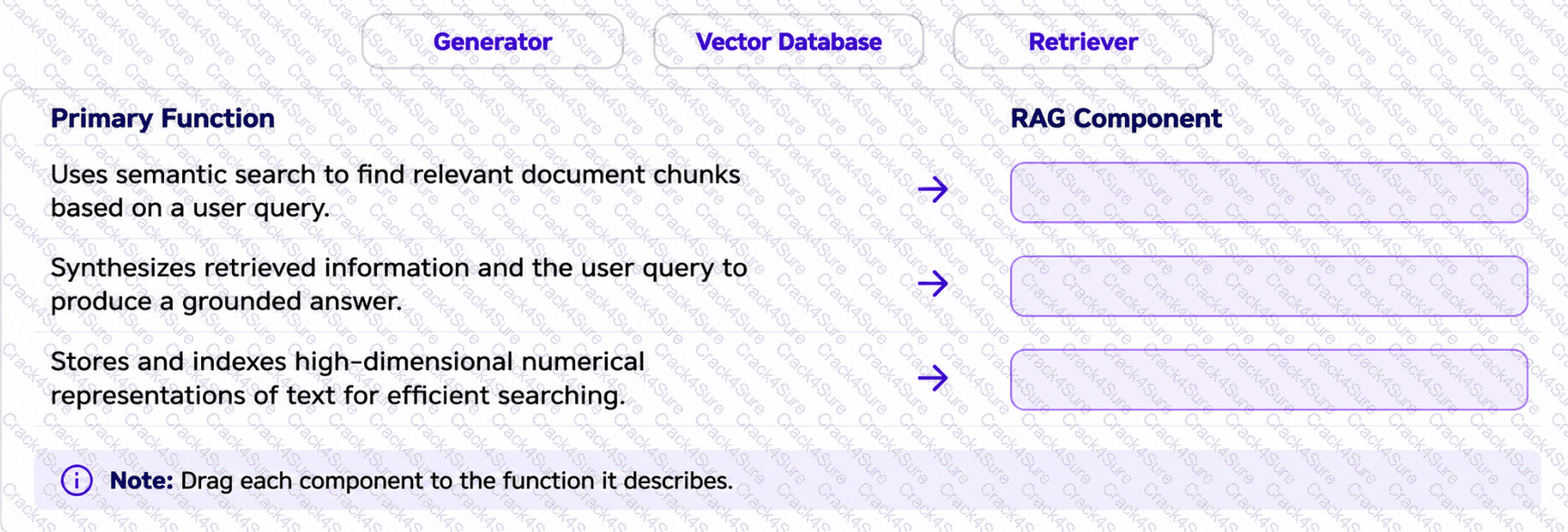
810-110 question answer

Question # 13

An AI-powered system must dynamically determine which tools to use when troubleshooting complex network outages. Why is an autonomous agentic system typically more costly to operate than a directive workflow for this task?

A.

Agents require specialized, high-cost GPU hardware clusters to maintain the state of the reasoning loop during tool execution.

B.

Agents require multiple API keys for every tool they access, which increases subscription costs.

C.

Agents consume tokens for every step of their internal reasoning loop, whereas workflows execute fixed, pre-programmed logic.

D.

Agents are billed by the hour of uptime, whereas workflows are billed only when a request is made.

Question # 14

During the Testing phase of the SDLC, a QA engineer must validate a new payment-processing function. Why is AI-generated synthetic data regarded as a high-value asset at this stage?

A.

It replaces the need for a dedicated testing framework by executing the payment function directly within the inference engine.

B.

It provides a verified legal certification that the payment processing logic is fully compliant with global financial regulations.

C.

It enables comprehensive validation of edge cases and error handling without exposing sensitive customer information.

D.

It automatically detects and remediates logical vulnerabilities within the payment function during the data ingestion process.

Question # 15

When an agent takes a CSV list and converts it into a Markdown table for inclusion in a final report, what operation is being performed?

A.

Data transformation

B.

Data classification

C.

Data filtering

D.

Data quantization

Question # 16

A team is developing an AI-powered customer-support agent. The team deploys a monitoring system that records token usage for each execution. What is the primary governance benefit of this implementation?

A.

It prevents the AI from hallucinating internal company policies.

B.

It ensures that the AI model is compliant with GDPR data residency requirements.

C.

It enables financial risk management by providing visibility into API consumption and cost.

D.

It improves the accuracy of the AI's troubleshooting responses.

Question # 17

An organization operates under regulatory requirements that forbid any proprietary source code from leaving its internal network. Which hosting strategy offers the greatest degree of data sovereignty?

A.

Cloud-based API with Zero Data Retention

B.

Hybrid deployment with cloud-based backup

C.

Managed SaaS AI platform with SOC 2 audit

D.

Local LLM deployment on internal hardware

Question # 18

What is the purpose of providing a JSON schema when configuring tool use for an AI agent?

A.

To define the required parameters and data types the agent must return

B.

To encrypt the payload before it is sent to the external service

C.

To reduce the token count of the agent's system prompt

D.

To map relationships between multiple tools in an agent workflow

Question # 19

A marketing team needs to produce high-fidelity images for a new product launch. Which type of model is specifically designed for this task, using a process of iterative noise reduction?

A.

Diffusion models

B.

Generative adversarial networks

C.

Variational autoencoders

D.

Large language models

Question # 20

A network engineer must automate the conversion of legacy CLI configurations into structured YAML for Ansible playbooks. Which AI capability should be used for this task?

A.

Vision Transformer

B.

Diffusion Models

C.

Large Language Models

D.

Variational Autoencoders

Question # 21

A practitioner is using AI to analyze customer support tickets and usage data in order to compare complaint patterns across different customer segments. Following the 4-step EDA (Exploratory Data Analysis) methodology, what should be done immediately after producing a high-level summary of the feedback data?

A.

Orient

B.

Correlate

C.

Hypothesize

D.

Visualize

Question # 22

An autonomous agent is intended to carry out bulk deletions of old customer records from a production database. Which design pattern should be used to avoid accidental data loss?

A.

Implement a human-in-the-loop approval gate before the database write occurs.

B.

Use a more powerful foundation model to ensure the agent is highly capable and less likely to make mistakes.

C.

Increase the agent's token budget to allow for more thorough and complex reasoning loops.

D.

Set the agent to autonomous mode to ensure it can react quickly to database changes.

Question # 23

What distinguishes generative AI from agentic AI?

A.

Generative AI uses retrieval-augmented generation and agentic AI does not support external data sources.

B.

Generative AI operates autonomously and agentic AI requires a prompt for each action.

C.

Generative AI produces single-turn responses and agentic AI executes multi-step reasoning loops.

D.

Generative AI requires tool access and agentic AI relies on its training data.

Question # 24

A developer is prototyping an AI assistant that must send a large amount of conversation history with every prompt. They observe that, as they enlarge the context window, the cost of each API call rises substantially. What is the main reason for this increase in cost?

A.

The AI model's internal temperature and creativity settings are automatically adjusted upward to handle larger datasets, increasing the computational load.

B.

Larger context windows require the AI to run on more expensive hardware in the cloud.

C.

API providers bill based on the total number of tokens processed, which includes both the input prompt, including history, and the generated output.

D.

Increasing the context window automatically triggers a more complex, high-reasoning model that is priced higher.

Question # 25

When using AI to collect external information for a technical report, what professional practice is required for attributing sources?

A.

Enable the AI web search tool to automatically filter out all unverified external sources.

B.

Trust the AI's internal knowledge base, as it is trained on vast amounts of data.

C.

Request a URL for every claim, then verify the existence and accuracy of the source.

D.

Utilize only the specific sources that the AI identifies as highly reliable in the chat.

Question # 26

Within an AI-driven automation workflow, what does the term "deterministic branching" refer to?

A.

A process where the AI model autonomously selects the next step based on its internal confidence score.

B.

A decision point where the next step is dictated by specific, pre-programmed rules.

C.

A workflow state that pauses execution until a human manually determines the next step.

D.

A dynamic system where branching criteria evolve over time using optimization algorithms.

Question # 27

An autonomous agent is assigned to troubleshoot a network outage. It repeatedly runs the same diagnostic tool using identical parameters, fails each time, and keeps doing so until its token budget is depleted. Which design principle is absent from this agent?

A.

A local LLM deployment to ensure the agent has lower latency for its tool calls.

B.

A vector database integration to allow the agent to perform semantic search on historical logs.

C.

A few-shot prompting strategy to provide the agent with more examples of successful troubleshooting.

D.

A reasoning loop that evaluates tool execution results to adjust the plan.

Question # 28

Why is implementing MCP preferable to creating custom tool-binding integrations for an agent that accesses three internal systems?

A.

It replaces the requirement for an LLM reasoning engine by automating the tool-selection logic internally.

B.

It provides a unified protocol, meaning the team only builds the integration once for any MCP-compatible model.

C.

It automatically encrypts all data at rest without requiring any additional configuration.

D.

It increases execution speed by allowing the agent to bypass the operating system.

Question # 29

Drag the responsible AI principle on the left to its corresponding action on the right. Not every option will be used.
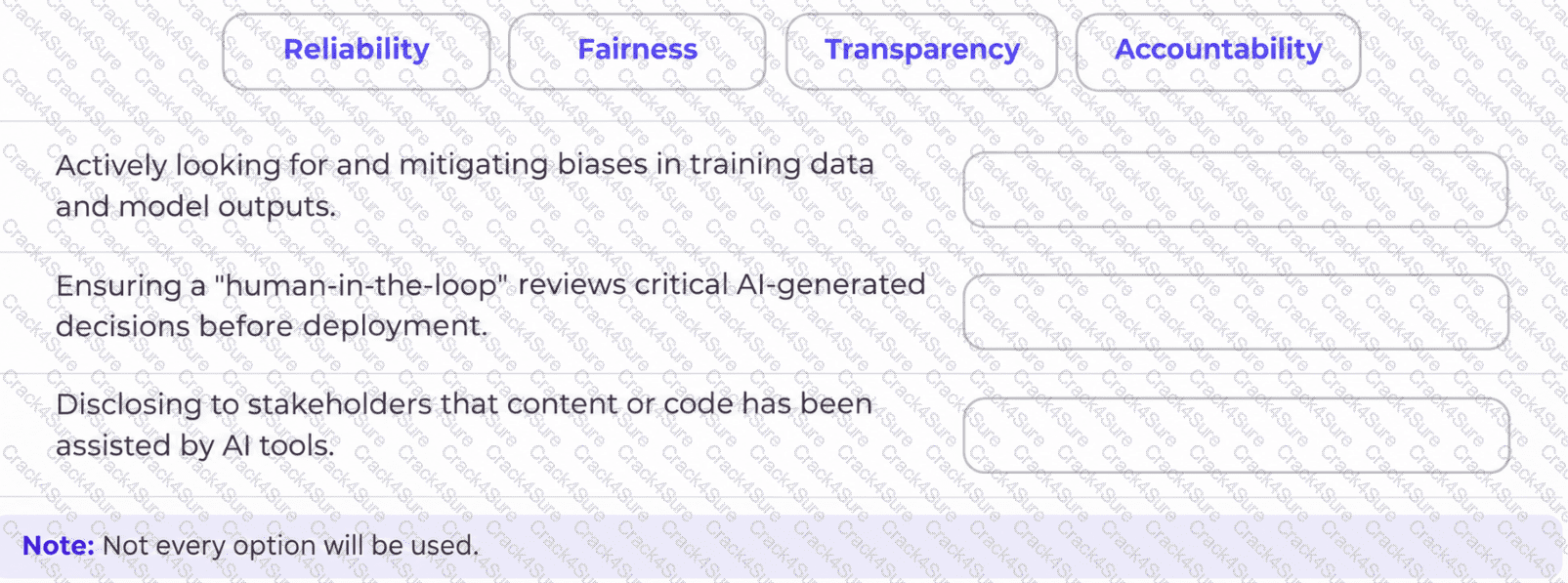
810-110 question answer

810-110 PDF

$35

$139.99

3 Months Free Update

  • Printable Format
  • Value of Money
  • 100% Pass Assurance
  • Verified Answers
  • Researched by Industry Experts
  • Based on Real Exams Scenarios
  • 100% Real Questions

810-110 PDF + Testing Engine

$47.5

$189.99

3 Months Free Update

  • Exam Name: Cisco AI Technical Practitioner (810-110 AITECH)
  • Last Update: Nov 22, 2026
  • Questions and Answers: 98
  • Free Real Questions Demo
  • Recommended by Industry Experts
  • Best Economical Package
  • Immediate Access

810-110 Engine

$40

$159.99

3 Months Free Update

  • Best Testing Engine
  • One Click installation
  • Recommended by Teachers
  • Easy to use
  • 3 Modes of Learning
  • State of Art Technology
  • 100% Real Questions included