Crack4sure Logo

We at Crack4sure are committed to giving students who are preparing for the GARP SCR Exam the most current and reliable questions . To help people study, we've made some of our Sustainability and Climate Risk exam materials available for free to everyone. You can take the Free SCR Practice Test as many times as you want. The answers to the practice questions are given, and each answer is explained.
A national regulator develops a new taxonomy for environmentally sustainable activities and policies. The taxonomy will provide clarity for companies, capital markets, and policymakers on sustainable activities. During the development process, regulators survey taxonomies used across various jurisdictions and decide to model after the EU Taxonomy.
Which characteristic of the EU Taxonomy will the regulator most likely implement in the new taxonomy?
A fashion company raises an SLL to improve the company ESG score. The sustainability team identifies two sustainability KPIs for finalizing the loan with a financial institution. Which of the following KPIs did the team most likely recommend for the SLL?
Senior management of a sportswear manufacturer will issue a bond to optimize company capital structure, while providing investors with an opportunity to contribute to positive transformation of the fashion industry. Management prefers a bond with a high rate of issuance, and the company sustainability team researches various green and sustainable finance instruments and issuance information over the past 5 years. The team recommends a bond that globally posted the highest growth in issuance between 2019 and 2020.
Which bond did the team recommend?
An EU vehicle braking system manufacturer implements a new sustainability framework for SLBs to finance projects with environmental and social benefits. The company sustainability team prepares a new SLB and submits the bond to an external reviewer for assessment. The bond contains four KPIs:
1. Scope 1 CO2 emissions
2. Supplier engagement on GHG emission reduction
3. Percentage of renewable energy used
4. Percentage of women in managerial roles
The bond benchmark year is 2022 and the bond will mature in 2030 Which of the following SPTs did the reviewer find aligns with the core components of SLB Principles?
To align with industry trends, the risk team at a fashion merchandizing company evaluates the company climate risk framework. The risk team enhances the company climate risk framework by including a list of potential transition risks. Which of the following transition risks does the team most likely include in the framework?
An alliance of electricity power producers examines a proposed cap-and-trade regulation that would affect most members. The alliance lobbies lawmakers to strengthen banking and borrowing provisions in the proposed regulation, allowing increased flexibility for the sector to comply with emissions limits.
What component of climate risk is the alliance directly attempting to influence?
To improve sustainability, a railroad and transportation services company will revitalize its rail network by installing an operating system that reduces idle time. A reduction in idle time will decrease GHG emissions. To finance this plan, the company will issue green bonds beginning in 2024. The company sustainability director develops sustainability objectives and eligibility criteria to communicate to investors.
The director is fulfilling which core component of the Green Bond Principles?
The CRO for a large agriculture company reviews reference scenarios as part of an annual climate scenario analysis exercise. The CRO creates a transition risk matrix that compares four different scenarios - W, X, Y, Z. Scenarios are compared according to scale of emissions cuts and pace of emission cuts. Scale is depicted as business as usual (BAU) to net-zero. Pace is depicted as orderly to disorderly. The CRO uses this matrix to explain transition risk to the company’s executive members:
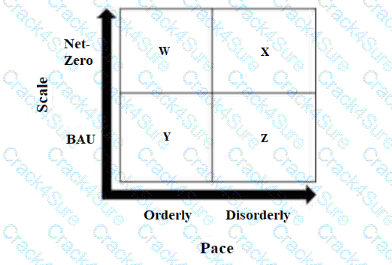
How should the CRO rank the reference scenarios from lowest level of transition risk to highest level of transition risk?
As climate change poses new financial risks to a central bank’s monetary policy operations, the bank decides to adapt operations with NGFS guidelines. Because the central bank does not include climate change in supervision practices, the bank consults subject matter experts (SMEs) to develop a proposal for central bank action on climate change. After completing the risk assessment, SMEs recommend the bank incorporate microprudential and macroprudential measures to embed climate change into supervision practices.
Which action are SMEs likely to recommend?
A sustainability analyst at a global commercial bank researches trends surrounding the green loan market in China to develop a new business strategy. The analyst finds green loans are gaining popularity in various sectors due to environmental and financial benefits. If the analyst recommends the addition of green loans to the business strategy, what China market trend most likely supports this decision?
A risk manager at an investment bank works on a climate disclosure project for a bank portfolio. To understand the climate impacts on the investment portfolio, the risk manager evaluates different metrics to measure climate risk exposure. The manager selects a metric that can be easily applied across asset classes. While the metric is sensitive to outliers, calculating the metric is simple and easy to communicate to investors. Which metric did the manager most likely select to measure climate risk exposure?
A climate analyst at a research institution analyzes climate risk for various companies. The analyst examines transmission channels of climate risk as part of the risk identification process.
Which of the following examples can the analyst use to describe an operational risk transmission channel?
A telecommunications corporation issues a green bond to finance energy efficiency improvements for the company’s office space worldwide. The company’s risk management department commissions an independent advisory assessment of the bond to check bond alignment with components of the Green Bond Principles.
What action does the corporation take to align the bond with the “process for project evaluation and selection” component of the Green Bond Principles?
An investment bank of a southern African country appoints a task force to assess current climate risk practices. The task force examines the potential of climate change to cause systemic risk at the macro level to inform climate investment strategies. The task force evaluates potential disruption scenarios to the financial system due to climate risk. Which risk type will most likely have the lowest potential to cause systemic risk to the financial system of the country?
A prominent housing developer plans construction of a small low-carbon-emitting city in an equatorial nation. The developer plans to maximize renewable energy use and estimates daily city summer solar energy generation capacity and load (total electricity demand), in megawatts (MW):
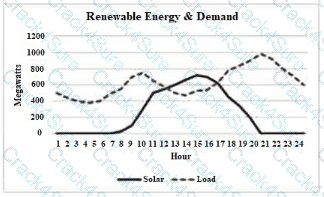
The developer estimates the following for capacity and load:
At 14:00 solar generation is highest at 720 MW
At 20:00 solar generation decreases to 0 MW
At 20:00 load is highest at 980 MW
At 4:00 load is lowest at 380 MW
How should the developer meet additional energy demand while achieving the lowest-carbon-emission goal option?
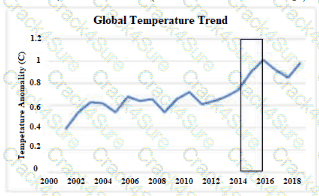
A scientist at a large agricultural company develops an internal presentation that explains weather variation and long-term climate change. The scientist presents global annual temperature anomalies (relative to a 1951-1980 average) throughout the last 20 years:
What natural forcing contributed to the temperature trend from 2014 to 2016?
A senior sustainability consultant at an African think tank explains the complexities of different Earth science systems to a group of ESG practitioners as part of the think tank’s continuing education program.
Which of the following statements by the sustainability consultant accurately describes the Earth’s greenhouse effect?
A large insurance company in South America expands use of climate scenario analysis. The company used RCPs in previous scenario analyses but now hires an actuary with climate expertise to incorporate SSPs in this process.
How can the actuary advise the insurance company use SSPs going forward?
A natural gas production company makes a 2040 net-zero commitment. Before publicly announcing the commitment, the company sustainability team verifies the credibility and transparency of the company net-zero commitment to minimize any greenwashing claims. What action will the team most likely take to strengthen the credibility of the company net-zero commitment?
Which of the following is an example of a just’ transition with regards to climate change?
A climate scientist develops a presentation on modern climate change for a group of policymakers.
What observation does the scientist include in the presentation that provides evidence of human attribution to current climate change?
The climate risk team at a global bank works on a sustainability and climate risk report for a forthcoming company strategy meeting. The meeting will focus on bank goals to achieve net zero GHG emissions by 2050. Bank leaders will discuss potential risk exposures the bank may face, as well as possible financial systemic effects.
Which of the following is an example of how systemic climate risk can translate into liquidity risk for the bank?
In response to a survey showing consumers consider sustainability a key factor in purchasing decisions, a group of cosmetics companies announce a collaboration to develop an environmental impact assessment and sustainability framework for cosmetics products. The framework enables customers to evaluate the environmental impact of products they purchase. The framework draft includes definitions of climate, green, and sustainable finance.
Which of the following definitions is appropriate for the proposed framework?
Senior management of a sportswear manufacturer will issue a bond to optimize company capital structure, while providing investors with an opportunity to contribute to positive transformation of the fashion industry. Management prefers a bond with a high rate of issuance, and the company sustainability team researches various green and sustainable finance instruments and issuance information over the past 5 years. The team recommends a bond that globally posted the highest growth in issuance between 2019 and 2020.
Which bond did the team recommend?
Which of the following greenhouse gases (GHGs) has the longest lifetime in the atmosphere?
A bank assesses lending portfolio alignment with various climate change scenarios. To assist in this process, the risk team applies the Paris Agreement Capital Transition Assessment (PACTA) tool to examine transition risk for power generation, automotive, and steel sectors. The team examines different PACTA metrics for each sector based on data availability and sectoral profile.
For sectors with no clear zero-carbon pathway, what metric will PACTA employ?
A large country joins the Paris Agreement and directs the national environmental department to disseminate new policies and goals to relevant federal agencies. Most agencies are familiar with past climate agreement principles and protocols but not those of the Paris Agreement.
The environmental department should educate federal agencies on what feature of the Paris Agreement?
A senior portfolio analyst at a global asset management firm performs a portfolio review to identify assets that may be affected by climate risk. Preliminary findings show the firm heavily invests in food and beverage companies with high climate risk exposure due to extreme temperatures and droughts. In a report to senior management, the analyst notes the firm can improve portfolio performance by examining physical risk, as the firm currently focuses primarily on transition risk.
Which approach to examining physical risk at the portfolio level should the analyst recommend?
A private equity fund invests in infrastructure development and agro-industrial projects. The fund hires a team of climate risk consultants to advise on investment structure and the potential climate risks to the fund. The team recommends data types and analytical tools to evaluate physical and transition risk impact at the company level.
How should the company evaluate company-level physical risk?
A team of climate risk specialists at a global non-profit research organization prepares a study on climate policy and achieving national climate change mitigation targets. The study focuses on actors, non-state and subnational (NSA) participants, and actions that can be taken to impact climate policy.
How should the team describe effective climate policy and climate change mitigation targets?
3 Months Free Update
3 Months Free Update
3 Months Free Update



TESTED 03 Oct 2026