Crack4sure Logo

We at Crack4sure are committed to giving students who are preparing for the HP HPE7-A10 Exam the most current and reliable questions . To help people study, we've made some of our HPE Network Security Expert Written Exam exam materials available for free to everyone. You can take the Free HPE7-A10 Practice Test as many times as you want. The answers to the practice questions are given, and each answer is explained.
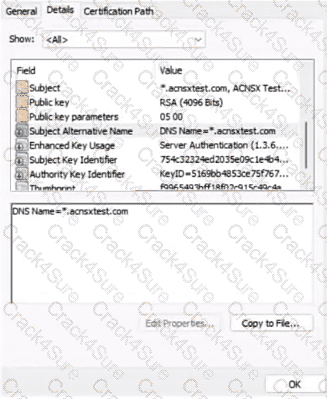
Refer to the exhibit.
Field: Subject
Value: .acnsxtest.com, ACNSX Test...
Field: Subject Alternative Name
Value: DNS Name=.acnsxtest.com
Field: Enhanced Key Usage
Value: Server Authentication (1.3.6.1.5.5.7.3.1)
You have received this certificate to install on an HPE Aruba Networking ClearPass server for RADIUS/EAP and RadSec use. What is one issue?
Introduction to the customer
You are assisting a company with adding HPE Aruba Networking ClearPass to its network, which uses HPE Aruba Networking network-infrastructure devices.
The company already has a Windows domain and Windows CA. The Windows CA issues certificates to domain computers, domain users, and servers such as domain controllers.
ClearPass cluster IP addressing and hostnames
Publisher = 10.47.47.5
Subscriber 1 = 10.47.47.6
Subscriber 2 = 10.47.47.7
Virtual IP with Subscriber 1 and Subscriber 2 = 10.47.47.8
Refer to the scenario.
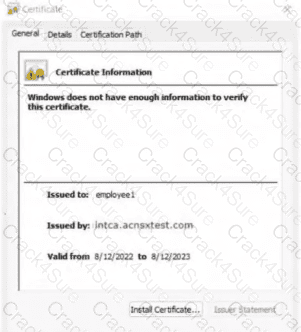
Assume that you configured CPPM to assign HPE Aruba Networking ClearPass roles and AOS user roles as indicated in the scenario. However, a penetration tester was able to access the network with medical-staff privileges on a client with a valid computer certificate but a revoked medical user certificate. In this situation, the customer wants the client to receive computer-only access.
What can you do to resolve this issue while continuing to meet the other customer requirements?
A customer operates an HPE Aruba Networking ClearPass cluster. The customer has AOS-CX switches that use 802.1X authentication with HPE Aruba Networking ClearPass Policy Manager (CPPM).
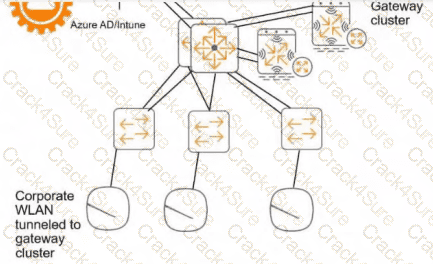
The switches use local port-access policies. The customer wants to begin tunneling wired clients that pass only user authentication to an HPE Aruba Networking gateway cluster. The gateway cluster must assign these clients the eth-internet role. The gateway must also assign the clients to VLAN 20.
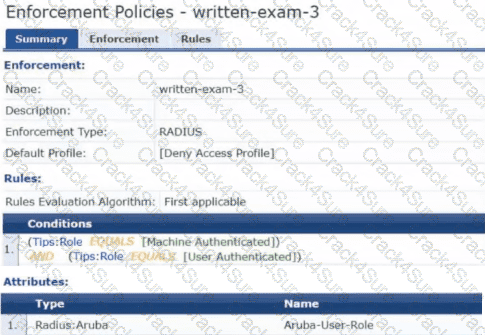
The intended enforcement policy and profiles are shown below:
* Policy: `written-exam-3`
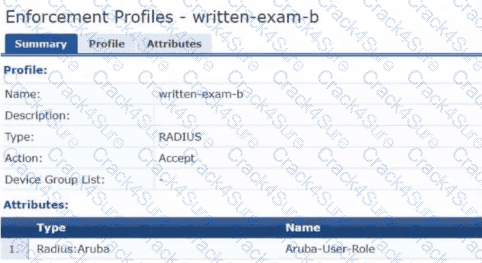
* Profile: `written-exam-b`
The gateway cluster contains two gateways with the following IP addresses:
Gateway 1: VLAN 4085 (system IP) = 10.20.4.21 | VLAN 20 (users) = 10.20.20.1 | VLAN 4094 (WAN) = 198.51.100.14
Gateway 2: VLAN 4085 (system IP) = 10.20.4.22 | VLAN 20 (users) = 10.20.20.2 | VLAN 4094 (WAN) = 198.51.100.12 | VRRP on VLAN 20 = 10.20.20.254
The customer needs high availability for tunnels between the switches and the gateway cluster. If one gateway fails, the other gateway must take over its tunnels. The switch must also be able to discover the gateway cluster even if one gateway in the cluster is unavailable.
Refer to the scenario. Assume that `myzone` is the name used for the UBT zone.
Which option is a valid minimal configuration for the AOS-CX port-access roles?
Your company uses HPE Aruba Networking AOS-10 APs and gateways, along with AOS-CX switches, all managed through HPE Aruba Networking Central. In HPE Aruba Networking Central, you need to collect a packet capture for a client connected to an AP.
What is a prerequisite?
A customer has an AOS-10 architecture managed by HPE Aruba Networking Central. HPE Aruba Networking infrastructure devices authenticate clients against an HPE Aruba Networking ClearPass cluster.
In HPE Aruba Networking Central, you are reviewing network traffic flows for a wireless IoT device categorized as a “Raspberry Pi” client. You observe SSH traffic. You then review several additional wireless IoT clients and find that they are also sending SSH.
Refer to the scenario.
You are assisting the customer in assessing ways to mitigate the potential threat detected. For the foreseeable future, until the security team has addressed the threat, the company wants to block most traffic from any IoT client detected sending SSH traffic. The company does want to allow limited access for these clients so that administrators can remediate them remotely.
What action should you take?
A customer has an AOS-10 architecture managed by HPE Aruba Networking Central. HPE Aruba Networking infrastructure devices authenticate clients against an HPE Aruba Networking ClearPass cluster.
In HPE Aruba Networking Central, you are reviewing network traffic flows for a wireless IoT device categorized as "Raspberry Pi" clients. You observe SSH traffic. You then review several additional wireless IoT clients and find that they are also sending SSH.
Refer to the scenario.
You are helping the customer evaluate ways to mitigate the potential threat that was detected. The customer suggests simply adding a rule that denies SSH traffic to the IoT client’s AOS user role.
What is the security drawback of this approach?
You want to use HPE Aruba Networking ClearPass Device Insight tags as conditions in CPPM role-mapping or enforcement-policy rules.
Which guidelines should you follow?
Introduction to the customer
You are assisting a company with adding HPE Aruba Networking ClearPass to its network, which uses HPE Aruba Networking network-infrastructure devices.
The company already has a Windows domain and Windows CA. The Windows CA issues certificates to domain computers, domain users, and servers such as domain controllers.
ClearPass cluster IP addressing and hostnames
Publisher = 10.47.47.5
Subscriber 1 = 10.47.47.6
Subscriber 2 = 10.47.47.7
Virtual IP with Subscriber 1 and Subscriber 2 = 10.47.47.8
Refer to the scenario.
You created a role-mapping policy as displayed in the exhibits below.
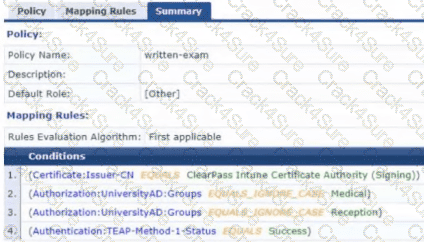
Policy Name: written-exam
Rules Evaluation Algorithm: First applicable
Conditions:
1. (Certificate:Issuer-CN EQUALS ClearPass Intune Certificate Authority (Signing))
2. (Authorization:UniversityAD:Groups EQUALS_IGNORE_CASE Medical)
3. (Authorization:UniversityAD:Groups EQUALS_IGNORE_CASE Reception)
4. (Authentication:TEAP-Method-1-Status EQUALS Success)
What one change must you make to this policy?
The customer needs a secure wireless solution that lets users onboard new wireless clients. You are recommending a new WLAN that will give users limited access for this process.
Which WLAN security should you recommend, assuming users have a mixture of WPA2- and WPA3-capable devices?
You are configuring gateway IDS/IPS settings in HPE Aruba Networking Central.
Why would you set the Fail Strategy to Bypass?
You are helping a company add HPE Aruba Networking ClearPass to its network, which uses HPE Aruba Networking infrastructure devices.
The company already has a Windows domain and Windows CA. The Windows CA issues certificates to domain computers, domain users, and servers such as domain controllers.
ClearPass cluster IP addressing and hostnames
Publisher = 10.47.47.5
Subscriber 1 = 10.47.47.6
Subscriber 2 = 10.47.47.7
Virtual IP with Subscriber 1 and Subscriber 2 = 10.47.47.8
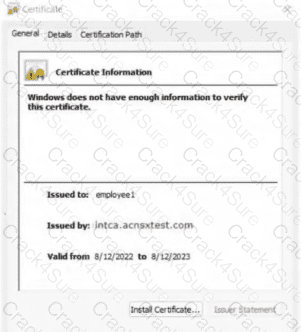
Refer to the scenario.
You have begun creating a CA to meet the customer's requirements for issuing certificates to mobile clients, as shown in the exhibit below.
Certificate Authority Settings:
Name: Exam Onboard CA
Mode: Root CA
Authority Info Access: Do not include OCSP Responder URL
Validity Period: 365 days
Clock Skew Allowance: 15
Subject Alternative Name: [X] Include device information in TLS client certificates
Digest Algorithm: SHA-512
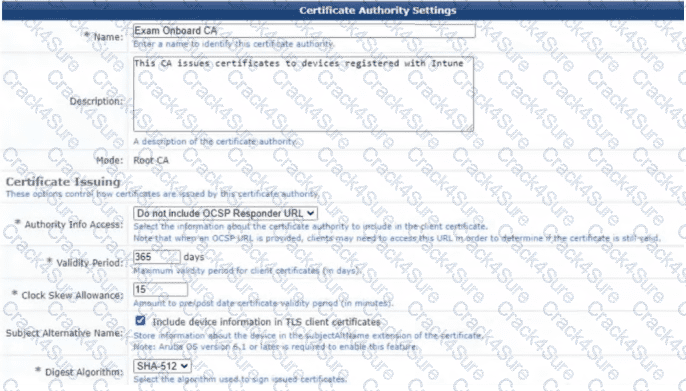
What change will help meet those requirements and the requirements for authenticating clients?
You must install a certificate on a standalone HPE Aruba Networking Mobility Controller (MC). The MC must use the certificate for the Web UI and to implement RadSec with HPE Aruba Networking ClearPass Policy Manager. You have received a certificate with these settings:
Subject: CN=mc49.site30.example.com
No SANs
Issuer: CN=ca89.example.com
EKUs: Server Authentication, Client Authentication
What problem does this certificate have for its intended uses?
A customer has an HPE Aruba Networking ClearPass cluster. The customer uses AOS-CX switches that perform 802.1X authentication through HPE Aruba Networking ClearPass Policy Manager (CPPM). The switches use local port-access policies.
The customer wants to begin tunneling wired clients that pass user authentication only to an HPE Aruba Networking gateway cluster. The gateway cluster must place these clients in the eth-internet role. The gateway must also assign the clients to VLAN 20.
The proposed enforcement policy and profiles are shown below:
* Policy: `written-exam-3`
* Profile: `written-exam-b`
The gateway cluster contains two gateways with the following IP addresses:
Gateway 1: VLAN 4085 (system IP) = 10.20.4.21 | VLAN 20 (users) = 10.20.20.1 | VLAN 4094 (WAN) = 198.51.100.14
Gateway 2: VLAN 4085 (system IP) = 10.20.4.22 | VLAN 20 (users) = 10.20.20.2 | VLAN 4094 (WAN) = 198.51.100.12 | VRRP on VLAN 20 = 10.20.20.254
The customer needs high availability for tunnels between the switches and the gateway cluster. If one gateway fails, the other gateway must take over its tunnels. The switch must also be able to discover the gateway cluster whether either gateway is present in the cluster.
Refer to the scenario.
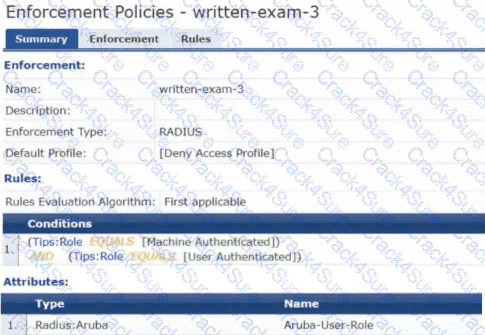
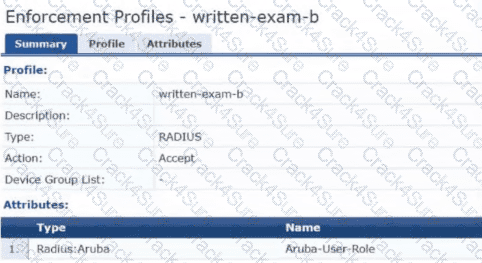
You are configuring the UBT zone on an AOS-CX switch. Which IP addresses should you configure in the zone?
You are assisting a company with adding HPE Aruba Networking ClearPass to its network, which uses HPE Aruba Networking network infrastructure devices.
The company already has a Windows domain and Windows CA. The Windows CA issues certificates to domain computers, domain users, and servers such as domain controllers.
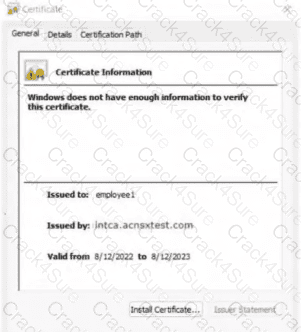
Refer to the scenario. On CPPM, you are creating the authentication source. You have configured the settings displayed on the tab and have not changed any other settings.
Authentication Sources - UniversityAD
Hostname: ad.acnsxtest.com
Connection Security: AD over SSL
Port: 636
Verify Server Certificate: [X] Enable
Bind DN: bind@acnsxtest.com
NetBIOS Domain Name: ACNSXTEST
Base DN: dc=acnsxtest,dc=com
Search Scope: SubTree Search
User Certificate: userCertificate
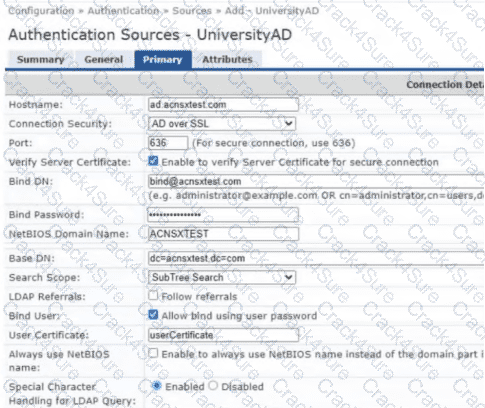
What else must you do to help authentication proceed correctly?
A customer uses an AOS-10 architecture managed by HPE Aruba Networking Central. HPE Aruba Networking infrastructure devices authenticate clients against an HPE Aruba Networking ClearPass cluster.
In HPE Aruba Networking Central, you examine network traffic flows for a wireless IoT device categorized as a "Raspberry Pi" client. You observe SSH traffic. After checking several additional wireless IoT clients, you find that they are also sending SSH traffic.
Refer to the scenario.
You need an easy way to communicate to HPE Aruba Networking ClearPass Policy Manager (CPPM) that an IoT client has used SSH.
What step should you take?
Your company uses an HPE Aruba Networking AOS-10 architecture managed by HPE Aruba Networking Central. A ClearPass Policy Manager (CPPM) cluster supplies authentication. The company also has a Palo Alto firewall. You want to configure the HPE Aruba Networking infrastructure to quarantine clients for which the firewall sends Syslog Threat messages to CPPM.
Network infrastructure devices already have a “quarantine” role configured.
You checked the CPPM event dictionary and found an entry for Palo Alto Syslog Threats that includes:
Prefix: PANW-Threat
Attributes such as syslogtimestamp and logtype
What is a correct component of the configuration in ClearPass server settings?
A financial institution must authenticate managers of HPE Aruba Networking Mobility Controllers (MCs) and HPE Aruba Networking Mobility Conductors through ClearPass Policy Manager (CPPM). The institution’s security policies require strong encryption for manager-authentication communications between the HPE Aruba Networking devices and CPPM.
What is a valid solution?
3 Months Free Update
3 Months Free Update
3 Months Free Update



TESTED 22 Nov 2026