Summer Special Sale - 70% Discount Offer - Ends in 0d 00h 00m 00s - Coupon code: spcl70

Practice Free HCVA0-003 HashiCorp Certified: Vault Associate (003) Exam Exam Questions Answers With Explanation

We at Crack4sure are committed to giving students who are preparing for the HashiCorp HCVA0-003 Exam the most current and reliable questions . To help people study, we've made some of our HashiCorp Certified: Vault Associate (003) Exam exam materials available for free to everyone. You can take the Free HCVA0-003 Practice Test as many times as you want. The answers to the practice questions are given, and each answer is explained.

Question # 6

Which of the following features in Vault will replicate service tokens between clusters?

A.

Disaster Recovery Replication

B.

Performance Replication

C.

Vault Agent

D.

Integrated Storage

Question # 7

Vault operators can create two types of groups in Vault. What are the two types?

A.

External groups

B.

Security groups

C.

Policy groups

D.

Internal groups

Question # 8

True or False? The following policy permits a user to read secrets contained in the path secrets/cloud/apps/jenkins?

text

CollapseWrapCopy

path " secrets/cloud/apps/jenkins/* " {

capabilities = [ " create " , " read " , " update " , " delete " , " list " ]

}

A.

True

B.

False

Question # 9

Tom is authenticating to Vault using the CLI. Which of the following commands allows Tom to authenticate using the userpass method WITHOUT logging his password to the shell history?

A.

vault login tom

B.

vault login -method=userpass username=tom

C.

vault login userpass username=tom password=jerry

D.

vault login -method=userpass username=tom password=jerry

Question # 10

True or False? Although AppRole is designed for machines, humans can use it to authenticate to Vault if you wish.

A.

True

B.

False

Question # 11

You need to create a limited-privileged token that isn’t impacted by the TTL of its parent. What type of token should you create?

A.

Service token with a use limit

B.

Orphan token

C.

Periodic token

D.

Root token

Question # 12

What is the default TTL for tokens in Vault if one is not specified?

A.

24 hours (1 day)

B.

15 minutes

C.

768 hours (32 days)

D.

60 minutes (1 hour)

Question # 13

You have ciphertext stored in an Amazon S3 bucket encrypted by the key named prod-customer. Will Vault decrypt this data with the command vault write transit/decrypt/prod-customer ciphertext= " vault:v4:Xa1f9FIJtn13em/Wb7QCsXsU/kCOn7... " given this output?

    $ vault read transit/keys/prod-customer

    Key Value

    --- -----

    ...

    keys map[4:1549347108 5:1549347109 6:1549347110]

    latest_version 6

    min_available_version 0

    min_decryption_version 4

    min_encryption_version 0

Will Vault decrypt this data for you by running the following command?

    $ vault write transit/decrypt/prod-customer ciphertext= " vault:v4:Xa1f9FIJtn13em/Wb7QCsXsU/kCOn7... "

A.

Yes, because the minimum decryption key configuration is set to 4

B.

No, since the latest version of the key is 6

Question # 14

Short-lived, dynamically generated secrets provide organizations with many benefits. Select the benefits from the options below. (Select four)

A.

Each application instance can generate its own credentials, rather than using a shared credential across all application instances

B.

Credentials only exist when needed

C.

Applications only have access to privileged accounts when needed

D.

Credentials accidentally checked into a code repo or discovered in a text file are likely to be invalid

E.

Dynamic credentials do not change, so legacy applications can easily take advantage of them

Question # 15

You have multiple Kubernetes pods that need frequent access to Vault to retrieve credentials for establishing connectivity to a backend database. You enable the Kubernetes auth method in Vault. What resource do you need to create within Kubernetes to complete this configuration?

A.

Username and password for kubectl

B.

k8s service account token

C.

A Vault token for authentication

D.

An AppRole role_id and secret_id

Question # 16

In Vault, there are two main types of tokens, batch and service. Which of the following is true about the renewable capabilities of each?

A.

Batch tokens cannot be renewed, but service can be renewed up to the max TTL

B.

Tokens cannot be renewed without reauthenticating to Vault

C.

Service tokens cannot be renewed, but batch can be renewed up to the max TTL

D.

Both batch and service tokens can be renewed up to the max TTL

Question # 17

What API endpoint is used to enable and configure a secrets engine?

A.

/v1/sys/init

B.

/v1/sys/mounts

C.

/v1/sys/config

D.

/v1/sys/plugins/catalog

Question # 18

Why are short-lived, dynamic secrets in Vault more secure than long-lived, static credentials?

A.

They provide better performance by caching credentials for longer durations

B.

They are created on-demand and expire after a short period, minimizing the risk of credential leakage

C.

They eliminate the need for authentication, allowing seamless access to Vault-managed systems

D.

They automatically rotate on a set schedule, reducing the need for manual intervention

Question # 19

A Fintech company is using Vault to store its static long-lived credentials so automated processes can quickly retrieve secrets. A user needs to add a new static secret for a new automated job. What CLI commands can be used to store a new static credential? (Select two)

A.

vault kv put kv/training/certification/vault @secrets.txt

B.

vault kv write kv/training/certification/vault key=username value=bryan

C.

vault kv create kv/training/certification/vault @secrets.txt

D.

vault kv put -mount=secret creds passcode=my-long-passcode

Question # 20

A new application is being provisioned in your environment. The application requires the generation of dynamic credentials against the Oracle database in order to read reporting data. Which is the best auth method to use to permit the application to authenticate to Vault?

A.

OIDC

B.

GitHub

C.

Userpass

D.

AppRole

Question # 21

How does the instance updates feature work when using the Vault Secrets Operator?

A.

By monitoring the Vault audit logs to watch for changes to the target path

B.

By constantly validating the current secret stored in Vault

C.

By continuously launching an init container to check for updates

D.

By subscribing to event notifications from Vault

Question # 22

Your organization recently suffered a security breach on a specific application, and the security response team believes that MySQL database credentials were likely obtained during the event. The application generated the credentials using the database secrets engine in Vault mounted at the path database/. How can you quickly revoke all of the secrets generated by this secrets engine?

A.

vault token revoke database/*

B.

vault secrets disable mysql

C.

vault lease renew database/creds/mysql

D.

vault lease revoke -prefix database/

Question # 23

Your organization uses a CI/CD pipeline to deploy its applications on Azure. During testing, you generate new credentials to validate Vault can create new credentials. The result of this command is below:

text

CollapseWrapCopy

$ vault read azure/creds/bryan-krausen

Key Value

--- -----

lease_id azure/creds/bryan-krausen/9eed0373-ca92-99b6-b914-779b7bb0e1d9

lease_duration 60m

lease_renewable true

client_id 532bf678-ee4e-6be1-116b-4e4221e445dd

client_secret be60395b-4e6b-2b7e-a4b3-c449a5c00973

What commands can be used to revoke this secret after you have finished testing? (Select three)

A.

vault lease revoke azure/

B.

vault lease revoke -prefix azure/

C.

vault lease revoke azure/creds/bryan-krausen/9eed0373-ca92-99b6-b914-779b7bb0e1d9

D.

vault lease revoke azure/creds/bryan-krausen

E.

vault lease revoke -prefix azure/creds/bryan-krausen

Question # 24

You are the primary Vault operator. During a routine audit, an auditor requested the ability to display all secrets under a specific path in Vault without seeing the actual stored data. Which policy permits the auditor to display the stored secrets without revealing their contents?

A.

path " kv/apps/production/ " { capabilities = [ " list " ] }

B.

path " kv/apps/+/ " { capabilities = [ " list " ] }

C.

path " kv/+/production " { capabilities = [ " list " ] }

D.

path " kv/apps/* " { capabilities = [ " list " , " read " ] }

Question # 25

Sara uses the Vault CLI for administrative tasks on the production cluster. However, she encounters permission-denied errors when making changes and needs to check which policies are attached to her token to view and adjust permissions. What command can she run on the Vault node to see the attached policies?

A.

vault operator diagnose

B.

vault policy list

C.

vault token capabilities

D.

vault token lookup

Question # 26

A developer team requests integration of their legacy application with Vault to encrypt and decrypt data for a backend database. They cannot modify the application for Vault authentication. What is the best way to achieve this integration?

A.

Enable the Transit secrets engine and configure the secrets engine to send data directly to the legacy app

B.

Have the app team call the Vault API to encrypt and decrypt the required data

C.

Enable and configure the Kubernetes auth method to allow the application to authenticate to Vault using a JWT

D.

Run the Vault Agent on the application server(s) and use the Auto Auth feature to manage the tokens

Question # 27

Over a few years, you have a lot of data that has been encrypted by older versions of a Transit encryption key. Due to compliance regulations, you have to re-encrypt the data using the newest version of the encryption key. What is the easiest way to complete this task without putting the data at risk?

A.

Rotate the encryption key used to encrypt the data

B.

Decrypt the data manually and encrypt it with the latest version

C.

Use the transit rewrap feature

D.

Create a new master key used by Vault

Question # 28

To secure your applications, your organization uses certificates generated by a public CA. However, this strategy has proven expensive and you have to revoke certificates even though they have additional time left. What Vault plugin can be used to quickly generate X.509 certificates to secure your internal applications?

A.

Identity secrets engine

B.

PKI secrets engine

C.

SSH secrets engine

D.

Transit secrets engine

Question # 29

You have a CI/CD pipeline using Terraform to provision AWS resources with static privileged credentials. Your security team requests that you use Vault to limit AWS access when needed. How can you enhance this process and increase pipeline security?

A.

Enable the SSH secrets engine and have Terraform generate dynamic credentials when deploying resources in AWS

B.

Enable the Transit secrets engine to encrypt the AWS credentials and have Terraform retrieve these credentials when needed

C.

Store the AWS credentials in the Vault KV store and use the Vault provider to obtain these credentials on each terraform apply

D.

Enable the aws secrets engine and configure Terraform to dynamically generate a short-lived AWS credential on each terraform apply

Question # 30

You are planning to deploy a new Vault cluster for your organization and notice that Vault supports a wide variety of storage backends. You need high availability since you will have multiple applications relying on the Vault service. When building your cluster, can you choose any of the available storage backends?

A.

Yes, because all backends provide similar functionality

B.

No, because not all storage backends provide similar functionality

Question # 31

Your organization audited an essential application and found it isn’t securely storing data. For added security, auditors recommended encrypting all data before storing it in a backend database, and the application server should not store encryption keys locally. Which secrets engine meets these requirements?

A.

PKI secrets engine

B.

SSH secrets engine

C.

Transit secrets engine

D.

Cubbyhole secrets engine

Question # 32

Which of the following capabilities can be used when writing a Vault policy? (Select four)

A.

list

B.

deny

C.

apply

D.

root

E.

create

F.

write

Question # 33

Which of the following are considered benefits of using policies in Vault? (Select three)

A.

Policies are assigned to a token on a 1:1 basis to eliminate conflicting policies

B.

Provides granular access control to paths within Vault

C.

Policies have an implicit deny, meaning that policies are deny by default

D.

Policies provide Vault operators with role-based access control

Question # 34

What of the following features are true about batch tokens in Vault? (Select two)

A.

Batch tokens are not persisted (written) to storage

B.

Batch tokens can be renewed

C.

Batch tokens are valid across all clusters when using Vault Enterprise replication

D.

Batch tokens can create child tokens

Question # 35

You are configuring your application to retrieve a new PKI certificate upon provisioning. The Vault admins have given you an AppRole role-id and secret-id to inject into the CI/CD pipeline job that provisions your app. The application uses the credentials to successfully authenticate to Vault using the API. Which of the following is true about the step next required after authenticating to Vault?

A.

The client token needs to be retrieved from the API response before requesting the new PKI certificate

B.

The initial API response should include the new PKI certificate and no further action is required

C.

The app still needs to use the role-id and secret-id to request the new PKI certificate via API

D.

Now that the app is authenticated, it can simply make another API request for the PKI certificate

Question # 36

All Vault instances, or clusters, include two built-in policies that are created automatically. Choose the two policies below and the correct information regarding each policy. (Select two)

A.

The root policy is created automatically. This policy provides superuser privileges and cannot be deleted

B.

The admin policy is created automatically. It provides administrative permissions but can be deleted if needed

C.

The default policy is created automatically. This policy can be modified but not deleted

D.

The default policy is created automatically. This policy cannot be modified but it can be deleted

Question # 37

Which of the following is true about the token authentication method in Vault? (Select three)

A.

The token auth method is automatically enabled in Vault and cannot be disabled

B.

External authentication mechanisms, such as GitHub, are used to dynamically create tokens

C.

The token auth method is used as the first method of authentication for Vault for a newly initialized Vault node/cluster

D.

Tokens cannot be used directly; they must be used in conjunction with one of Vault’s many auth methods

Question # 38

After decrypting data using the Transit secrets engine, the plaintext output does not match the plaintext credit card number that you encrypted. Which of the following answers provides a solution?

$ vault write transit/decrypt/creditcard ciphertext= " vault:v1:cZNHVx+sxdMEr....... "

Key: plaintext Value: Y3JlZGl0LWNhcmQtbnVtYmVyCg==

A.

Vault is sealed, therefore the data cannot be decrypted. Unseal Vault to properly decrypt the data

B.

The user doesn’t have permission to decrypt the data, therefore Vault returns false data

C.

The resulting plaintext data is base64-encoded. To reveal the original plaintext, use the base64 --decode command

D.

The data is corrupted. Execute the encryption command again using a different data key

Question # 39

True or False? The Vault Secrets Operator does NOT encrypt client cache, such as Vault tokens and leases, by default in Kubernetes Secrets.

A.

True

B.

False

Question # 40

What API endpoint is used to manage secrets engines in Vault?

A.

/secret-engines/

B.

/sys/mounts

C.

/sys/capabilities

D.

/sys/kv

Question # 41

After encrypting data using the Transit secrets engine, you’ve received the following output. Which of the following is true based on the output displayed below?

Key: ciphertext Value: vault:v2:45f9zW6cglbrzCjI0yCyC6DBYtSBSxnMgUn9B5aHcGEit71xefPEmmjMbrk3

A.

The original encryption key has been rotated at least once

B.

The data is stored in Vault using a KV v2 secrets engine

C.

This is the second version of the encrypted data

D.

Similar to the KV secrets engine, the Transit secrets engine was enabled using the transit v2 option

Question # 42

Which of the following statements are true regarding Vault seal and unseal (select three)?

A.

By default, Vault uses the Shamir Sharing algorithm to create unseal keys during the initialization process

B.

When using Vault Auto Unseal feature, Vault returns unseal keys to the user when it is initialized

C.

Vault can use a third-party KMS solution to automatically unseal during a service restart

D.

Vault supports high availability for the Auto Unseal feature, allowing you to point to multiple keys

Question # 43

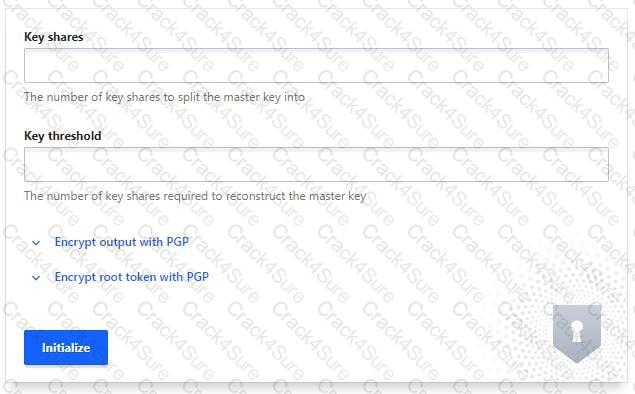
You’ve hit the URL for the Vault UI, but you’re presented with this screen. Why doesn’t Vault present you with a way to log in?
HCVA0-003 question answer

A.

The Consul storage backend was not configured correctly

B.

Vault needs to be initialized before it can be used

C.

A Vault policy is preventing you from logging in

D.

The Vault configuration file has an incorrect configuration

Question # 44

In regards to the Transit secrets engine, which of the following is true given the following command and output (select three):

$ vault write encryption/encrypt/creditcard plaintext=$(base64 < < < " 1234 5678 9101 1121 " )

Key: ciphertext Value: vault:v3:cZNHVx+sxdMErXRSuDa1q/pz49fXTn1PScKfhf+PIZPvy8xKfkytpwKcbC0fF2U=

A.

The Transit secrets engine is mounted at the encryption path

B.

The name of the keyring used to encrypt the data is creditcard

C.

There are at least three data keys associated with this keyring

D.

The data was written to the encryption path, which is provided by default when enabling the Transit secrets engine

Question # 45

From the options below, select the benefits of using the PKI (x.509 certificates) secrets engine (select three):

A.

TTLs on Vault certs are longer to ensure certificates are valid for a longer period of time

B.

Reducing, or eliminating certificate revocations

C.

Reduces time to get a certificate by eliminating the need to generate a private key and CSR

D.

Vault can act as an intermediate CA

Question # 46

    A Jenkins server is using the following token to access Vault. Based on the lookup shown below, what type of token is this? $ vault token lookup hvs.FGP1A77Hxa1Sp6Pkp1yURcZB


    Key Value

    --- -----

    accessor RnH8jtgrxBrYanizlyJ7Y8R

    creation_time 1604604512

    creation_ttl 24h

    display_name token

    entity_id n/a

    expire_time 2025-11-06T14:28:32.8891566-05:00

    explicit_max_ttl 0s

    id hvs.FGP1A77Hxa1Sp6KRau5eNB

    issue_time 2025-11-06T14:28:32.8891566-05:00

    meta < nil >

    num_uses 0

    orphan false

    path auth/token/create

    period 24h

    policies [admin default]

    renewable true

    ttl 23h59m50s

    type service

A.

Periodic token

B.

Batch token

C.

Orphaned token

D.

Secondary token

Question # 47

During a service outage, you must ensure all current tokens and leases are copied to another Vault cluster for failover so applications don’t need to authenticate. How can you accomplish this?

A.

Have Vault write all the tokens and leases to a file so you have a second copy of them

B.

Configure all applications to use the auto-auth feature of the Vault Agent

C.

Configure Disaster Recovery replication and promote the secondary cluster during an outage

D.

Replicate to another cluster using Performance Replication and promote the secondary cluster during an outage

Question # 48

You’ve set up multiple Vault clusters, one on-premises intended to be the primary cluster, and the second cluster in AWS, which was deployed for performance replication. After enabling replication, developers complain that all the data they’ve stored in the AWS Vault cluster is missing. What happened?

A.

There is a certificate mismatch after replication was enabled since Vault replication generates its own TLS certificates to ensure nodes are trusted entities

B.

All of the data on the secondary cluster was deleted after replication was enabled

C.

The data was automatically copied to the primary cluster after replication was enabled since all writes are always forwarded to the primary cluster

D.

The data was moved to a recovery path after replication was enabled. Use the vault secrets move command to move the data back to its intended location

Question # 49

Your company ' s security policies require that all encryption keys must be rotated at least once per year. After using the Transit secrets engine for a year, the Vault admin issues the proper command to rotate the key named ecommerce that was used to encrypt your data. What command can be used to easily re-encrypt the original data with the new version of the key?

A.

vault write -f transit/keys/ecommerce/rotate < old data >

B.

vault write -f transit/keys/ecommerce/update < old data >

C.

vault write transit/encrypt/ecommerce v1:v2 < old data >

D.

vault write transit/rewrap/ecommerce ciphertext= < old data >

Question # 50

Which of the following statements best describes the difference in cluster strategies between self-managed Vault and HashiCorp-managed Vault?

A.

Self-managed clusters require users to handle setup, maintenance, and scaling, whereas HCP Vault Dedicated is fully managed by HashiCorp and offloads most operational tasks

B.

Neither self-managed clusters nor HCP Vault Dedicated include enterprise security features such as replication or disaster recovery

C.

Both self-managed clusters and HCP Vault Dedicated require manual patching and upgrades, but only self-managed clusters are hosted in the user’s cloud

D.

In self-managed clusters, HashiCorp is responsible for scaling, upgrades, and patching, while HCP Vault Dedicated requires the user to handle all operational overhead

Question # 51

Tommy has written an AWS Lambda function that will perform certain tasks for the organization when data has been uploaded to an S3 bucket. Security policies for the organization do not allow Tommy to hardcode any type of credential within the Lambda code or environment variables. However, Tommy needs to retrieve a credential from Vault to write data to an on-premises database. What auth method should Tommy use in Vault to meet the requirements while not violating security policies?

A.

AWS

B.

Userpass

C.

Token

D.

AppRole

Question # 52

When configuring Vault replication and monitoring its status, you keep seeing something called ' WALs ' . What are WALs?

A.

Warning of allocated logs

B.

Write along logging

C.

Write-ahead logs

D.

Wake after LAN

Question # 53

From the options below, select the benefits of using a batch token over a service token (select four).

A.

Often used for ephemeral, high-performance workloads

B.

Can be a root token

C.

Can be used on performance replication clusters (if orphan)

D.

Has accessors

E.

Lightweight and scalable

F.

No storage cost for token creation

Question # 54

Given the following policy, which command below would not result in a permission denied error (select two)?

path " secret/* " { capabilities = [ " create " , " update " ] allowed_parameters = { " student " = [ " steve " , " frank " , " jamie " , " susan " , " gerry " , " damien " ] } }

path " secret/apps/* " { capabilities = [ " read " ] }

path " secret/apps/results " { capabilities = [ " deny " ] }

A.

vault kv put secret/apps/results student03=practice

B.

vault kv put secret/apps/app01 student=bryan

C.

vault kv put secret/common/results student=frank

D.

vault kv get secret/apps/api_key

Question # 55

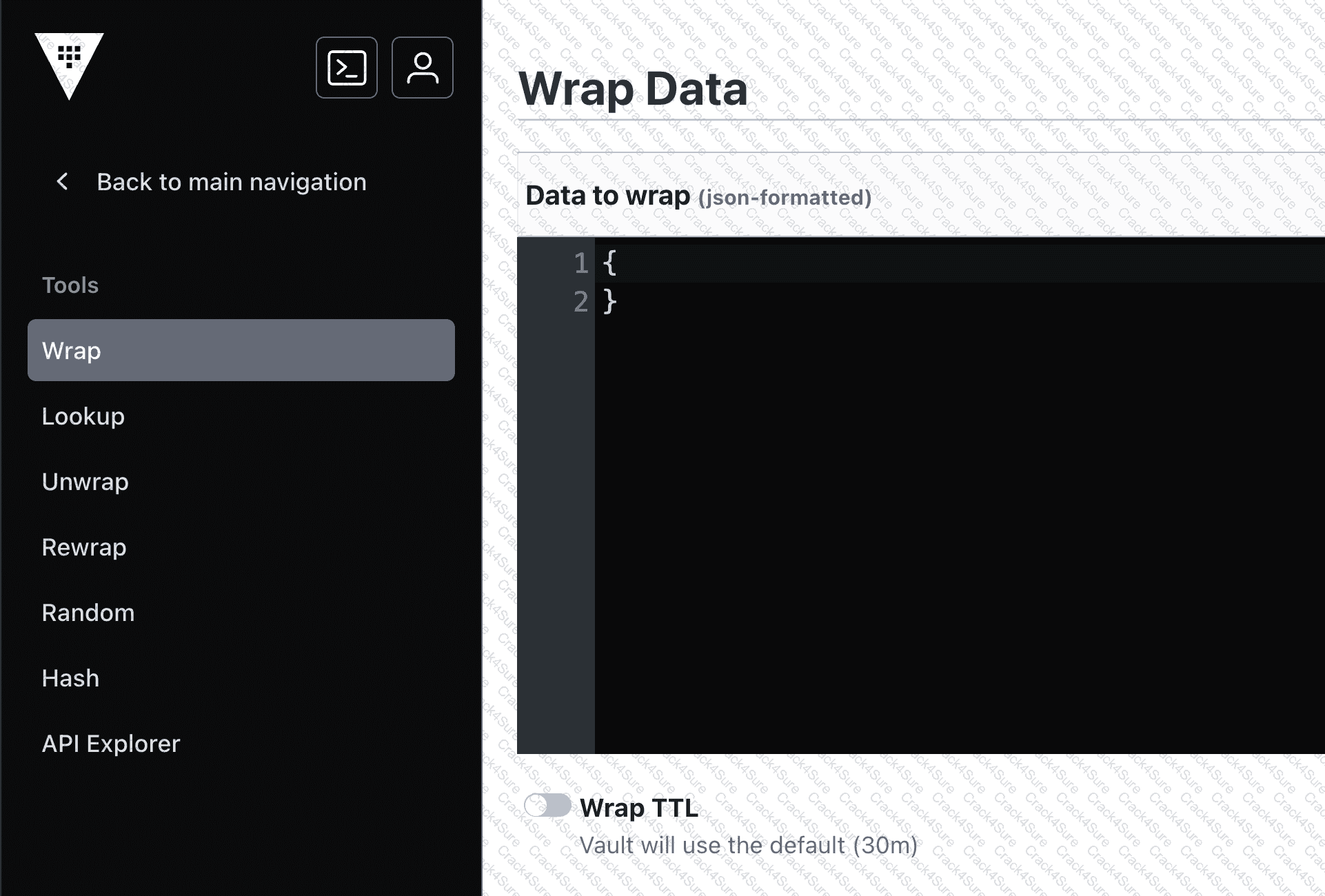
What could you do with the feature found in the screenshot below (select two)?
HCVA0-003 question answer

A.

Using a short TTL, you could encrypt data in order to place only the encrypted data in Vault

B.

Encrypt the Vault master key that is stored in memory

C.

Encrypt sensitive data to send to a colleague over email

D.

Use response-wrapping to protect data

Question # 56

When using the Vault Secrets Operator, where is the secret written to after being retrieved from Vault?

A.

The secret is never written to any service or persistent storage

B.

Directly to the filesystem of the pod

C.

Kubernetes Secrets

D.

To the cloud-provider’s native secret manager (Azure Key Vault, AWS Secrets Manager, etc.)

Question # 57

How long does the Transit secrets engine store the resulting ciphertext by default?

A.

24 hours

B.

30 days

C.

32 days

D.

Transit does not store data

Question # 58

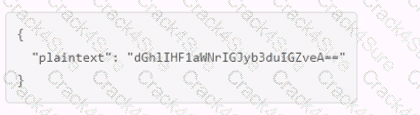
A user issues the following cURL command to encrypt data using the transit engine and the Vault AP:

HCVA0-003 question answer

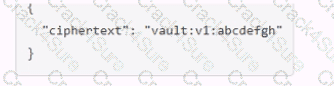
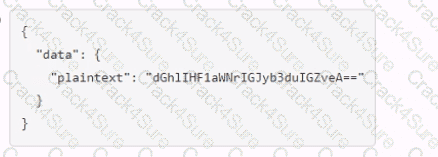
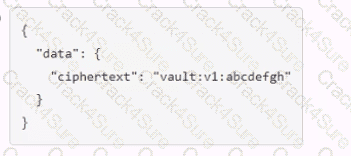
Which payload.json file has the correct contents?
A.

HCVA0-003 question answer

B.

HCVA0-003 question answer

C.

HCVA0-003 question answer

D.

HCVA0-003 question answer

Question # 59

Vault supports which type of configuration for source limited token?

A.

Cloud-bound tokens

B.

Domain-bound tokens

C.

CIDR-bound tokens

D.

Certificate-bound tokens

Question # 60

You are performing a high number of authentications in a short amount of time. You ' re experiencing slow throughput for token generation. How would you solve this problem?

A.

Increase the time-to-live on service tokens

B.

Implement batch tokens

C.

Establish a rate limit quota

D.

Reduce the number of policies attached to the tokens

Question # 61

Use this screenshot to answer the question below:
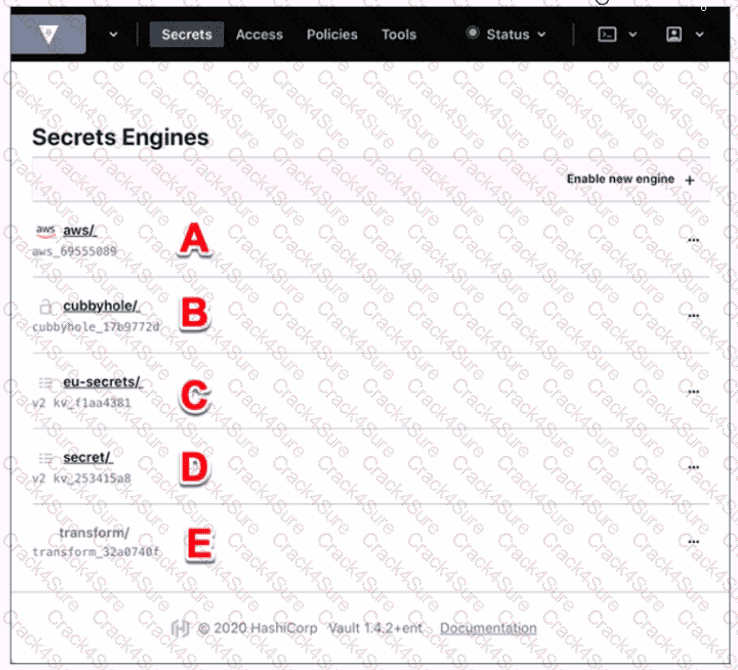
HCVA0-003 question answer

Where on this page would you click to view a secret located at secret/my-secret?

A.

A

B.

B

C.

C

D.

D

E.

E

Question # 62

You would like to provision virtual machines (VMs) using infrastructure as code (IaC). The VMs require an OAuth token to access GCP services during provisioning. You are required to use tokens that can be generated and revoked automatically.

Which secrets engine would meet this need?

A.

Identity secrets engine

B.

Key/Value secrets engine version 2

C.

Google Cloud secrets engine

D.

SSH secrets engine

Question # 63

A Vault cluster’s listener configuration is shown in the exhibit.

Given the configuration displayed, what VAULT_ADDR environment variable value would target this cluster?

Exhibit:

listener " tcp " { address = " 10.0.0.50:8200 " tls_disable = true }

A.

https://10.0.0.50:8200

B.

https://127.0.0.1:8200

C.

http://127.0.0.1:8200

D.

http://10.0.0.50:8200

Question # 64

The vault lease renew command increments the lease time from:

A.

The current time

B.

The end of the lease

Question # 65

What artifacts allow you to regenerate a root token after you have revoked it?

Pick the 2 correct responses below.

A.

Access to the OS root user.

B.

Policy with sudo access.

C.

Initial root token.

D.

Unseal keys.

E.

Recovery keys.

Question # 66

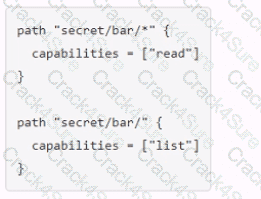
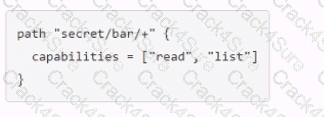
You have been tasked with writing a policy that will allow read permissions for all secrets at path secret/bar. The users that are assigned this policy should also be able to list the secrets. What should this policy look like?
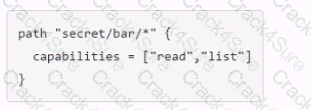
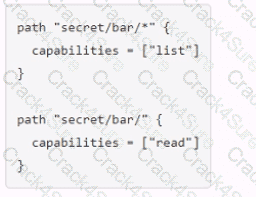
A.

HCVA0-003 question answer

B.

HCVA0-003 question answer

C.

HCVA0-003 question answer

D.

HCVA0-003 question answer

Question # 67

Security requirements demand that no secrets appear in the shell history. Which command does not meet this requirement?

A.

generate-password | vault kv put secret/password value

B.

vault kv put secret/password value-itsasecret

C.

vault kv put secret/password value=@data.txt

D.

vault kv put secret/password value-SSECRET_VALUE

Question # 68

The HTTP POST method was used to invoke the Vault API endpoint /auth/ldap/login/:username.

Which statements describe this operation?

Pick the 2 correct responses below.

A.

A Vault token must be provided in the request header.

B.

If the authentication was successful, the returned response will contain a client token.

C.

The returned response is encrypted and must be decrypted using Base64.

D.

User authentication can only be performed via the CLI or UI.

E.

A password must be provided in the request payload.

Question # 69

Which of the following is a machine-oriented Vault authentication backend?

A.

Okta

B.

AppRole

C.

Transit

D.

GitHub

Question # 70

An authentication method should be selected for a use case based on:

A.

The auth method that best establishes the identity of the client

B.

The cloud provider for which the client is located on

C.

The strongest available cryptographic hash for the use case

D.

Compatibility with the secret engine which is to be used

Question # 71

When unsealing Vault, each Shamir unseal key should be entered:

A.

Sequentially from one system that all of the administrators are in front of

B.

By different administrators each connecting from different computers

C.

While encrypted with each administrators PGP key

D.

At the command line in one single command

Question # 72

Two screenshots are shown in the exhibit.

You expect the ACL Policies menu to be shown as seen in Image 1. Instead, the ACL Policies menu is not displayed, as in Image 2.

Why would this menu not be displayed?

A.

Your token’s policies do not allow access to manage policies.

B.

The policy engine is not enabled.

C.

You need to be in the policy namespace.

D.

None of these explain this scenario.

Question # 73

Which is true about Vault authentication responses when using the Vault API?

A.

The Vault API cannot be used for authentication.

B.

The returned tokens are not needed as all API endpoints are unauthenticated.

C.

The returned tokens should be deleted to avoid any use in future requests.

D.

The returned token must be passed in the request header.

Question # 74

Your organization has an initiative to reduce and ultimately remove the use of long lived X.509 certificates. Which secrets engine will best support this use case?

A.

PKI

B.

Key/Value secrets engine version 2, with TTL defined

C.

Cloud KMS

D.

Transit

Question # 75

What environment variable overrides the CLI ' s default Vault server address?

A.

VAULT_ADDR

B.

VAULT_HTTP_ADORESS

C.

VAULT_ADDRESS

D.

VAULT _HTTPS_ ADDRESS

Question # 76

To give a role the ability to display or output all of the end points under the /secrets/apps/* end point it would need to have which capability set?

A.

update

B.

read

C.

sudo

D.

list

E.

None of the above

Question # 77

An organization would like to use a scheduler to track & revoke access granted to a job (by Vault) at completion. What auth-associated Vault object should be tracked to enable this behavior?

A.

Token accessor

B.

Token ID

C.

Lease ID

D.

Authentication method

Question # 78

True or False? After initializing Vault or restarting the Vault service, each individual node in the cluster needs to be unsealed.

A.

True

B.

False

Question # 79

Which two interfaces automatically assume the token for subsequent requests after successfully authenticating? (Select two)

A.

CLI

B.

API

C.

UI

Question # 80

Which of the following best describes the function of the Vault Secrets Operator in a Kubernetes environment?

A.

It replaces the Kubernetes secrets API entirely and operates purely as a certificate authority for all workloads.

B.

It is a standalone Vault server that automatically applies security policies and rotates root tokens.

C.

It continuously reconciles and synchronizes secrets from Vault to Kubernetes, ensuring secrets are always updated

D.

It provides an interface to dynamically provision Kubernetes clusters through Vault’s infrastructure secrets.

Question # 81

The Vault Agent provides which of the following benefits? (Select three)

A.

Token renewal

B.

Authentication to Vault

C.

Client-side caching of responses

D.

Automatically creates secrets in the desired storage backend

Question # 82

When generating a dynamic secret, what value is returned that a user can use to renew or revoke the lease?

A.

renewable

B.

token_ttl

C.

lease_max

D.

lease_id

Question # 83

You are using Azure Key Vault for the auto-unseal configuration on your cluster. After the Vault service restarts, what command must you run to unseal Vault?

A.

You don’t need to run a command when using auto-unseal

B.

vault operator members

C.

vault operator unseal

D.

vault operator init

Question # 84

True or False? The command vault lease revoke -prefix aws/ will revoke all leases associated with the secret engine mounted at /aws.

A.

True

B.

False

Question # 85

True or False? All Vault policies are deny by default.

A.

True

B.

False

Question # 86

Without logging into another interface, what feature can Chad use to execute a simple CLI command to enable a new secrets engine?
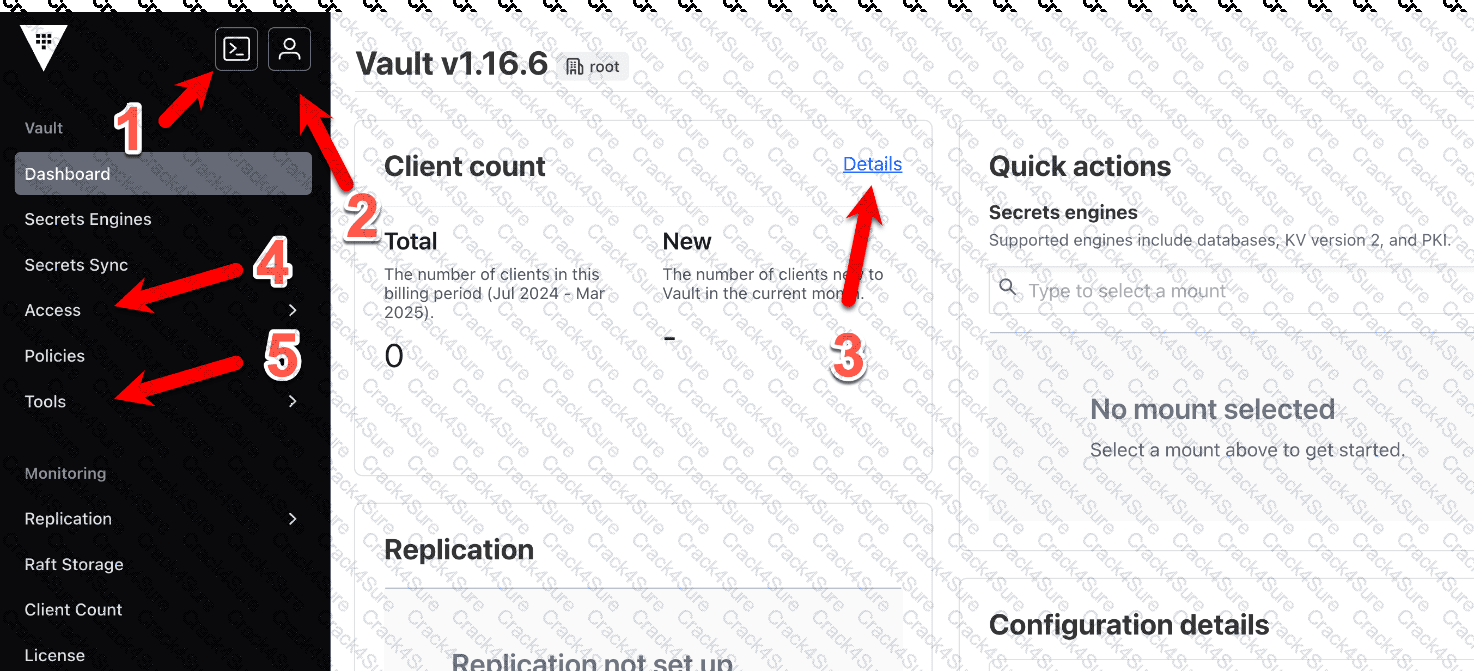
HCVA0-003 question answer

A.

CLI emulation in the Vault UI (Feature 1)

B.

User information button (Feature 2)

C.

Client count details (Feature 3)

D.

Access management link (Feature 4)

Question # 87

An application requires a specific key/value pair to be updated in order to process a batch job. The value should be either " true " or " false. " However, when developers have been updating the value, sometimes they mistype the value or capitalize the value, causing the batch job not to run. What feature of a Vault policy can be used to restrict entry to the required values?

A.

Add a deny statement for all possible misspellings of the value

B.

Add an allowed_parameters value to the policy

C.

Change the policy to include the list capability

D.

Use a * wildcard at the end of the policy

Question # 88

Which of the following statements best describes the difference between static and dynamic credentials in a secrets management system?

A.

They are functionally identical—the only difference is what secrets engine creates them.

B.

Static credentials only apply to specific use cases, while dynamic credentials can be used everywhere.

C.

Static credentials often remain persistent for long periods of time, while dynamic are short-lived and auto-rotated.

D.

Static credentials are ephemeral and rotated frequently, while dynamic credentials remain unchanged indefinitely.

Question # 89

Select the two default policies created in Vault. (Select two)

A.

root

B.

user

C.

admin

D.

default

E.

base

F.

vault

Question # 90

Which two characters can be used when writing a policy to reflect a wildcard or path segment? (Select two)

A.

The ampersand &

B.

The at symbol @

C.

The splat character *

D.

A dollar sign $

E.

The pound symbol #

F.

The plus symbol +

Question # 91

Which is not a capability that can be used when writing a Vault policy?

A.

delete

B.

modify

C.

create

D.

list

E.

read

F.

update

Question # 92

You have a legacy application that requires secrets from Vault that must be written to a local configuration file. However, you cannot refactor the application to communicate directly with Vault. What solution should you implement to satisfy the requirements?

A.

Run the Vault Agent and use the templating feature

B.

Use the Vault Proxy with Auto-Auth to authenticate with Vault

C.

Use the Vault Proxy to act as a proxy for the Vault API

D.

Use the Vault Agent and cache the newly created tokens and leases

Question # 93

After creating a dynamic credential on a database, the DBA accidentally deletes the credentials on the database itself. When attempting to remove the lease, Vault returns an error stating that the credential cannot be found. What command can be run to make Vault remove the secret?

A.

vault lease revoke -force -prefix < lease_path >

B.

vault lease -renew

C.

vault lease revoke -enforce

D.

vault revoke -apply

Question # 94

You are trying to create a new orphan token but receiving a Permission Denied error. What capabilities are required to create this token without using a root token?

A.

write privileges on the path auth/token

B.

write privileges on the path sys/mounts

C.

sudo privileges on the path auth/token/create

D.

sudo privileges on the path sys/mounts/token

Question # 95

Beyond encryption and decryption of data, which of the following is not a function of the Transit secrets engine?

A.

Generate hashes and HMACs of data

B.

Sign and verify data

C.

Store the encrypted data securely in Vault for retrieval

D.

Act as a source of random bytes

Question # 96

Which of the following is not an action associated with the Transit secrets engine when interacting with data?

A.

encrypt

B.

decrypt

C.

rewrap

D.

update

Question # 97

You need to write a Vault operator policy and give the users access to perform administrative actions in Vault. What path is used for Vault backend functions?

A.

/security

B.

/admin

C.

/vault

D.

/system

E.

/sys

F.

/backend

HCVA0-003 PDF

$33

$109.99

3 Months Free Update

  • Printable Format
  • Value of Money
  • 100% Pass Assurance
  • Verified Answers
  • Researched by Industry Experts
  • Based on Real Exams Scenarios
  • 100% Real Questions

HCVA0-003 PDF + Testing Engine

$52.8

$175.99

3 Months Free Update

  • Exam Name: HashiCorp Certified: Vault Associate (003) Exam
  • Last Update: Jun 21, 2026
  • Questions and Answers: 324
  • Free Real Questions Demo
  • Recommended by Industry Experts
  • Best Economical Package
  • Immediate Access

HCVA0-003 Engine

$39.6

$131.99

3 Months Free Update

  • Best Testing Engine
  • One Click installation
  • Recommended by Teachers
  • Easy to use
  • 3 Modes of Learning
  • State of Art Technology
  • 100% Real Questions included