Pre-Summer Special Sale - 70% Discount Offer - Ends in 0d 00h 00m 00s - Coupon code: spcl70

Practice Free JN0-106 Junos - Associate (JNCIA-Junos) Junos OS 21.2 Exam Questions Answers With Explanation

We at Crack4sure are committed to giving students who are preparing for the Juniper JN0-106 Exam the most current and reliable questions . To help people study, we've made some of our Junos - Associate (JNCIA-Junos) Junos OS 21.2 exam materials available for free to everyone. You can take the Free JN0-106 Practice Test as many times as you want. The answers to the practice questions are given, and each answer is explained.

Question # 6

JN0-106 question answer

Referring to the exhibit, you are configuring a Junos router to provide connectivity to a building across town on the network 10.10.10.0/24. The next-hop router is at 10.10.1.1, which is reachable using interface ge-0/0/1. After committing the configuration in the exhibit, users report they still cannot reach the 10.10.10.0/24 network, and the route does not appear as active in the routing table. In this scenario, which statement is correct?

A.

The next-hop address 10.1.1.1 is not directly connected or reachable through another route.

B.

Static routes must include the outgoing interface as the next hop.

C.

The static route requires a preference value to be specified or it will not install.

D.

The static route requires the retain keyword to remain active in the routing table.

Question # 7

You power on a new MX Series router for the first time and connect to the console. You notice that no transit interfaces are passing traffic. In this scenario, which statement is correct?

A.

All interfaces are enabled with DHCP client enabled.

B.

All interfaces are enabled and have an IP address of 10.0.0.1.

C.

The interfaces are configured as Layer 2 trunk ports.

D.

The interfaces are not configured.

Question # 8

Which statement describes the purpose of configuring traceoption log files in Junos OS?

A.

The traceoption log files automatically optimize routing decisions based on traffic patterns.

B.

The traceoption log files enable detailed debugging of specific protocols or processes.

C.

The traceoption log files allow permanent storage of all system logs for compliance purposes.

D.

The traceoption log files provide real-time monitoring of interface bandwidth utilization.

Question # 9

Which statement accurately describes the Junos candidate configuration?

A.

It is a backup configuration stored in the rollback archive.

B.

It is the active configuration currently running on the device.

C.

It is a temporary configuration that becomes active only after a reboot.

D.

It is a configuration that stores proposed changes before they are committed.

Question # 10

According to HPE Juniper Networking, when should you use the replace pattern command instead of the rename command?

A.

You want to create a private candidate configuration.

B.

You want to disable a physical interface.

C.

You need to edit a single component name in the configuration.

D.

You want to globally replace all occurrences of a specific string.

Question # 11

Click the Exhibit button.

JN0-106 question answer

Referring to the exhibit, which two actions will occur when a packet matches the firewall filter? (Choose two.)

A.

A counter will be incremented.

B.

The packet will be discarded.

C.

The packet will be forwarded.

D.

An ICMP destination unreachable message will be returned.

Question # 12

Which Junos tool should you use to identify the path that packets take through the network to a destination?

A.

monitor interface traffic

B.

traceroute

C.

SNMP

D.

ping

Question # 13

Which two statements are correct about logical units? (Choose two.)

A.

A physical interface can host multiple logical units.

B.

Logical units can have multiple IP addresses.

C.

Logical units are used only for management interfaces.

D.

A physical interface can host only one logical unit.

Question # 14

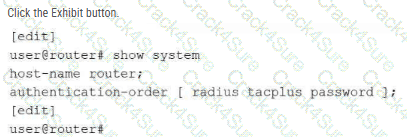
Exhibit:

JN0-106 question answer

You have configured multiple authentication methods on your Junos device, including RADIUS, TACACS+, and local user accounts. A user attempts to log in, but the RADIUS server is unavailable. Referring to the exhibit, which statement is correct?

A.

The user is prompted to select a different authentication method.

B.

The login attempt fails immediately.

C.

Junos will continue to attempt to authenticate with the RADIUS server until it responds.

D.

Junos attempts the next configured authentication method.

Question # 15

What is the main function of the forwarding table on a Junos device?

A.

It contains only active routes used to forward packets through the PFE.

B.

It advertises routes to neighboring routers.

C.

It stores all learned routes from routing protocols.

D.

It determines the best route based on route preference.

Question # 16

What is the primary purpose of an IPv6 link-local address?

A.

to provide Layer 2 connectivity

B.

to assign a unique address for multicast traffic

C.

to enable communication between devices on the same segment

D.

to replace the default gateway in IPv6 networks

Question # 17

According to HPE Juniper Networking, what are two recommended tasks you should perform before upgrading Junos OS on a device? (Choose two.)

A.

Delete all rollback configurations.

B.

Verify available storage space using the show system storage command.

C.

Disable all interfaces to prevent traffic during the upgrade.

D.

Back up the active current configuration.

Question # 18

Which statement is correct about traffic flow in the network shown in the exhibit?

JN0-106 question answer

A.

A routing loop can occur if one of the users sends packets to 10.1.99.1.

B.

Only User A can reach destinations beyond Router R1.

C.

Router R2 will drop packets destined for user B and user C.

D.

Router R1 will discard all packets from all three users.

Question # 19

Which two tasks are performed by the Routing Engine in a Junos device? (Choose two.)

A.

The Routing Engine runs routing protocols.

B.

The Routing Engine evaluates transit traffic against firewall filters.

C.

The Routing Engine manages the device configuration.

D.

The Routing Engine forwards transit traffic.

Question # 20

You asked a network engineer to configure a new logical interface on a Juniper router. The interface must use the fourth usable host address from the 172.16.40.128/29 subnet. Which IP address is correct in this scenario?

A.

172.16.40.135

B.

172.16.40.132

C.

172.16.40.130

D.

172.16.40.131

Question # 21

How many usable hosts are in a /24 subnet mask?

A.

250

B.

254

C.

255

D.

256

Question # 22

Exhibit:

JN0-106 question answer

Referring to the exhibit, with firewall filter Packet-Filter attached to an interface, if traffic is sent from 192.168.1.1 to 8.8.8.8 for a UDP DNS query, what will happen to the traffic?

A.

The traffic will match term 1 and be forwarded.

B.

The traffic will match the default last term and be forwarded.

C.

The traffic will match the default last term and be discarded.

D.

The traffic will match term 3 and be forwarded.

Question # 23

Which statement about class of service (CoS) in a network is correct?

A.

CoS encrypts traffic to secure data across the network.

B.

CoS prioritizes certain types of traffic during congestion.

C.

CoS assigns IP addresses dynamically to optimize routing.

D.

CoS prevents broadcast storms by segmenting VLANs.

Question # 24

Which two statements about route preference in Junos are correct? (Choose two.)

A.

Both direct and static routes have the same preference.

B.

Both direct and local routes have the same preference.

C.

Both OSPF internal and OSPF AS external routes have the same preference.

D.

Both EBGP and IBGP routes have the same preference.

Question # 25

After the factory default configuration is loaded, which configuration object must be created prior to the first commit?

A.

host name

B.

loopback IP address

C.

out-of-band connectivity

D.

root authentication

Question # 26

Your routing policy has three terms. A route matches the first term with an accept action. In this scenario, what happens next?

A.

The route is rejected by default.

B.

The route is evaluated by the second term.

C.

The route is sent to the next policy chain.

D.

The route is accepted and no further terms are evaluated.

Question # 27

Which two functions are performed by the PFE? (Choose two.)

A.

It maintains the routing table.

B.

It implements firewall filters.

C.

It selects active routes.

D.

It forwards transit traffic.

Question # 28

Which two statements describe the result when you enter ? at the command-line prompt? (Choose two.)

A.

It lists the available commands and options.

B.

It lists tips for the help menu.

C.

It displays help about a text string contained in a statement.

D.

It displays summary information about the commands and options.

JN0-106 PDF

$33

$109.99

3 Months Free Update

  • Printable Format
  • Value of Money
  • 100% Pass Assurance
  • Verified Answers
  • Researched by Industry Experts
  • Based on Real Exams Scenarios
  • 100% Real Questions

JN0-106 PDF + Testing Engine

$52.8

$175.99

3 Months Free Update

  • Exam Name: Junos - Associate (JNCIA-Junos) Junos OS 21.2
  • Last Update: May 10, 2026
  • Questions and Answers: 95
  • Free Real Questions Demo
  • Recommended by Industry Experts
  • Best Economical Package
  • Immediate Access

JN0-106 Engine

$39.6

$131.99

3 Months Free Update

  • Best Testing Engine
  • One Click installation
  • Recommended by Teachers
  • Easy to use
  • 3 Modes of Learning
  • State of Art Technology
  • 100% Real Questions included