Spring Special Sale - 70% Discount Offer - Ends in 0d 00h 00m 00s - Coupon code: spcl70

Note! JN0-450 has been withdrawn. The new exam code is JN0-451

Practice Free JN0-450 Mist AI - Specialist (JNCIS-MistAI) Exam Questions Answers With Explanation

We at Crack4sure are committed to giving students who are preparing for the Juniper JN0-450 Exam the most current and reliable questions . To help people study, we've made some of our Mist AI - Specialist (JNCIS-MistAI) exam materials available for free to everyone. You can take the Free JN0-450 Practice Test as many times as you want. The answers to the practice questions are given, and each answer is explained.

Question # 6

Which statement is correct about wireless assurance?

A.

Wireless assurance is a legacy WLAN construct that is difficult to use.

B.

Wireless assurance can be used to proactively optimize WLAN performance.

C.

Wireless assurance is used by clients to ensure that a Wi-Fi connection is stable and reliable before joining.

D.

Wireless assurance does not require a subscription.

Question # 7

The wireless service level expectation (SLE) for successful connects uses which three classifiers? (Choose three.)

A.

DHCP

B.

association

C.

asymmetry uplink

D.

IP services latency

E.

authorization

Question # 8

Referring to the exhibit, what does the security alert indicate?
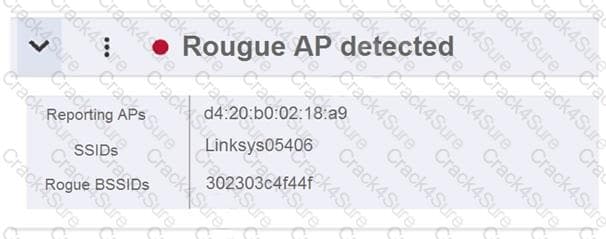
JN0-450 question answer

A.

An AP that is not part of the Mist Org is connected to the same wired network as the Mist APs.

B.

An AP that is not part of the Mist Org is launching a DDoS attack on the Mist APs.

C.

An AP that is not part of the Mist Org is advertising the same SSIDs as the Mist APs.

D.

An AP that is not part of the Mist Org is operating in the same RF channel as the nearby Mist AP.

Question # 9

Some users are having throughput problems on some devices. You need to understand if users may be on older devices in this situation. Which SLE metric and classifier allows you find this information?

A.

capacity/client count

B.

throughput/network issues

C.

capacity/client usage

D.

throughput/device capability