Crack4sure Logo

We at Crack4sure are committed to giving students who are preparing for the Microsoft AI-300 Exam the most current and reliable questions . To help people study, we've made some of our Operationalizing Machine Learning and Generative AI Solutions exam materials available for free to everyone. You can take the Free AI-300 Practice Test as many times as you want. The answers to the practice questions are given, and each answer is explained.
Fabrikam Inc. needs to improve the performance of a GPT-5 model based on the stated technical requirements.
Which action should you perform first?
You need to isolate training workloads while remaining cost-aware to address Fabrikam Inc.’s issues, constraints, and technical requirements.
What should you implement?
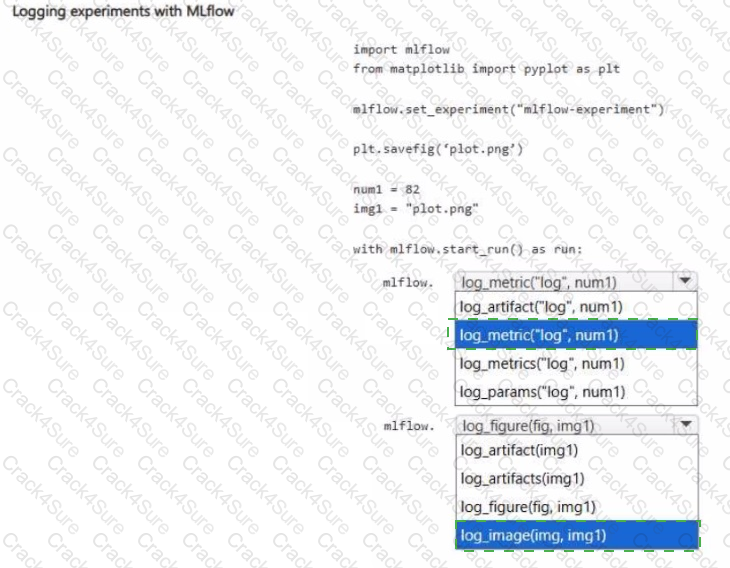
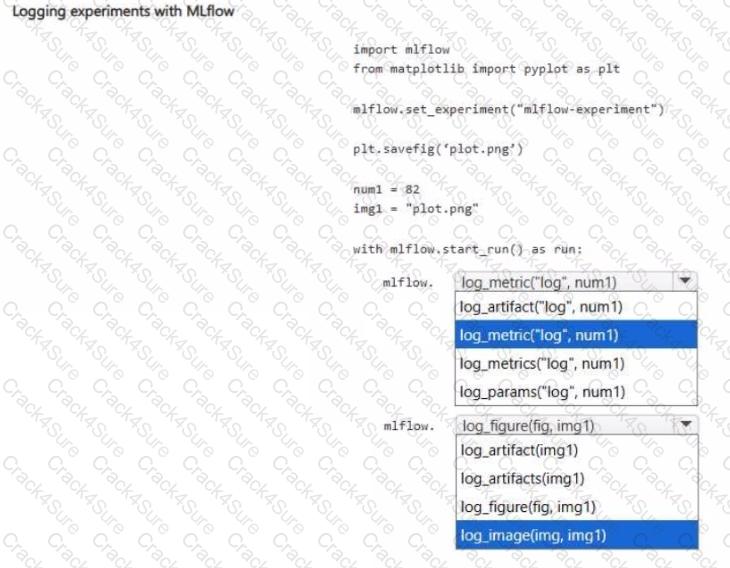
You have an Azure Machine Learning workspace.
You plan to set up logging and tracking experiments by using MLflow Tracking.
You need to log the accuracy as a numerical value and the training loss as a plot.
How should you complete the commands? To answer, select the appropriate options in the answer area.
NOTE: Each correct selection is worth one point.
Note: This question is part of a series of questions that present the same scenario. Each question in the series contains a unique solution that might meet the stated goals. Some question sets might have more than one correct solution, while others might not have a correct solution.
After you answer a question in this section, you will NOT be able to return to it. As a result, these questions will not appear in the review screen.
You train and register an Azure Machine Learning model.
You plan to deploy the model to an online endpoint.
You need to ensure that applications will be able to use the authentication method with a non-expiring artifact to access the model.
Solution:
Create a managed online endpoint and set the value of its auto_mode parameter to key. Deploy the model to the inline endpoint.
Does the solution meet the goal?
A financial services company is deploying Microsoft Foundry to host generative AI workloads that process regulated customer data. The Microsoft Foundry environment must prevent any public network exposure while still allowing services managed by Microsoft Foundry to communicate with dependent Azure resources.
Security auditors require that all traffic to and from the Microsoft Foundry resource remain on private networks, with no public endpoints available.
You need to configure the Microsoft Foundry environment so that network access is restricted while maintaining full platform functionality.
Which two actions should you perform? Each correct answer presents part of the solution. NOTE: Each correct selection is worth one point. Choose two.
You manage an Azure Machine Learning workspace. You use Azure Machine Learning Python SDK v2 to configure a trigger to schedule a pipeline job. You need to create a time-based schedule with recurrence pattern.
Which two properties must you use to successfully configure the trigger? Each correct answer presents part of the solution. NOTE: Each correct selection is worth one point.
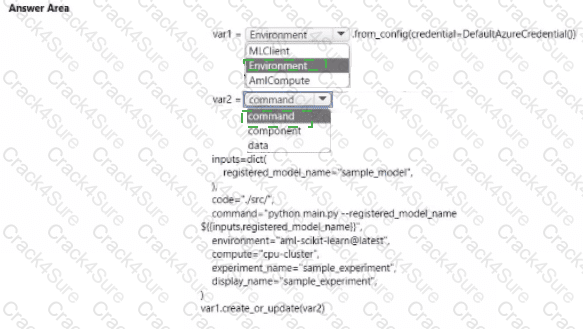
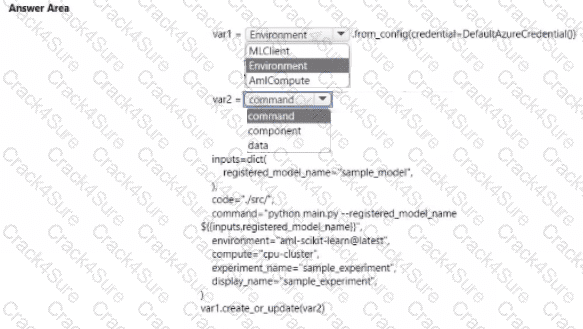
You create an Azure Machine Learning workspace
You are developing a Python SDK v2 notebook to perform custom model training in the workspace. The notebook code imports all required packages.
You need to complete the Python SDK v2 code to include a training script. environment, and compute information.
How should you complete ten code? To answer, select the appropriate options in the answer area.
NOTE: Each correct selection is worth one point
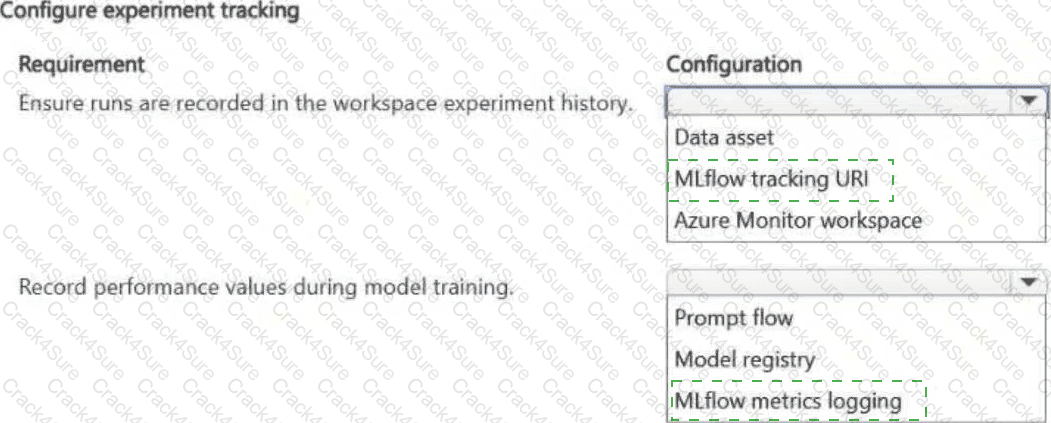
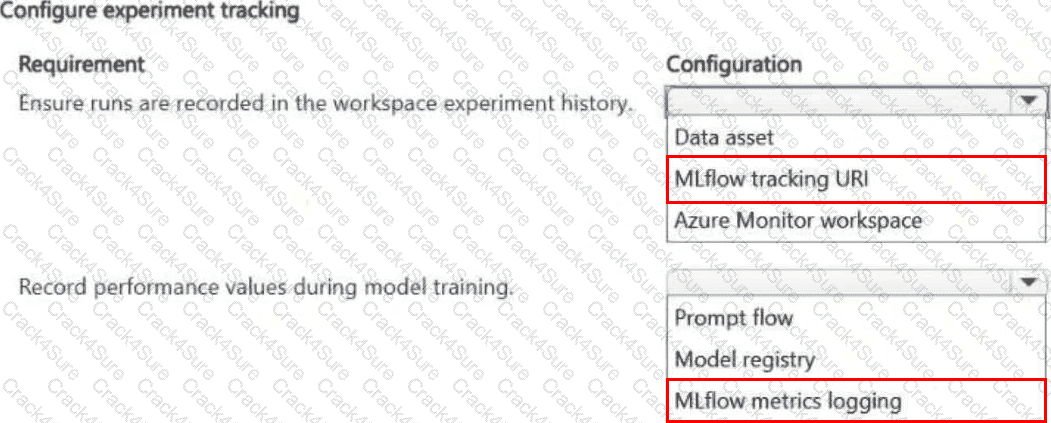
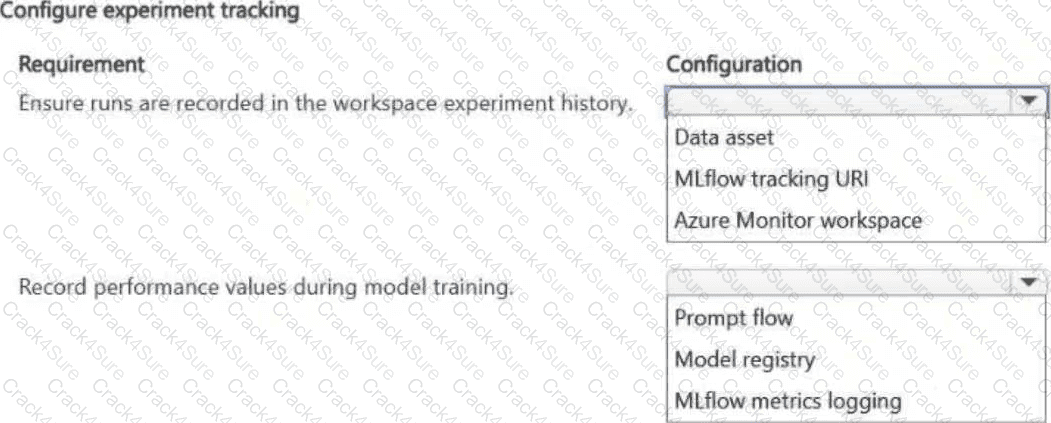
You use Azure Machine Learning to train models across multiple experiments by using the same workspace.
You must record training runs in a centralized location to compare results from different jobs.
During training, performance values must be captured so they appear in the experiment run history.
You need to configure experiment tracking.
What should you configure for each requirement? To answer, select the appropriate options in the answer area. NOTE: Each correct selection is worth one point.
you create an Azure Machine learning workspace named workspace1. The workspace contains a Python SOK v2 notebook mat uses Mallow to correct model coaxing men’s anal arracks from your local computer.
Vou must reuse the notebook to run on Azure Machine I earning compute instance m workspace.
You need to comminute to log training and artifacts from your data science code.
What should you do?
A team uses a hosted Git repository to store training code and pipeline definitions of a machine learning experiment.
The team must ensure that access to the repository is granted without requiring each developer to store personal access tokens on their machines.
Repository access must be secure and centrally managed to reduce credential spread.
You need to enable secure access between an Azure Machine Learning workspace and the repository.
You have an Azure Machine Learning (ML) model deployed to an online endpoint.
You need to review container logs from the endpoint by using Azure Ml Python SDK v2. The logs must include the console log from the inference server with print/log statements from the models scoring script.
What should you do first?
You manage an Azure Machine Learning workspace.
You must set up an event-driven process to trigger a retraining pipeline.
You need to configure an Azure service that will trigger a retraining pipeline in response to data drift in Azure Machine Learning datasets. Which Azure service should you use?
You are authoring a notebook in Azure Machine Learning studio.
You must install packages from the notebook into the currently running kernel. The installation must be limited to the currently running kernel only.
You need to install the packages.
Which magic function should you use?
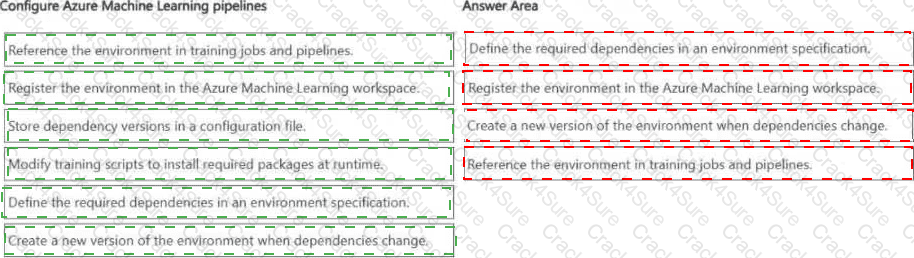
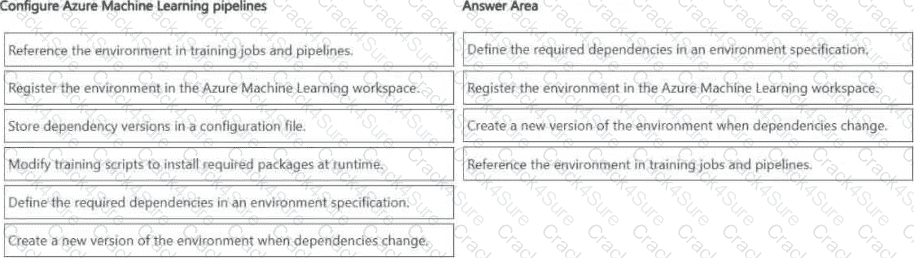
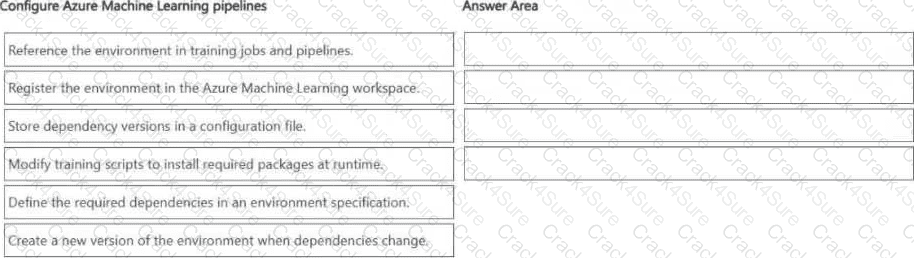
A team runs training jobs by using multiple Azure Machine Learning pipelines.
The team must ensure that all runs use the same Python packages and system libraries. The solution must allow dependency updates to be versioned without modifying training code.
You need to configure the workspace so that runtime dependencies are consistent and reusable.
Which four actions should you perform in sequence? To answer, move the appropriate actions from the list of actions to the answer area and arrange them in the correct order.
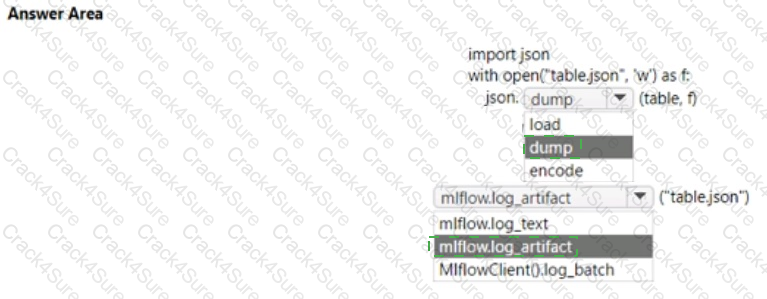
You create an Azure Machine Learning workspace.
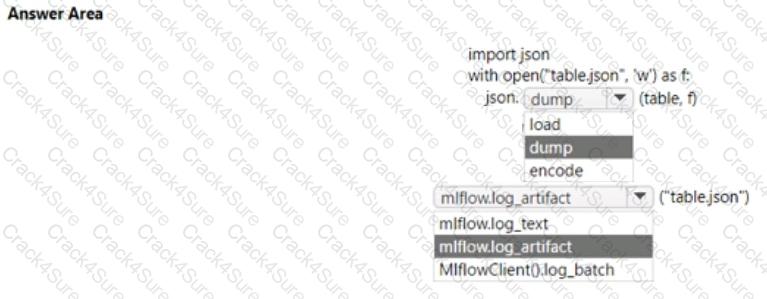
You must use the Python SDK v2 to implement an experiment from a Jupyter notebook in the workspace. The experiment must log a table in the following format:
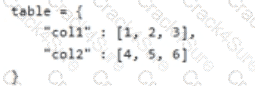
You need to complete the Python code to log the table.
How should you complete the code? To answer, select the appropriate options in the answer area.
NOTE: Each correct selection is worth one point.
A team deploys a model to a real-time endpoint in Azure Machine Learning. You deploy some updates to the endpoint.
The endpoint returns errors after the new deployment is released.
You need to restore the service as quickly as possible.
What should you do first?
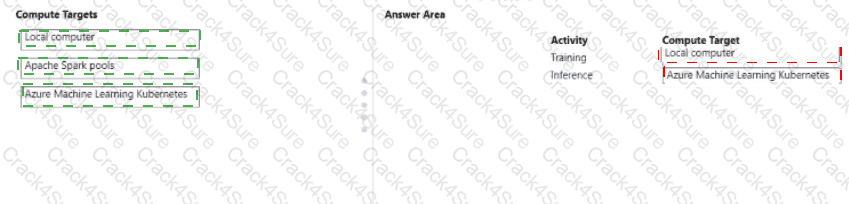
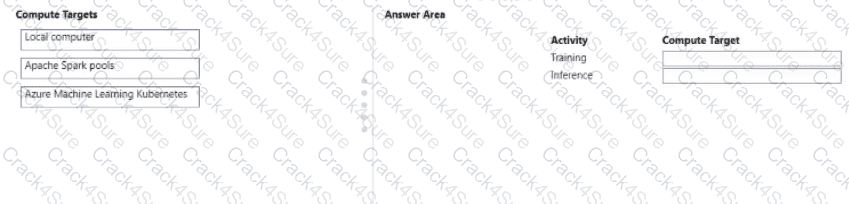
You are designing an Azure Machine Leaning solution by using the Python SDK v2.
You must train and deploy the solution by using a compute target. The compute target must meet the following requirements:
• Enable the use of on-premises compute resources.
• Support autoscalling.
You need to configure a compute target for training and inference.
Which compute target t should you configure?
To answer select the appropriate options in the answer area.
NOTE: Each correct selection is worth one point.
You create an Azure Machine Learning workspace.
You must configure an event-driven workflow to automatically trigger upon completion of training runs in the workspace. The solution must minimize the administrative effort to configure the trigger.
You need to configure an Azure service to automatically trigger the workflow.
Which Azure service should you use?
You manage an Azure Machine Learning workspace That has an Azure Machine Learning datastore.
Data must be loaded from the following sources:
• a credential-less Azure Blob Storage
• an Azure Data Lake Storage (ADLS) Gen 2 which is not a credential-less datastore
You need to define the authentication mechanisms to access data in the Azure Machine Learning datastore.
Which data access mechanism should you use? To answer, move the appropriate data access mechanisms to the correct storage types. You may use each data access mechanism once, more than once, or not at all. You may need to move the split bar between panes or scroll to view content.
NOTE: Each correct selection is worth one point.

Note: This question is part of a series of questions that present the same scenario. Each question in the series contains a unique solution that might meet the stated goals. Some question sets might have more than one correct solution, while others might not have a correct solution.
After you answer a question in this section, you will NOT be able to return to it. As a result, these questions will not appear on the review screen.
You work in Microsoft Foundry with a prompt flow.
You must manually evaluate prompts and compare results across prompt variants.
You need to capture the inputs, outputs, token usage, and latencies for each flow run for the evaluation.
Solution: Use the prompt flow SDK to enable tracing for the flow before executing runs. Then run the flow to generate traceable results.
Does the solution meet the goal?
You create an Azure Machine Learning workspace.
You must use the Python SDK v2 to implement an experiment from a Jupyter notebook in the workspace. The experiment must log string metrics. You need to implement the method to log the string metrics. Which method should you use?
A data science team plans to evaluate multiple hyperparameter values automatically while training a model in Azure Machine Learning.
The tuning process must run multiple training trials without manually modifying the training script for each run.
You need to automate hyperparameter tuning for the training job.
What should you do?
A real-time endpoint is deployed in Azure Machine Learning to serve predictions to a web application.
Users report intermittent failures and unexpected responses when calling the endpoint.
You need to identify the appropriate troubleshooting action for each reported issue.
Which troubleshooting action should you perform for each issue? To answer, move the appropriate troubleshooting actions to the correct issues. You may use each troubleshooting action once, more than once, or not at all. You may need to move the split bar between panes or scroll to view content. NOTE: Each correct selection is worth one point.

-
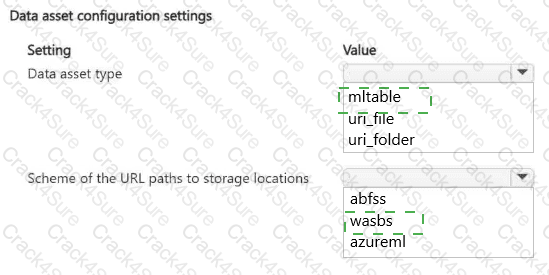
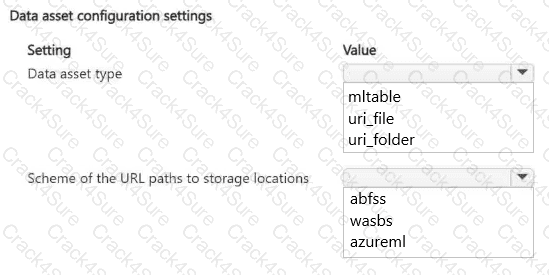
You have an Azure Machine Learning workspace and a collection of image files stored in two Azure Blob Storage accounts.
You need to configure data asset properties.
Which values should you use in your configuration? To answer, select the appropriate options in the answer area.
NOTE: Each correct selection is worth one point.
-
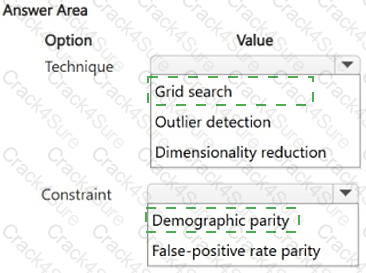
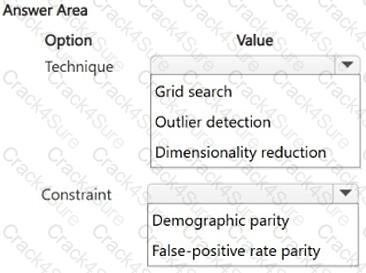
A biomedical research company plans to enroll people in an experimental medical treatment trial.
You create and train a binary classification model to support selection and admission of patients to the trial. The model includes the following features: Age, Gender, and Ethnicity.
The model returns different performance metrics for people from different ethnic groups.
You need to use Fairlearn to mitigate and minimize disparities for each category in the Ethnicity feature.
Which technique and constraint should you use? To answer, select the appropriate options in the answer area.
NOTE: Each correct selection is worth one point.
A data science team completes multiple training runs within an experiment by using MLflow.
The team wants to store a selected model in Azure Machine Learning so that it can be versioned and deployed later.
The model must be versioned centrally for reuse across environments.
You need to version the trained model.
Which two actions should you perform? Each correct answer presents part of the solution. NOTE: Each correct selection is worth one point. Choose two.
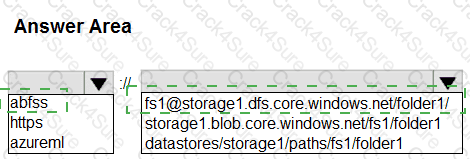
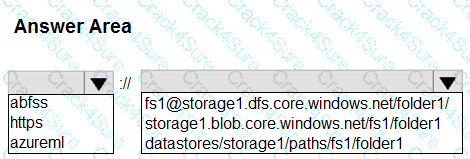
You create an Azure Data Lake Storage Gen2 stowage account named storage1 containing a file system named fsi and a folder named folder1.
The contents of folder1 must be accessible from jobs on compute targets in the Azure Machine Learning workspace.
You need to construct a URl to reference folder1.
How should you construct the URI? To answer, select the appropriate options in the answer area.
NOTE: Each correct selection is worth one point.
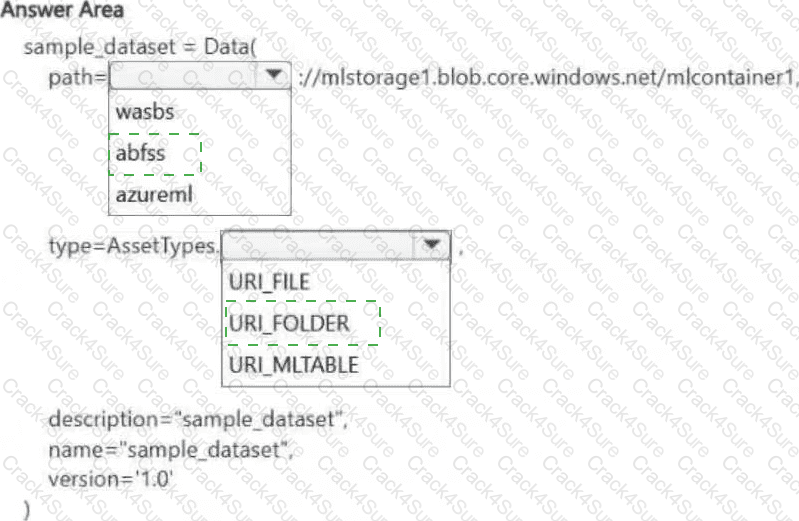
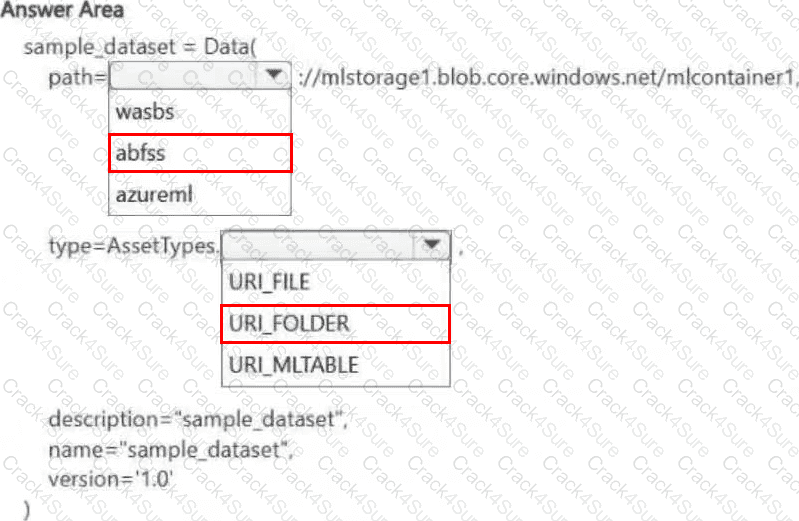
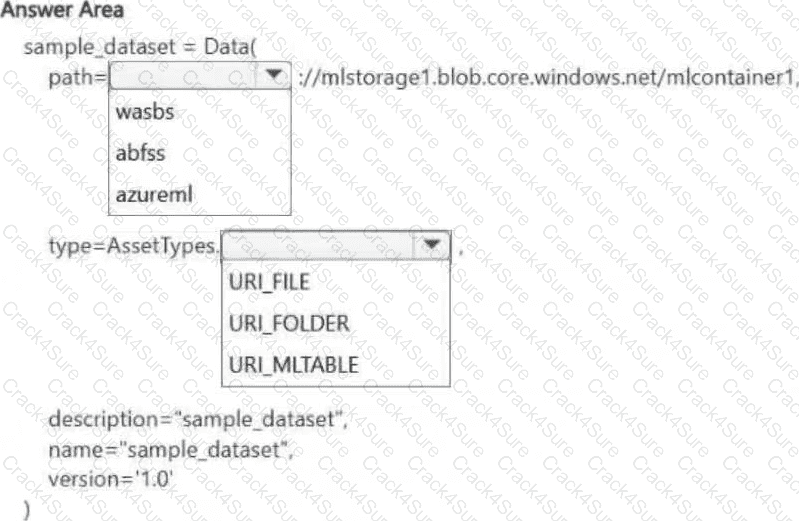
You manage an Azure Machine Learning workspace named workspace1 by using the Python SDK v2. You create a General Purpose v2 Azure storage account named mlstorage1. The storage account includes a publicly accessible container named mlcontainer1. The container stores 10 blobs with files in the CSV format.
You must develop Python SDK v2 code to create a data asset referencing all blobs in the container named mlcontainer1.
You need to complete the Python SDK v2 code.
How should you complete the code? To answer, select the appropriate options in the answer area. NOTE: Each correct selection is worth one point.
A team is working in Microsoft Foundry to test and compare large language model (LLM) prompt variants in a development environment.
The team requires consistent inputs to evaluate prompt variants without relying on live user traffic.
You need to create a controlled evaluation of input data.
Which action should you perform first?
3 Months Free Update
3 Months Free Update
3 Months Free Update



TESTED 06 Oct 2026