Crack4sure Logo

We at Crack4sure are committed to giving students who are preparing for the NREMT EMT Exam the most current and reliable questions . To help people study, we've made some of our Emergency Medical Technicians (EMT002) Exam exam materials available for free to everyone. You can take the Free EMT Practice Test as many times as you want. The answers to the practice questions are given, and each answer is explained.
Who is ultimately responsible for maintaining certification requirements and ensuring continuing education requirements are met?
You are transporting a febrile 62-year-old male who has a cough and body aches. His vital signs are BP 136/80, P 100, R 16, and his SpO? is 99% on room air. You should first:
Which of the following findings are indicative of increasing intracranial pressure? Select the two answer options that are correct.
Which of the following actions are appropriate management for two-rescuer pediatric basic life support? Select the three correct options.
Which of the following is a potential complication of positive pressure ventilation?
An EMT is responding to a motor vehicle collision on a busy highway at nighttime. Which of the following tactics should the EMT employ to keep themselves safe from moving traffic? Select the three answer options that are correct.
An 86-year-old patient is found unresponsive in the snow. The patient was reported missing the night before from an assisted living facility. How long should the EMT assess the patient’s pulse?
A 9-year-old patient who was injured in an MCI is brought to the treatment area with a delayed triage tag. Which of the following signs or symptoms would the EMT expect to find? Select the three correct options.
A 40-year-old patient is unresponsive following an electrical injury. What is the most likely cause of the patient ' s mental status?
Your unit is responding to an industry specializing in electroplating. There are several workers who are ill. During triage you smell bitter almonds. You should most likely suspect:
The ability to assess a situation quickly, appropriately take control, set action priorities, and give clear and concise direction can best be described as
A 38-year-old patient is unconscious with slow, shallow, and gasping breaths. The patient is not moving. What should the EMT perform first?
A 68-year-old patient has difficulty breathing and audible crackles. The patient has missed the last two dialysis appointments. The vital signs are BP 188/90 mmHg, P 120/min, R 24/min, and SpO? 92% on room air. Which of the following conditions should the EMT most strongly suspect?
A patient is experiencing acute coronary syndrome but is not hypoxemic. Which of the following results could come from oxygen administration? Select the two answer options that are correct.
What finding indicates that a mild airway obstruction has become a severe obstruction?
A 56-year-old patient has substernal chest discomfort radiating to the left arm and shoulder. The patient is nauseous, weak, and diaphoretic. The vital signs are BP 118/68, P 88, R 16, and SpO? 95% on room air. Which of the following interventions would be appropriate for this patient? Select the two answer options that are correct.
Calling your medical director for orders to assist with administration of an additional dose of nitroglycerin is an example of
A 77-year-old male presents with generalized aches and pain. He has been taking over-the-counter pain relief pills multiple times a day for the last 3 weeks. Your physical examination is most likely to reveal signs of
A 48-year-old patient has fever and bloody stools. The vital signs are BP 92/60 mmHg, P 118/min, R 20/min, and SpO? 92% on room air. What additional finding most strongly indicates bowel perforation as the cause of the patient ' s presentation?
A patient who is 30 weeks pregnant is in cardiac arrest after being hit by a car. How should the EMT proceed? Select the two answer options that are correct.
A patient who was involved in a car crash removes the cervical collar you placed on his neck and refuses to allow you to replace it. You should
The unauthorized confinement of a person is considered:
A 25-year-old patient had ingested an unknown quantity of a household cleaner one hour earlier. The patient has swelling around the mouth and stridor. Which of the following actions should the EMT prioritize? Select the two answer options that are correct.
Which of the following findings are consistent with congestive heart failure? Select the two answer options that are correct.
The police have placed a 20-year-old patient into custody. The patient is in handcuffs, is agitated, and is angry. The skin is hot and diaphoretic. The vital signs are BP 180/98, P 150, R 28, and SpO? 97% on room air. Which of the following actions would be appropriate for the EMT to take while transporting this patient? Select the two answer options that are correct.
Following an EMS call, any requests concerning protected health information should be directed to the
A 60-year-old patient has severe pain in the right hip after falling down four stairs. They have deformity and shortening of the right leg. The vital signs are BP 164/88, P 90, R 18, and SpO? 96% on room air. What actions should the EMT take for this patient? Select the two answer options that are correct.
Which of the following signs and symptoms indicate dehydration in an infant? Select the three correct options.
What phase of an explosion is most likely to produce injuries to the gas-containing organs of the body?
What are the dangers of delivering excessive ventilations to a patient who achieves ROSC following cardiac arrest? Select the two answer options that are correct.
A 65-year-old patient with a history of angina reports chest pain and shortness of breath after playing golf. The patient stated the pain began one hour ago and has not stopped with rest. The vital signs are BP 86/64, P 112, R 22, and SpO? 89% on room air. Which of the following actions should the EMT do next?
An EMT is using a BVM to ventilate a 28-year-old patient with asthma. The patient is unresponsive, and their vital signs are BP 70/40, P 142, R 8, and SpO2 89% on room air. The patient is becoming increasingly difficult to ventilate. What should the EMT do next?
In an MCI, a 32-year-old patient is unresponsive and not breathing. Which of the following interventions should the EMT perform first?
An 11-month-old patient has difficulty breathing. Which of the following findings would indicate respiratory failure to the EMT?
What characteristics of the pediatric airway are different from the adult airway?
A 45-year-old patient has chest pain, shortness of breath, and skin that is cool and diaphoretic. The patient states they have a feeling of impending doom. Which of the following conditions should the EMT most strongly suspect?
A patient has heart failure with pulmonary edema. They have shortness of breath, and crackles are present in both lungs. The patient is nauseated and has vomited once. The vital signs are BP 90/40, P 110, R 10, and SpO? 89% on room air. Which of the following signs or symptoms prevent the EMT from using CPAP? Select the three correct options.
You have consulted with on-line medical direction to terminate resuscitation of a 74-year-old female. How should you inform her family of this decision?
You are called to a small hotel where it is reported by the manager that several persons, in separate rooms, are unresponsive. Your first actions should be to
In order for a plaintiff to recover damages in a lawsuit against an EMT, there must be a duty to perform, breach of duty, damage, and
Which of the following would be considered a public health event by EMS?
A 29-year-old patient has stridor and erythema while at an outside event. The vital signs are P 100/min and R 22/min. Which of the following medications should the EMT administer first?
Reassessment of a patient begins with repeating the
When treating a patient suspected of having tuberculosis, you should
What is the difference between the injury patterns in children and those of adults?
A 21-year-old patient is nauseous and actively vomiting. The patient has a sweet odor on the breath. The skin is warm, flushed, and dry. The patient is breathing at 40/min. What should the EMT most strongly suspect is the cause of the patient ' s condition?
While responding to an emergency, a car is tailgating the ambulance. Which of the following actions should the EMT take?
Which of the following elements proves tort negligence in a court of law?
A mountain climber tells you that he came down from a hike because he was coughing up blood. You should suspect
A 27-year-old patient is under arrest and in handcuffs after an altercation with police. The patient has a swollen left wrist that is tender to the touch. There is no deformity to the wrist, and distal pulses are present. The EMT is considering the following transport options:
• Option 1: Transport the patient in the ambulance, handcuffed, with the key-holding officer following the ambulance in a police car.
• Option 2: Transport the patient in the ambulance, but exchange the handcuffs for locking leather restraints to which the EMT has a key.
Which of these options should the EMT choose, if either?
Which of the following are nerve agents? Select the two answer options that are correct.
A 76-year-old patient has behavioral changes that began this morning. The patient is also having trouble ambulating and speaking. Which of the following conditions should the EMT suspect? Select the two answer options that are correct.
A 23-year-old male fell down a flight of stairs, struck his head, and briefly lost consciousness. He opens his eyes when you ask him questions, knows his name, but doesn ' t know where he is or what happened. He is able to squeeze your hands on command. What is his Glasgow Coma Score?
You observe your partner as he completes a patient care report. He documents giving a medication that you know he did not administer. You should first
What type of medical direction do standing orders and protocols describe?
A 78-year-old female tripped and fell while walking. Her left leg is rotated externally and shorter than her right leg. You should suspect
A patient is having a stroke. Which of the following details are most important to report to the receiving hospital? Select the two answer options that are correct.
The key to effectively managing a multiple casualty incident is to
When would application of an oxygen humidifier be most beneficial? Select the three answer options that are correct.
A 67-year-old patient is unresponsive, and an EMT checks for a pulse prior to applying an AED. Which of the following screenable rhythms, ventricular fibrillation or ventricular tachycardia, if either, may still produce a pulse in this patient?
An infectious disease spread by the fecal-oral route that is considered an acute infection with a currently available vaccine is
Through which of the following routes is hepatitis A transmitted?
One of the complications of splinting is
Which of the following assessment findings indicates respiratory failure?
A 24-year-old patient is in cardiac arrest after being submerged in cold water. Which of the following circumstances should occur prior to considering termination of resuscitation efforts?
A 26-year-old patient is 26 weeks pregnant and has severe abdominal pain after being involved in a motor vehicle collision. There is minimal vaginal bleeding, and uterine contractions are present. What condition should the EMT suspect as the most likely cause of the patient ' s signs and symptoms?
A 3-year-old patient has a sore throat and fever. They are drooling. Which of the following actions should the EMT take?
The ability to think and reason is located in which region of the brain?
An 84-year-old patient has a sudden onset of weakness to one side of the body. The patient has a history of hypertension and high cholesterol. The vital signs are BP 176/94 mmHg, P 108/min, R 18/min, and SpO? 97% on room air. For which of the following additional symptoms should the EMT assess? Select the three correct options.
A 49-year-old patient is in cardiac arrest. The EMT applies an AED that shocks the patient into a rhythm with a pulse. Which of the following concepts permits the EMT to use the AED in this situation?
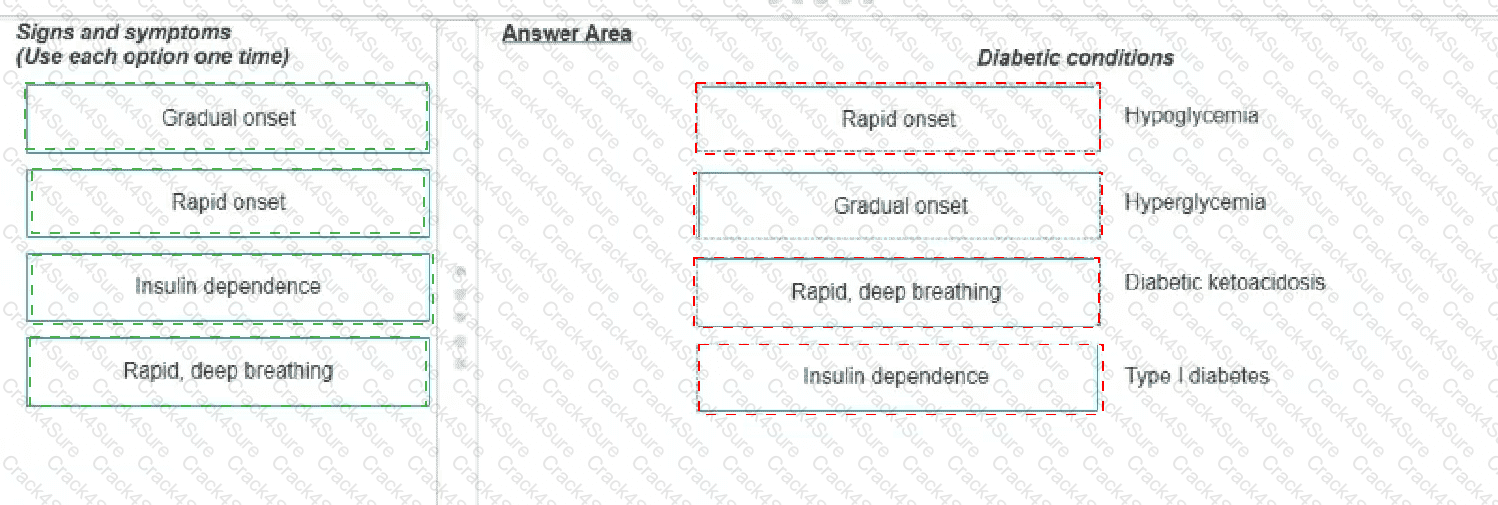
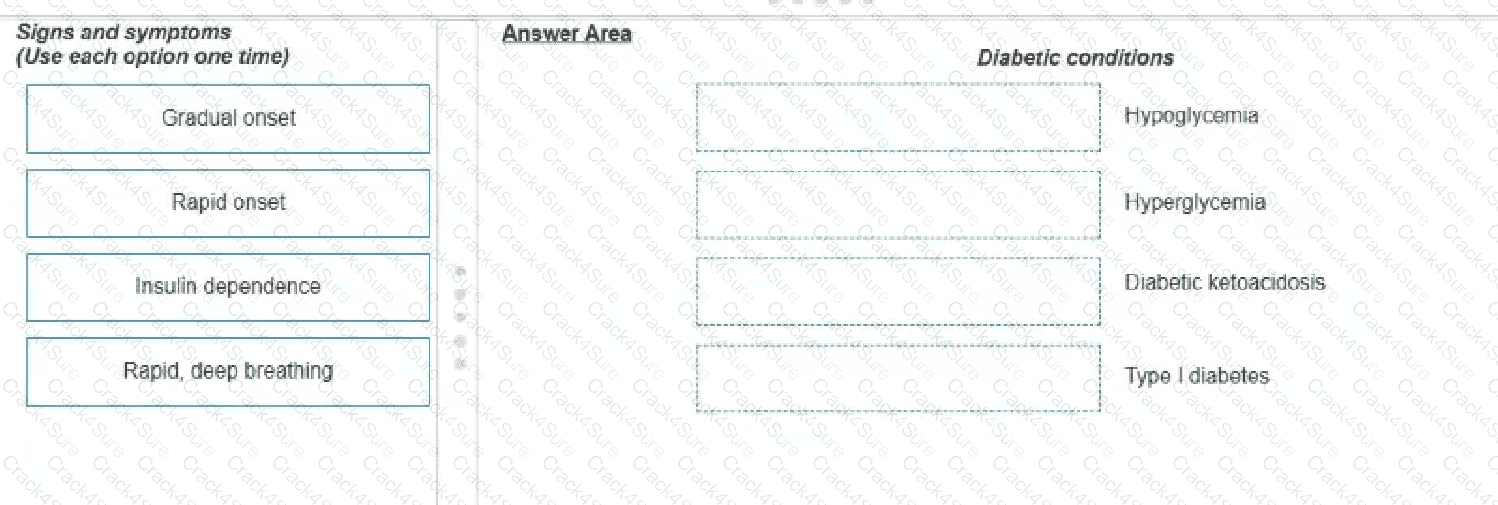
Which of the following signs or symptoms would be most closely associated with each of these diabetic conditions? Move each sign or symptom into the Answer Area one time to indicate the most closely associated diabetic condition.
An EMT cannot find a pulse on a responsive patient. Which of the following should the EMT do next?
A 33-year-old patient with an irregular heart rhythm has chest pain and shortness of breath. The vital signs are BP 124/92, P 170, R 24, and SpO? 89% on room air. Which of the following medications is most appropriate for this patient?
A person grabs your arm during an argument. This is considered
Which of the following pathophysiological responses causes a patient with neurogenic shock to become hypotensive?
A 1-year-old patient has meningitis. Which of the following signs and symptoms should the EMT expect to find? Select the three answer options that are correct.
A 9-month-old patient is unresponsive in a crib. The patient is not breathing. Which of the following actions should the EMT perform first?
A program whose efforts are to limit the effects of an injury or illness that you cannot completely prevent is called:
An 8-year-old patient has abdominal pain, tearing, drooling, and a runny nose after being found in the family tool shed. The patient’s signs and symptoms are most likely caused by which of the following chemicals?
3 Months Free Update
3 Months Free Update
3 Months Free Update



TESTED 07 Oct 2026