Pre-Summer Special Sale - 70% Discount Offer - Ends in 0d 00h 00m 00s - Coupon code: spcl70

Practice Free NCP-MCI-7.5 Nutanix Certified Professional - Multicloud Infrastructure (NCP-MCI) 7.5 Exam Questions Answers With Explanation

We at Crack4sure are committed to giving students who are preparing for the Nutanix NCP-MCI-7.5 Exam the most current and reliable questions . To help people study, we've made some of our Nutanix Certified Professional - Multicloud Infrastructure (NCP-MCI) 7.5 exam materials available for free to everyone. You can take the Free NCP-MCI-7.5 Practice Test as many times as you want. The answers to the practice questions are given, and each answer is explained.

Question # 6

The administrator expanded a Nutanix cluster repurposed nodes from a decommissioned cluster. The administrator has validated the following:

    Same number of cores, amount of memory and storage

    The nodes are on the same subnet

    The nodes are running the same version of AOS and AHV

After the nodes were added the administrator discovered that VMs cannot be migrated to the recently added nodes.

What would be the reason for this issue?

A.

The nodes firmware needs to be updated using LCM before the VMs will be able to migrate.

B.

An Acropolis Dynamic Scheduler (ADS) task is running and the VMs will migrate when it completes.

C.

The VMs were created on new generation of CPU and must be power-cycled to renegotiate new features.

D.

The VMs have VM-VM affinity rules and cannot migrate until affinity rules are updated.

Question # 7

An administrator needs to enable Marketplace in Prism Central before deploying Nutanix apps.

Which prerequisite must be met on the Prism Element cluster hosting Prism Central to enable Marketplace?

A.

Data services IP must be configured.

B.

SMTP must already be enabled.

C.

LACP must be configured on all uplinks.

D.

LDAP must be configured.

Question # 8

An administrator reverts a VM to a recovery point using Prism Central. What is the expected behavior for the VM ' s categories and ownership after the revert?

A.

Both the VM ' s categories and ownership revert to the state captured in the recovery point.

B.

Categories are reverted to the recovery point state, but ownership is preserved.

C.

Both the VM ' s categories and ownership are preserved at their current state.

D.

Categories are preserved, but ownership reverts to the recovery point state.

Question # 9

An administrator needs to be able to use remaining capacity for storage and memory.

What settings should the administrator set to accomplish this?

A.

Capacity High Availability and Memory Reservation

B.

Storage Capacity and Memory High Availability

C.

Rebuild Capacity Reservation and High Availability

D.

Rebuild Capacity Reservation and Memory Reservation

Question # 10

An administrator supports multiple AHV clusters under Prism Central and uses Intelligent Operations playbooks for remediation.

The organization recently standardized alert policies, but the alert policy names and IDs change between environments due to automated deployments and periodic updates.

The requirement is to trigger a remediation playbook for any alert that matches a defined performance pattern (for example, impact type and severity plus a keyword pattern), regardless of which specific alert policy generated it, while avoiding unrelated non-performance alerts.

Which playbook trigger best meets the requirement?

A.

Alerts Matching Criteria trigger - configured with the required alert filters so the playbook triggers for any alert meeting the criteria.

B.

Webhook trigger - configured so an external system calls the playbook endpoint only when performance incidents are detected.

C.

Alert trigger - configured to a single alert policy so the playbook triggers only when that specific policy generates an alert.

D.

Event trigger - configured for a single event type so the playbook triggers when that event type is generated for the selected entities.

Question # 11

A Windows VM will be cloned repeatedly and each clone needs OS-level customization during deployment.

What is the most efficient method to accomplish this task?

A.

Create template for each deployment

B.

Create a VM from snapshot

C.

Guest customization profile

D.

Clone and manually configure

Question # 12

An administrator decided to simplify volume group management by automatically enabling vDisk load balancing for better performance.

How can the administrator enabled vDisk load balancing by default for volume groups?

A.

For Linux VMs ensure the SCSI device timeout is no more than 30 seconds.

B.

Directly attach vDisk load balanced volume groups to VMs.

C.

Attach no more than 16 load balanced volume groups per guest VM.

D.

Use the data services IP address for attached volume groups.

Question # 13

An administrator needs to move a running VM to another host in the same cluster without shutting it down.

Which is the best way to achive this task?

A.

Restore from recovery point.

B.

Restore from third-party backup.

C.

Clone from previous snapshot.

D.

Live migrate within the cluster.

Question # 14

How many S3 targets are supported for Prism Central point-in-time backups?

A.

1

B.

2

C.

3

D.

4

Question # 15

An administrator is tasked with configuring asynchronous replication between two Availability Zones (AZs) using a Protection Policy.

Which requirement must be met to successfully configure asynchronous replication?

A.

Storage container name of the protected entities must be identical on primary and recovery clusters.

B.

Primary and recovery clusters must both be registered with a single Prism Central instance.

C.

Round trip time (RTT) latency between the primary and recovery clusters must be less than 5 ms.

D.

Primary and recovery clusters must be running the same version of Prism Central.

Question # 16

How many storage pools and storage containers are created during cluster creation?

A.

Two pools, two containers

B.

Two pools, three containers

C.

One pool, three containers

D.

One pool, two containers

Question # 17

Which storage-optimization method is recommended for full clone VDI workloads?

A.

Thin Provisioning

B.

Capacity deduplication

C.

Post-process map reduce

D.

Erasure Coding

Question # 18

An administrator manages a shared AHV environment where Dev workloads must not exceed 2,000 IOPS per VM during business hours to prevent noisy-neighbor impact on Prod.

The administrator already uses categories to group VMs (for example, category Env=Dev) and wants a scalable approach that applies consistent throttling to all current and future Dev VMs without configuring each VM individually.

Which approach best meets the requirement?

A.

Increase the replication factor for Dev workloads so additional copies distribute I/O and cap IOPS.

B.

Configure a storage policy with QoS throttling and associate the policy to the category used by Dev VMs.

C.

Set Storage QoS attributes on one representative Dev VM, then clone that VM so all Dev VMs inherit the QoS settings.

D.

Enable compression on the storage container hosting Dev VMs to reduce latency and enforce an effective IOPS limit.

Question # 19

While configuring a remote site for PD-Based DR, an administrator elects to skip vStore mapping. Assuming the same container names don ' t exist on the two sites, what is the expected behavior of data placement at the remote site for replications?

A.

Replications fail to complete.

B.

The default container is always chosen.

C.

Container with lowest ID is chosen.

D.

A container is randomly chosen.

Question # 20

A VM is protected by a protection policy and the volume group is configured with CHAP authentication. An administrator rotates the VM’s password as part of the monthly routine. What action must the administrator perform to ensure the password is retained in the event of a failover?

A.

Update the associated recovery plan.

B.

Set the password as part of startup policy.

C.

Update the associated protection policy.

D.

Set the password in the VG recovery points.

Question # 21

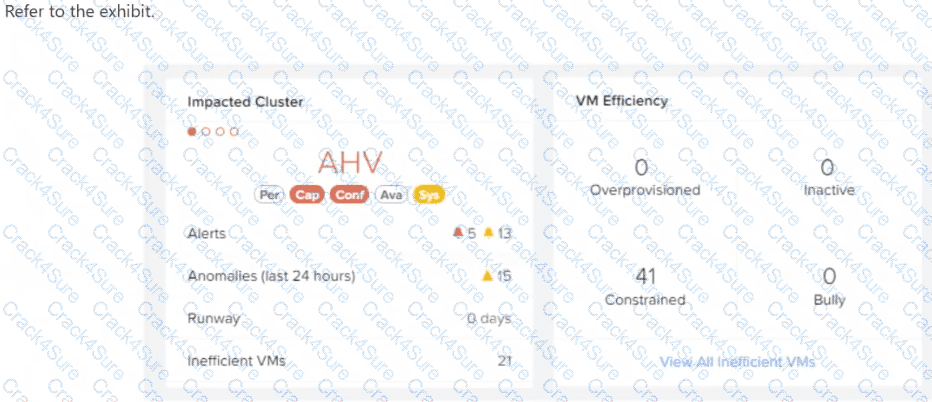
Refer to Exhibit:

NCP-MCI-7.5 question answer

After logging into Prism Central, an administrator observes that there are a large number of constrained VMs.

What does this indicate about those VMs?

A.

They are inactive and in a zombie state.

B.

They are lacking in sufficient resources.

C.

They are over-sized and wasting memory.

D.

They are consuming too much CPU.

Question # 22

When the administrator attempts to configure a Volume Group and connect an external iSCSI initiator, the connection fails. Which cluster configuration step did the administrator most likely miss?

A.

Enabling Microservices Infrastructure on Prism Central.

B.

Configuring the Data Services IP address on the cluster.

C.

Configuring an LDAP directory service for iSCSI authentication.

D.

Registering the cluster to Prism Central before creating Volume Groups.

Question # 23

An administrator is troubleshooting intermittent VM I/O stalls that appear across hosts and clusters.

The issue is sporadic, and the administrator needs to rapidly collect the correct platform logs for deeper analysis and possible escalation. The administrator wants to use a supported mechanism designed for efficient log collection, and must ensure the environment prerequisites are met so the tool can be used successfully.

Which option correctly describes the supported approach and a key prerequisite?

A.

Use Logbay to collect logs, which is available once the node has a CVM deployed or the AHV compute node has been added to the cluster.

B.

Use Panacea to troubleshoot the incident, retrieving the required host and CVM logs directly, without first collecting a log bundle from the cluster.

C.

Use storage policy compliance reports and evaluations, include the underlying system logs needed to diagnose performance issues.

D.

Use ADS to export diagnostic bundles automatically whenever built-in log collection function detects contention hotspots.

Question # 24

A corporate security policy mandates strict protection against boot-level rootkits and requires the isolation of NTLM password hashes from the running operating system to prevent " pass-the-hash " attacks.

During the initial testing phase, the administrator deploys a test VM using the standard AHV creation workflow. While configuring the guest operating system, administrator attempts to enable Windows Defender Credential Guard via Group Policy. However, the feature fails to start, and the system logs indicate that the underlying virtualization platform does not meet the necessary hardware security requirements.

Which specific configuration change must the administrator apply to the VM to satisfy the security policy requirements?

A.

Enable UEFI firmware, configure the disk controller to use the IDE bus, and add a vTPM device.

B.

Enable Generation 2 firmware, check the VBS flag, and add a vTPM device.

C.

Enable Legacy BIOS firmware, check the Secure Boot option, and add a vTPM device.

D.

Enable UEFI firmware, check the Secure Boot option, and add a Virtual Trusted Platform Module (vTPM) device.

Question # 25

Due to user complaints of slow VM performance, an administrator is reviewing performance metrics on their Nutanix cluster and executes iostat on a Controller VM (CVM).

The following output is captured:

#TIMESTAMP 1768953673 : 01/21/2026 12:01:13 AM

avg-cpu: %user %nice %system %iowait %steal %idle

2.32 0.09 7.53 83.20 0.00 6.86

Based on this output, which statement most accurately describes the current state of the CVM?

A.

The CVM is likely waiting on disk I/O operations to complete, suggesting a potential bottleneck in the storage subsystem or underlying physical drives.

B.

The CVM is suffering from excessive network throughput congestion, resulting in a high percentage of CPU cycles being dedicated to interrupt processing.

C.

The CVM is under heavy computational load from Nutanix services, as evidenced by the high percentage of active processing cycles currently in use.

D.

The CVM is experiencing significant CPU contention from the hypervisor, as indicated by the discrepancy between low user percentage and high system overhead.

Question # 26

An administrator would like to upgrade LCM (Life Cycle Management) to the latest version on an AHV cluster. Which step should the administrator take to guarantee LCM is upgraded to the latest version?

A.

Perform an inventory

B.

Upgrade AHV

C.

Upgrade AOS

D.

Run NCC health check

Question # 27

Which setting will ensure a specific storage container maintains a minimum amount of available storage, even if other containers in the same storage pool are consuming space?

A.

Advertised Capacity (Logical)

B.

Reserved Capacity (Logical)

C.

Throttled Throughput (IOPS)

D.

Total Space (Physical)

Question # 28

A company has recently purchased five new Nutanix clusters. The lab manager has been tasked with remotely deploying the Nutanix infrastructure in the most efficient way possible. Which tool would best help to accomplish this task?

A.

Foundation for Windows/Mac

B.

Foundation Central

C.

Standalone Foundation VM

D.

Phoenix ISO image

Question # 29

An administrator is configuring Runway Analysis settings in Prism Central and selects Auto Detect under Reserve Capacity For Failure.

How will runway capacity be calculated in this configuration?

A.

The runway analysis reserves a fixed 10% of cluster CPU, memory, and storage capacity by default.

B.

The runway analysis calculates capacity using the full cluster resources but automatically adds a performance buffer.

C.

The runway analysis reserves capacity only for storage resources while CPU and memory remain unchanged.

D.

The runway analysis excludes the resources of the largest node so estimates account for a node failure.

Question # 30

What is the RPO time, in hours, for Prism Central backups?

A.

24

B.

36

C.

48

D.

72

Question # 31

An administrator needs to protect a group of mission-critical virtual machines.

The business requirements are:

    Recovery Point Objective (RPO) must be set to 5 minutes.

    New mission critical VMs should be automatically protected.

Which data protection type supports this configuration?

A.

Protection Domain with NearSync replication

B.

Protection Policy with NearSync replication

C.

Protection Domain with Asynchronous replication

D.

Protection Policy with Asynchronous replication

Question # 32

An administrator is deploying a new cluster with dense storage. Each node will have 100TB of storage. How many logical cores will be assigned to each CVM?

A.

6

B.

8

C.

12

D.

14

Question # 33

During an LCM upgrade, the pre-check test_ahv_entering_mm_pinned_vms pre-check fails on an AHV host. The administrator reviews the listed VMs and finds that:

    One VM is configured as an Agent VM

    Two VMs are running Windows Defender Credential Guard

    One VM has a vGPU-enabled

Based on the behavior of this pre-check, which action is required to allow the host to enter maintenance mode and proceed with the LCM upgrade?

A.

Enable DRS in the cluster to allow the VMs running Windows Defender Credential Guard to migrate.

B.

Update the VM-VM anti-affinity rules so that the Agent VM can migrate to a different host in the cluster.

C.

Manually migrate the Agent VM and the vGPU enabled VM to a different node in the cluster.

D.

Power off Agent VM, Credential Guard VMs, and pinned vGPU-enabled VM and restart the upgrade.

NCP-MCI-7.5 PDF

$33

$109.99

3 Months Free Update

  • Printable Format
  • Value of Money
  • 100% Pass Assurance
  • Verified Answers
  • Researched by Industry Experts
  • Based on Real Exams Scenarios
  • 100% Real Questions

NCP-MCI-7.5 PDF + Testing Engine

$52.8

$175.99

3 Months Free Update

  • Exam Name: Nutanix Certified Professional - Multicloud Infrastructure (NCP-MCI) 7.5
  • Last Update: Apr 19, 2026
  • Questions and Answers: 110
  • Free Real Questions Demo
  • Recommended by Industry Experts
  • Best Economical Package
  • Immediate Access

NCP-MCI-7.5 Engine

$39.6

$131.99

3 Months Free Update

  • Best Testing Engine
  • One Click installation
  • Recommended by Teachers
  • Easy to use
  • 3 Modes of Learning
  • State of Art Technology
  • 100% Real Questions included