Crack4sure Logo

We at Crack4sure are committed to giving students who are preparing for the Oracle 1z0-1054-23 Exam the most current and reliable questions . To help people study, we've made some of our Oracle Financials Cloud: General Ledger 2023 Implementation Professional exam materials available for free to everyone. You can take the Free 1z0-1054-23 Practice Test as many times as you want. The answers to the practice questions are given, and each answer is explained.
Which two statements are true about the Intercompany Reconciliation report?
You have redesigned your chart of accounts and need to update your existing cross-validation rules. There is a requirement for new rules; some simply need to be updated and others need to be deleted.
What is the most efficient way to achieve this?
A company implementing Oracle General Ledger has a business requirement to report under two accounting conventions and is considering setting up a primary and secondary ledger. The two accounting standards are very close.
Which data conversion level should you recommend to ensure only manual journals will be entered in the secondary ledger?
When will Intercompany processing balance a journal using the accounts identified here for the UK Ledger?

Challenge 2
Manage Shorthand Aliases
Scenario
Your client intends to utilize the Shorthand Aliasfeature and would like to see how the aliases willappear when entering transactions.
Task 2
Create a shorthand alias for the US Chart of Accounts to record Revenue Domestic for Supremo Fitness, Line of Business 2, and US Operations Cost Center.
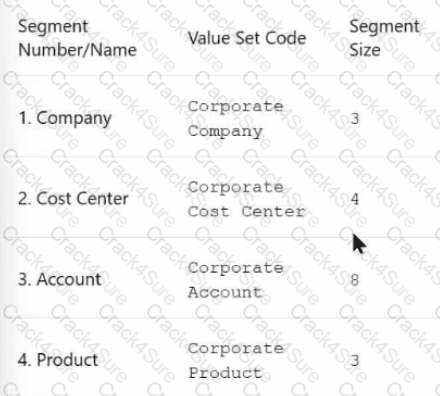
Note:
. Prefix your alias name with 07, where 07 is
your exam ID.
. There is no Product or Intercompany
impact.
Task3
Manage Chart of Accounts Mappings
Scenario
Your client needs to consolidate their UK Ledger to the Canadian parent ledger. Each Chart of Accounts
has the following segments:
Company-LoB-Account-Cost Center-Product-Intercompany
Know that the Company, LoB, Product, and Intercompany segments share the same value sets.
Create a Chart of Accounts mappings to map UK Chart of Accounts to CA Chart of Accounts that meets the following specifications:
Cost Center Mapping
. Balance Sheet (0 and 000) should be mapped to
Balance Sheet
. All other cost centers should be mapped to 610
Account Mapping
. Asset accounts (in the 1000 range) should be
mapped to account 11101
. Liability accounts (in the 2000 range) should be
mapped to account 22100
. Equity accounts (in the 3000 range) should be
mapped to account 34000
. Revenue accounts (in the 4000 range) should be
mapped to account 42000
. Expense accounts (from 5000 onwards) should be
mapped to account 51100
Note:
· Do not use conditions based on parents.
. Treat any account after the 5000 range as an expense.
· Ensure all maps are numeric only.
· When creating your mapping rules for each segment
please allow for existing and future segment values



TESTED 09 Oct 2026