Summer Special Sale - 70% Discount Offer - Ends in 0d 00h 00m 00s - Coupon code: spcl70

Practice Free 1z0-1054-26 Oracle Financials Cloud: General Ledger 2026 Implementation Professional Exam Questions Answers With Explanation

We at Crack4sure are committed to giving students who are preparing for the Oracle 1z0-1054-26 Exam the most current and reliable questions . To help people study, we've made some of our Oracle Financials Cloud: General Ledger 2026 Implementation Professional exam materials available for free to everyone. You can take the Free 1z0-1054-26 Practice Test as many times as you want. The answers to the practice questions are given, and each answer is explained.

Question # 6

On a primary ledger in the system options close section, the following field has been selected ' Prevent General Ledger Period Closure When Open Subledger Periods Exist ' .

For which three subledgers can you opt out of the period close checking feature by using the lookup ORA_GL_INCLD_STRICT_PRD_CLOSE? (Choose three.)

A.

Receipt accounting

B.

Receivables

C.

Revenue Management

D.

Assets

E.

Order Management

Question # 7

A subsidiary company is about to configure their General Ledger in a highly regulated country where there is a legal requirement to produce fiscal reports under local GAAP. Subledgers transferring to General Ledger must use the local currency, and there is a requirement to report to the parent company (not local currency) using International Financial Reporting Standards (IFRS).

Which two ledger types should be configured to fulfill this reporting requirement?

A.

Reporting currency with the local accounting convention

B.

Reporting currency with the IFRS accounting convention

C.

Secondary ledger with the IFRS accounting convention

D.

Primary ledger with the IFRS accounting convention

E.

Primary ledger with the local accounting convention

Question # 8

You are setting up Close Monitor for your organization. What is the key consideration when selecting the ledgers or ledger sets that form part of the Close Monitor hierarchy?

A.

The members of the Close Monitor hierarchy must share a common Chart of Accounts and calendar.

B.

The members of the Close Monitor hierarchy must all be primary ledgers or secondary ledgers.

C.

The members of the Close Monitor hierarchy must all share the same accounting convention.

Question # 9

The intercompany accountants on the cloud project are trying to reconcile intercompany balances using the latest intercompany reconciliation report.

However, they have some concerns about the information presented in the report and want you to clarify the content in the standard reconciliation report.

What is included in the intercompany reconciliation report?

A.

It displays ledger balancing lines generated when the primary balancing segment (BSV) is in balance but not the second or third BSVs.

B.

It displays all clearing company balances for the period.

C.

It displays the intercompany receivables and intercompany payables lines generated for the provider and receiver of each intercompany transaction.

Question # 10

Which two allow access to the BI Catalog for creating an Oracle Transactional Business Intelligence analysis? (Choose two.)

A.

Universal Content Management Workspace

B.

Reports and Analytics

C.

Business Process Management Workspace

D.

Enterprise Performance Management Workspace

E.

Scheduled Processes

Question # 11

A new Oracle Fusion Cloud client needs to produce an income statement on a regular basis using Smart View. Which Smart View tool would be best for this?

A.

Smart Slices

B.

Smart Queries

C.

Account Groups

D.

Query Designer

Question # 12

After user acceptance testing of the new Oracle Fusion Cloud system, the company ' s accountants report that they want to be notified of anomalies in certain account balances in real time. The anomalies should include an increase or decrease that is above or below a percentage amount threshold.

What is the best way to meet this requirement?

A.

Use Account Inspector.

B.

Perform an account analysis online.

C.

Create an Account Group using Account Monitor.

D.

Open a Smart View file saved on your desktop.

Question # 13

TheDelete Translated Balancesprocess provides the ability to completely reset translations in the event thatsignificant changesare made to the accounting configuration.

Once the deletion process completes, what additional process must you run?

A.

Submit the Create Scenario Dimension Members process to ensure that the balances cube maintains translated balances that are consistent with future translations.

B.

Submit the Update General Ledger Balances Cube process to ensure that the balances cube maintains translated balances that are consistent with future translations.

C.

Submit the Create General Ledger Balances Cube process to ensure that the balances cube maintains translated balances that are consistent with future translations.

D.

Submit the Create Currency Dimension Members process to ensure that the balances cube maintains translated balances that are consistent with future translations.

Question # 14

You entered users who are bothemployees and contingent workers. You want an automated way toassign, reassign, and remove rolesfrom users. What feature do you use?

A.

Oracle Identity Manager Roles Assignment

B.

Access Policy Manager ' s Role Generation

C.

You cannot reassign contingent workers

D.

Role Mappings

E.

Data Roles

Question # 15

Your subsidiaries and your corporate ledger all have different Charts of Accounts and different calendars. Apart from that, the consolidation process is straightforward.

What consolidation option would you recommend?

A.

Balance Transfer Consolidation

B.

Oracle Hyperion Financial Management

C.

Reporting Currency

D.

Secondary Ledger

Question # 16

What are The two advantages of having an intercompany segment in the Chart of Accounts?

A.

Identifies partners in each intercompany line through balancing, by populating the intercompany segment with the trading partner.

B.

Assists reconciliation through balancing, by populating the intercompany payable and intercompany receivable accounts.

C.

Assists reconciling intercompany transactions and helps identify elimination entries.

D.

Enables balancing of many to-many primary balancing segment value journals and many to many legal entity journals

Question # 17

You are implementingFinancials Cloudand are usingspreadsheetsto loadLegal Entities, Business Units, and Account Hierarchies.

Which threesetup objectscan be loaded via aspreadsheetfromFunctional Setup Manager?

A.

Complete Accounting Configuration

B.

Suppliers and Customers

C.

Banks, Bank Accounts, and Branches

D.

Setup data for Receivables and Payables product.

E.

Chart of account values, accounting calendar, and ledger

Question # 18

You are creating a journal approval rule and need to assign the approval to multiple controllers in parallel.

Which assignee type should you use?

A.

Parallel

B.

Serial

C.

Single

D.

FYI

Question # 19

You are planning to use the Related Value Sets feature with your Chart of Accounts to create a dependency between the Company and Cost Center segments. For example, when using Company 101, the list of displayed cost centers should be in the range 100 to 199. When setting up your value sets, which validation type should you choose for the Cost Center segment?

A.

Dependent

B.

Subset

C.

Table

D.

Independent

Question # 20

In the implementation project, there is a requirement to add new transactional attributes to the journal approval notification.

Which two Business Intelligence catalog objects should you copy (or customize) and edit? (Choose two.)

A.

The layout Template

B.

Output type

C.

The Style Template

D.

The Sub Template

E.

The Data Model

Question # 21

You need to define a chart of accounts that includes an intercompany segment. Your customer plans to use segment value security rules for the Company segment.

What is Oracle ' s recommended method to define this chart of accounts?

A.

Define the intercompany segment with a default value.

B.

Share the same value set for the company and intercompany segments.

C.

Define the company segment and assign both the primary balancing segment and intercompany segment labels.

D.

Create two different value sets for the company and intercompany segments.

Question # 22

Your current Oracle Fusion Cloud implementation project includes the configuration of multiple ledgers per country and the setting up of accounting automation to drive journal processing efficiencies. In a particular country (which has a primary, secondary, and multiple reporting currency ledgers), there is a requirement to exclude the country ' s journal processing from accounting automation.

If you enter a ledger set (including all ledgers for that country) on the Exclusion tab of Manage Accounting Automation, what is removed from accounting automation processing?

A.

Just the primary ledger

B.

The secondary and reporting currency ledgers only

C.

The primary, secondary, and reporting currency ledgers

D.

The primary and reporting ledgers only

Question # 23

Manage Chart of Accounts Structure and Instance

Scenario

Your client is implementing Oracle Fusion Cloud Financials. The decision is to have a 5-segment Chart of Accounts: Company, Cost Center, Account, Product, and Intercompany. You are working in

the General Ledger team and will be responsible for creating the Chart of Accounts Structure and Instance for the Chart of Accounts.

Task 1

Create a Chart of Accounts Structure and Instance for the following Chart of Accounts:
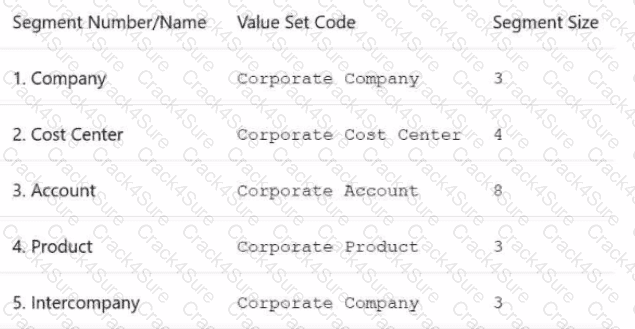
1z0-1054-26 question answer

Note:

· Prefix all your setups with 07, where 07 is your candidate ID

· There is one balancing segment.

· Choose the appropriate segment labels.

. For the purpose of this test there is no need to deploy the flexfield.

. Valid code combinations should be added to the Code Combination table automatically.

· Shorthand aliases will not be implemented.

. Accept the defaults for the instance segments.

Question # 24

Task 3

Manage Chart of Accounts Mappings

Scenario

Your client needs to consolidate their UK Ledger to the Canadian parent ledger. Each Chart of Accounts

has the following segments:

Company-LoB-Account-Cost Center-Product-Intercompany

Know that the Company, LoB, Product, and Intercompany segments share the same value sets.

Create a Chart of Accounts mappings to map UK Chart of Accounts to CA Chart of Accounts that meets the following specifications:

Cost Center Mapping

. Balance Sheet (0 and 000) should be mapped to

Balance Sheet

. All other cost centers should be mapped to 610

Account Mapping

. Asset accounts (in the 1000 range) should be

mapped to account 11101

. Liability accounts (in the 2000 range) should be

mapped to account 22100

. Equity accounts (in the 3000 range) should be

mapped to account 34000

. Revenue accounts (in the 4000 range) should be

mapped to account 42000

. Expense accounts (from 5000 onwards) should be

mapped to account 51100

Note:

· Do not use conditions based on parents.

. Treat any account after the 5000 range as an expense.

· Ensure all maps are numeric only.

· When creating your mapping rules for each segment

please allow for existing and future segment values

1z0-1054-26 PDF

$33

$109.99

3 Months Free Update

  • Printable Format
  • Value of Money
  • 100% Pass Assurance
  • Verified Answers
  • Researched by Industry Experts
  • Based on Real Exams Scenarios
  • 100% Real Questions

1z0-1054-26 PDF + Testing Engine

$52.8

$175.99

3 Months Free Update

  • Exam Name: Oracle Financials Cloud: General Ledger 2026 Implementation Professional
  • Last Update: Jul 4, 2026
  • Questions and Answers: 143
  • Free Real Questions Demo
  • Recommended by Industry Experts
  • Best Economical Package
  • Immediate Access

1z0-1054-26 Engine

$39.6

$131.99

3 Months Free Update

  • Best Testing Engine
  • One Click installation
  • Recommended by Teachers
  • Easy to use
  • 3 Modes of Learning
  • State of Art Technology
  • 100% Real Questions included