Crack4sure Logo

We at Crack4sure are committed to giving students who are preparing for the VMware 3V0-23.25 Exam the most current and reliable questions . To help people study, we've made some of our Advanced VMware Cloud Foundation 9.0 Storage exam materials available for free to everyone. You can take the Free 3V0-23.25 Practice Test as many times as you want. The answers to the practice questions are given, and each answer is explained.
An administrator is working on a VMware Cloud Foundation (VCF) Workload Domain that was configured to use vSAN for principal storage. The administrator wishes to create and configure a datastore cluster to host tenant VMs using that vSAN backed storage across multiple clusters, mixed OSA and ESA, in the domain.
What should the administrator consider?
An administrator is tasked with deploying a VMware Cloud Foundation (VCF) Workload Domain that meets the following requirements:
• vSAN ESA as principal storage
• RAID-6 with FTT=2
• Support for Storage Traffic Separation
The administrator is provided the following hardware to perform the task:
• Four ESX hosts, each host contains:
24 CPU cores
96 GB memory
Two 25GbE network NICs
12 NVMe devices 4 TB each, connected to a single SATA/SAS/NVMe Tri-mode controller What four changes must the administrator make to the hardware before deploying the new Workload Domain? (Choose four.)
An administrator has deployed a three-host vSphere cluster with a small amount of VMFS storage and wants to add additional capacity from a vSAN ESA cluster located in the same vCenter Server.
When the administrator selects the vSphere cluster and navigates to the Configure tab, the Datastore Management option is missing under the vSAN section.
What prerequisite must be met before the administrator can mount the remote datastore?
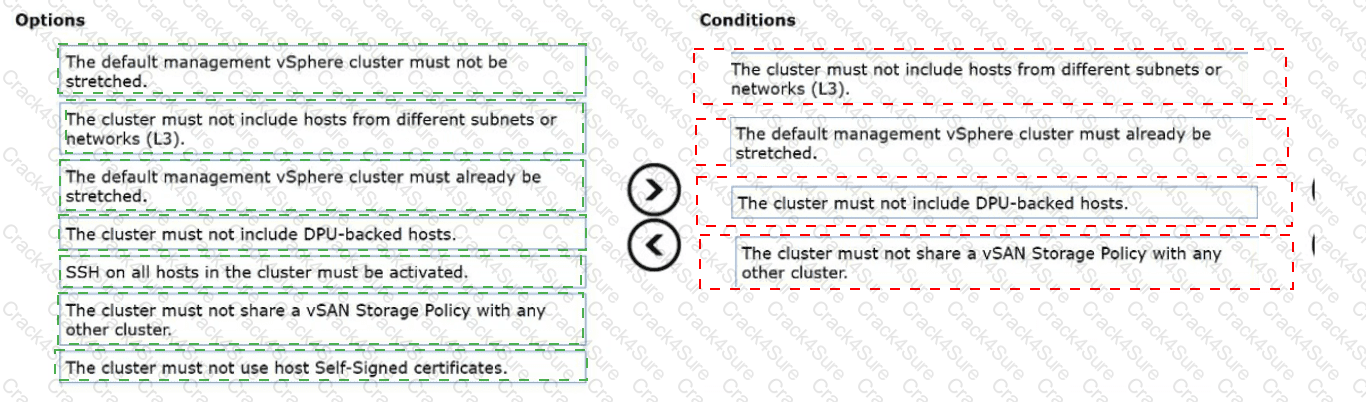
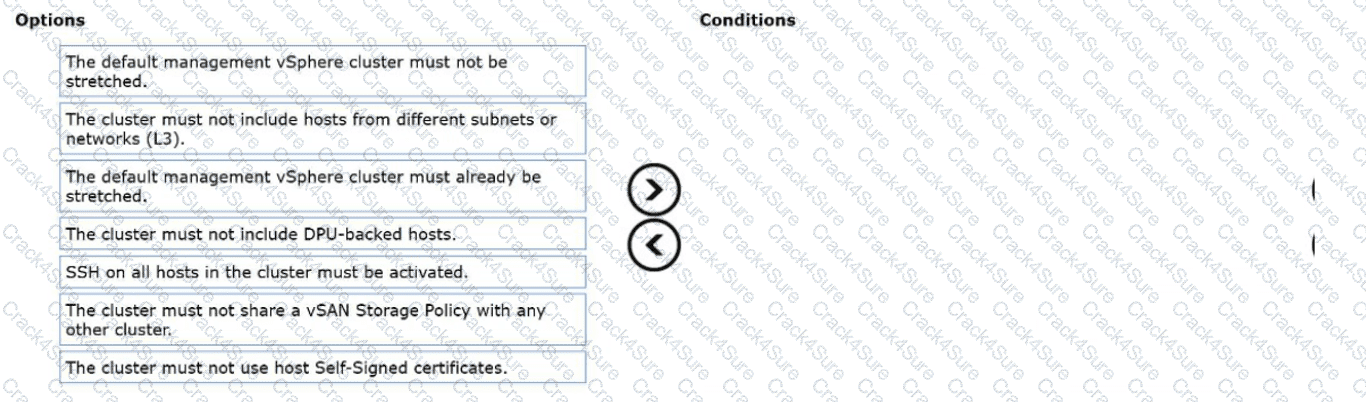
An administrator is tasked with stretching a vSAN cluster in a VMware Cloud Foundation (VCF) Workload Domain across two availability zones within a region. Both availability zones contain an equal number of hosts.
What four Conditions must also be met in order to stretch the cluster?
Drag and drop the four correct options from the Options list on the left and place them into the Conditions on the right in any order. (Choose four.)
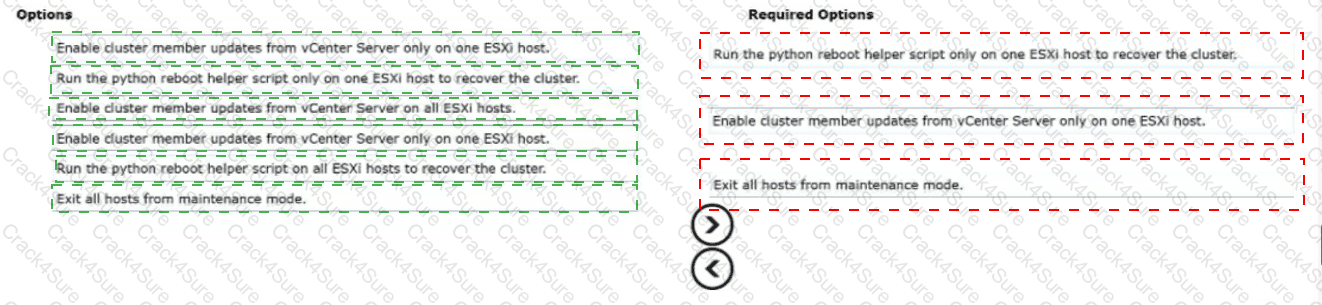
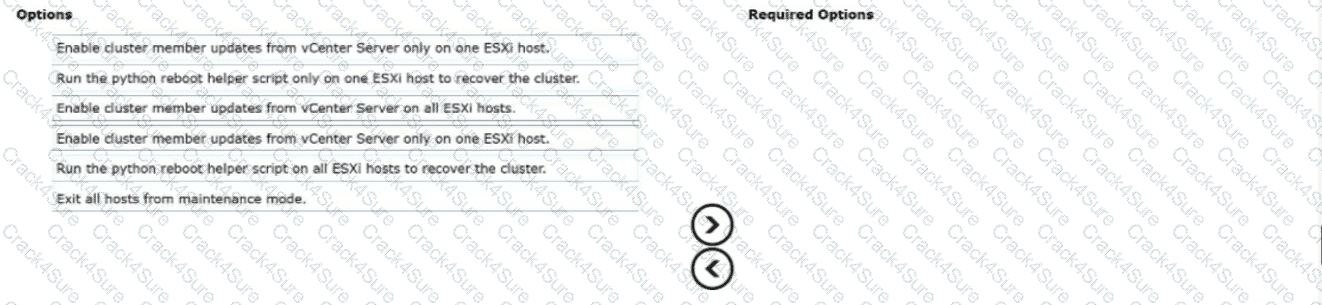
After a planned power outage, an administrator decided to restart the vSAN cluster manually.
Drag and drop the three correct options from the Options list on the left and place them into the Required Options on the right in any order. (Choose three.)
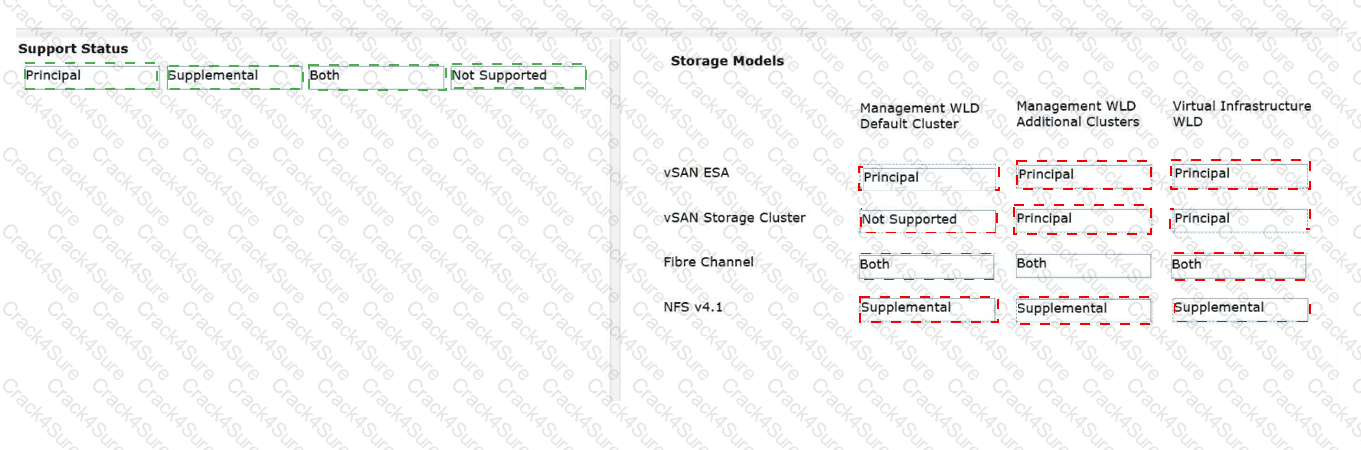
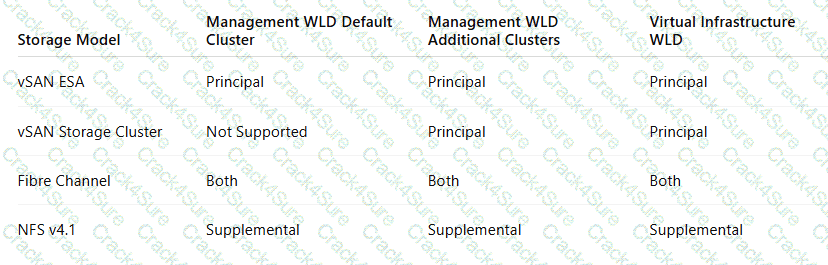
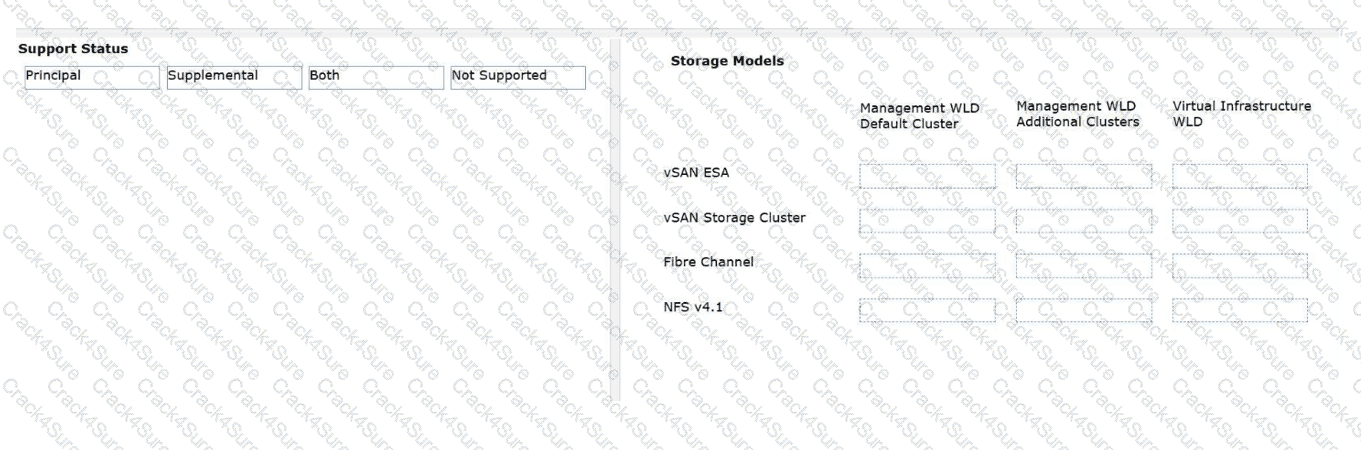
An architect is describing the for a client which storage platforms are supported in which types of Domains for automated installation in VMware Cloud Foundation (VCF) Private Clouds.
Drag and drop the Support Status of each storage model on the left to each type of Workload Domain on the right.
An administrator is managing a stretched vSAN ESA cluster where each site has three hosts.
The following parameters apply to the storage policy being configured at the datastore level:
• The policy is configured at the datastore level
• Site disaster tolerance = Site mirroring - stretched cluster
• Failures to tolerate = 1 failure - RAID-1 (mirroring)
• Number of disk stripes = 1
When inspecting some of the Virtual Machines (VMs), why do objects have 3 disk stripes?
An administrator is tasked with designing a highly available vSAN ESA two-node cluster for a remote VMware Cloud Foundation (VCF) workload domain. The solution should be able to survive the failure of any disk group in addition to a host failure without data loss.
What is the minimum total number of nested fault domains required for the design?
A vSAN ESA solution is configured using the following requirements:
• Seven ESX Hosts, each host contains:
32 CPU
256 GB memory
25 GbE network
12 storage devices 4 TB each
One storage pool using the 12 storage devices • RAID-6 with FTT=2 If a storage device on a single host fails, what percentage of that host’s capacity is impacted?
As part of standard operating procedures, when an administrator leaves the organization, a shallow rekey operation must be performed on a vSAN ESA cluster with vSAN Data-at-Rest Encryption enabled.
Which key is rotated during a shallow rekey operation?
An administrator is tasked with setting up immutable snapshots for recovery in case of a cyber-attack.
Which two limitations apply when configuring immutable snapshots? (Choose two.)
A financial organization successfully deployed a new Workload Domain in VMware Cloud Foundation (VCF) using NFS storage. All ESX hosts are commissioned and connected to the same storage network. The system administrator is tasked to configure a new NFS datastore in the existing cluster.
Which two steps are correct? (Choose two.)
vSAN encounters a noncompliant Virtual Machine and is able to locate a full replica of 55% of the votes for the noncompliant objects.
What action will vSAN do with the Virtual Machine?
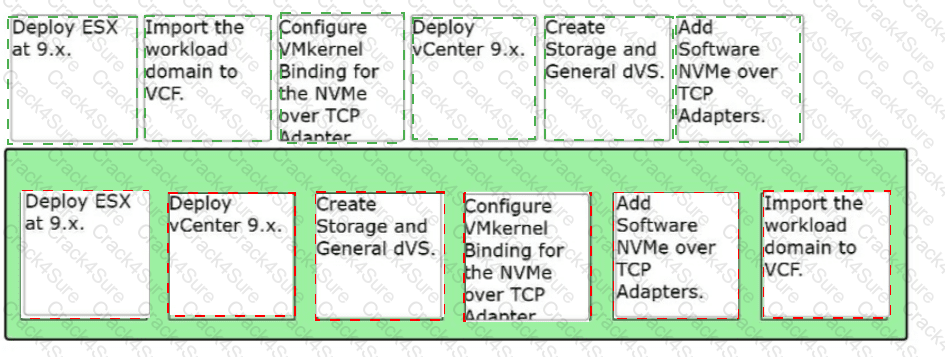
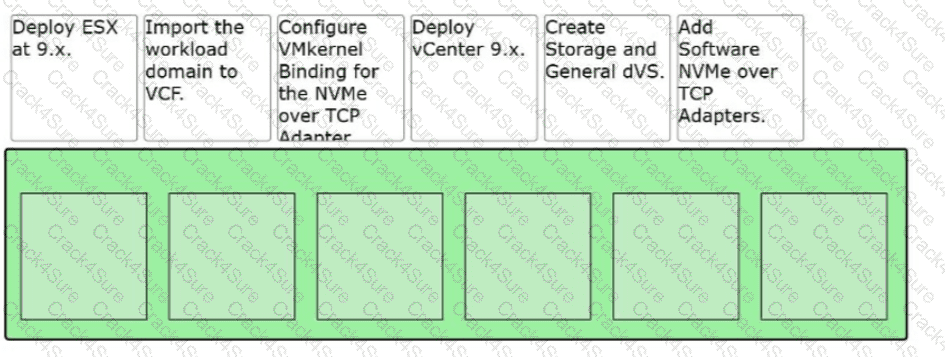
A VMware Cloud Foundation (VCF) Workload Domain is requested to be deployed with the following information:
. 6 blade style hosts with no local storage beyond the operating system.
. 4 25 Gb networking cards installed in each host.
. A 30 TB external array configured to support NVMe/TCP only.
. 2 dVS switches, one configured for storage isolation and one for all other traffic.
. NVMe/TCP multi-path configuration required.
. Existing Management Domain is deployed with VCF.
Place the steps for importing VCF on to this configuration.
An administrator attempts to enable vSAN Data-at-Rest Encryption on a cluster but receives the following error message:
“Key provider < vSphere Native Key Provider > is not available on host.”
The administrator configured the vSphere Native Key Provider (NKP) using the default settings.
What should the administrator validate before enabling vSAN Data-at-Rest Encryption?
An administrator is monitoring a vSAN ESA backed workload domain that is dedicated for running AI inferencing. When the administrator navigates to the Storage Performance dashboard in VMware Cloud Foundation Operations, the performance dashboard shows:
• High backend write latency ( > 8 ms)
• Low read latency ( < 1 ms)
• Normal network throughput
• Disk Group Health = Green
Based on the readings above, what would be the explanation?
An administrator has been tasked with deploying vSAN Data Protection in a VMware Cloud Foundation (VCF) Workload Domain. The administrator deploys the VMware Live Recovery OVA and logs into the management interface to start the Configure Appliance process, but the appliance fails to register with vCenter.
What are two possible causes the administrator can check to resolve the issue? (Choose two.)
An architect is designing a vSAN Original Storage Architecture (OSA) cluster for a VMware Cloud Foundation (VCF) Management Domain. The following details were made available:
• 12 hosts, each host with: 3 x 800 GB NVMe (cache) and 12 x 3.84 TB SAS SSD (capacity).
• Planned configuration: 3 disk groups per host (1 NVMe + 4 SSD each).
• Storage policy: FTT = 2 (RAID-1), Checksum. Deduplication and Compression are Enabled.
• Network: 25 GbE dedicated vSAN network fabric, properly configured for jumbo frames.
After deployment and loading test data to 70% capacity, the operations team reported extended resync times when two hosts are placed into maintenance mode with “Ensure Accessibility” selected and no hardware or network bottlenecks were detected.
How can the administrator explain the observed behavior?
3 Months Free Update
3 Months Free Update
3 Months Free Update



TESTED 06 Oct 2026