Crack4sure Logo

We at Crack4sure are committed to giving students who are preparing for the dbt Labs dbt-Analytics-Engineering Exam the most current and reliable questions . To help people study, we've made some of our dbt Analytics Engineering Certification Exam exam materials available for free to everyone. You can take the Free dbt-Analytics-Engineering Practice Test as many times as you want. The answers to the practice questions are given, and each answer is explained.
Given this dbt_project.yml:
name: "jaffle_shop"
version: "1.0.0"
config-version: 2
profile: "snowflake"
model-paths: ["models"]
macro-paths: ["macros"]
snapshot-paths: ["snapshots"]
target-path: "target"
clean-targets:
- "logs"
- "target"
- "dbt_modules"
- "dbt_packages"
models:
jaffle_shop:
orders:
materialized: table
When executing a dbt run your models build as views instead of tables:
19:36:14 Found 1 model, 0 tests, 0 snapshots, 0 analyses, 179 macros, 0 operations, 0 seed files, 0 sources, 0 exposures, 0 metrics
19:36:16 Concurrency: 1 threads (target='default')
19:36:17 Finished running 1 view model in 3.35s.
19:36:17 Completed successfully
19:36:17 Done. PASS=1 WARN=0 ERROR=0 SKIP=0 TOTAL=1
Which could be a root cause of why the model was not materialized as a table?
The target-path is incorrectly configured.
32. You are creating a fct_tasks model with this CTE:
with tasks as (
select * from {{ ref('stg_tasks') }}
)
You receive this compilation error in dbt:
Compilation Error in model fct_tasks (models/marts/fct_tasks.sql)
Model 'model.dbt_project.fct_tasks' (models/marts/fct_tasks.sql) depends on a node named 'stg_tasks' which was not found
Which is correct? Choose 1 option.
Options:
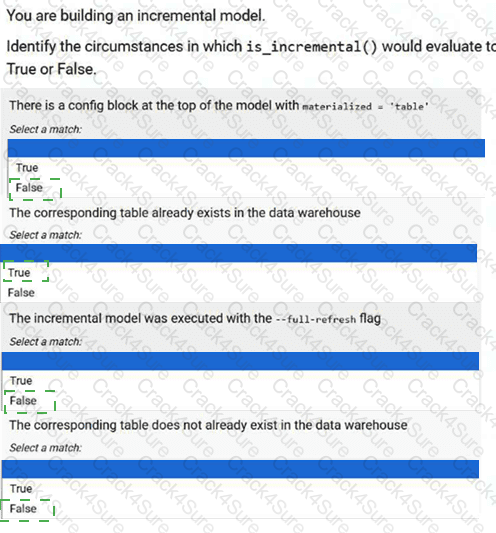
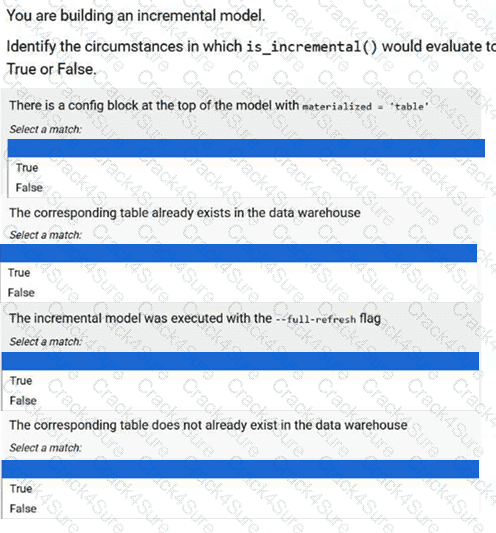
You are building an incremental model.
Identify the circumstances in which is_incremental() would evaluate to True or False.
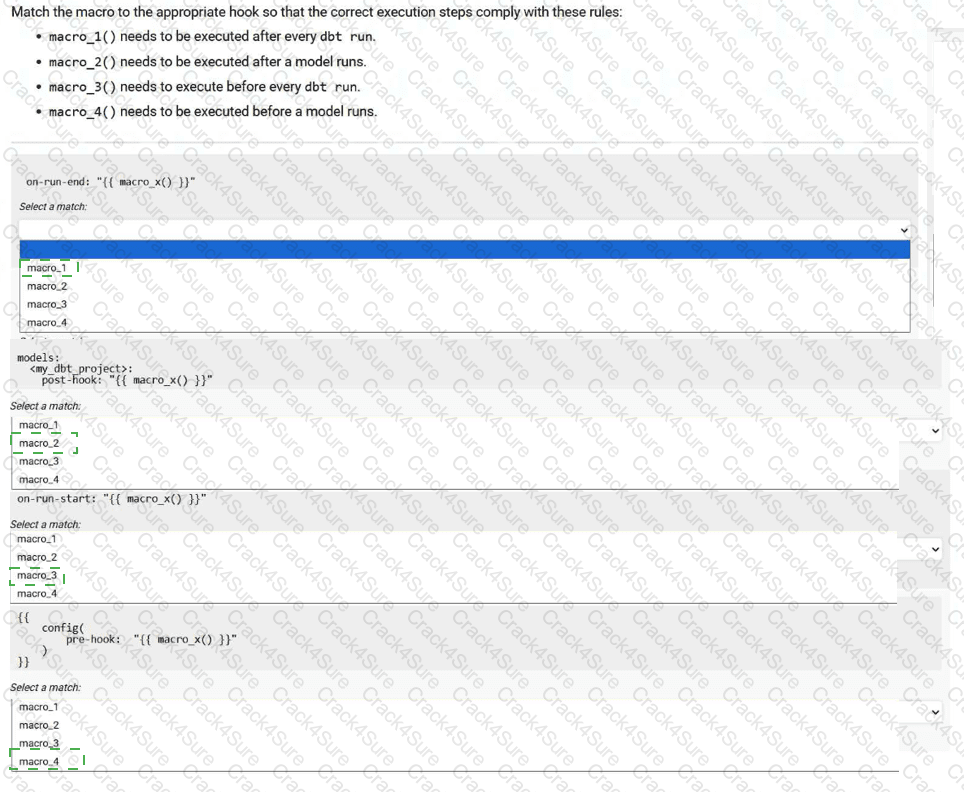
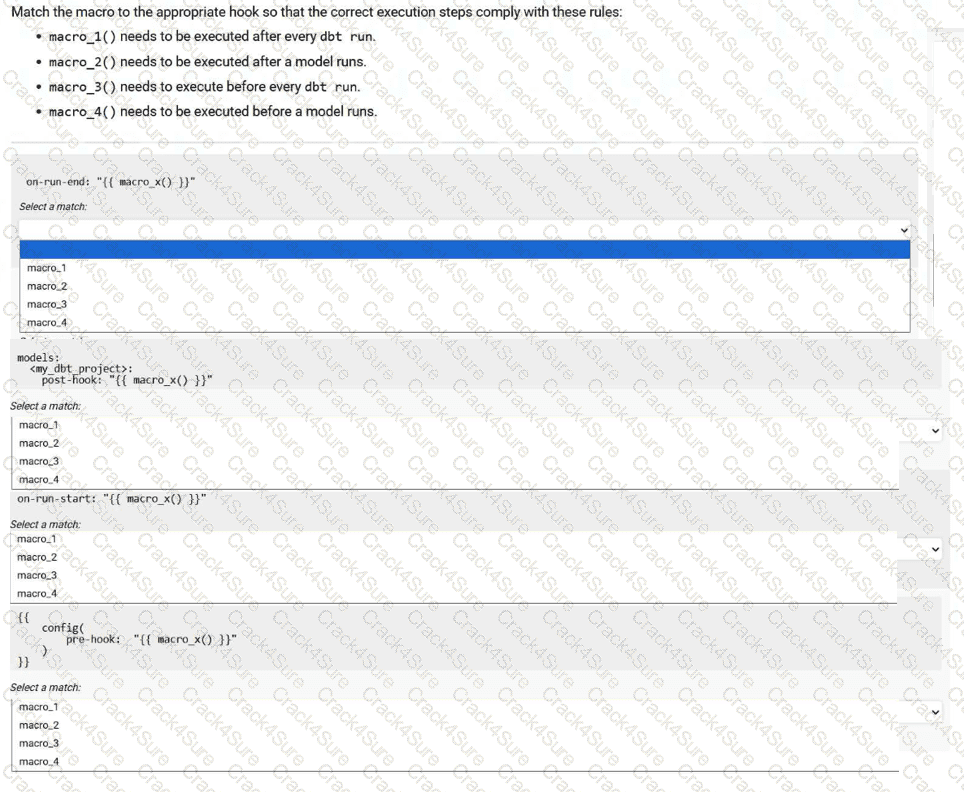
Match the macro to the appropriate hook so that the correct execution steps comply with these rules:
macro_1() needs to be executed after every dbt run.
macro_2() needs to be executed after a model runs.
macro_3() needs to execute before every dbt run.
macro_4() needs to be executed before a model runs.
13. An analyst on your team has informed you that the business logic creating the is_active column of your stg_users model is incorrect.
You update the column logic to:
case
when state = 'Active'
then true
else false
end as is_active
Which test can you add on the state column to support your expectations of the source data? Choose 1 option.
Which command materializes my_model and only its first-degree parent model(s) in the data platform?
Choose 1 option.
You work at an e-commerce company and a vendor provides their inventory data via CSV file uploads to an S3 bucket.
How do you prep the data for dbt transformations?
Choose 1 option.
Which of the following is true about restricting the usage of models in dbt?
Choose 1 option.
Which two dbt commands work with dbt retry?
Choose 2 options.
You have written this new agg_completed_tasks dbt model:
with tasks as (
select * from {{ ref('stg_tasks') }}
)
select
user_id,
{% for task in tasks %}
sum(
case
when task_name = '{{ task }}' and state = 'completed'
then 1
else 0
end
) as {{ task }}_completed
{% endfor %}
from tasks
group by 1
The dbt model compiles to:
with tasks as (
select * from analytics.dbt_user.stg_tasks
)
select
user_id,
from tasks
group by 1
The case when statement did not populate in the compiled SQL. Why?
Consider this DAG:
app_data.detail_categories -> stg_detail_categories -> skills_with_details
app_data.details -> stg_details -> lessons_with_details
What will support making this DAG more modular? Choose 1 option.
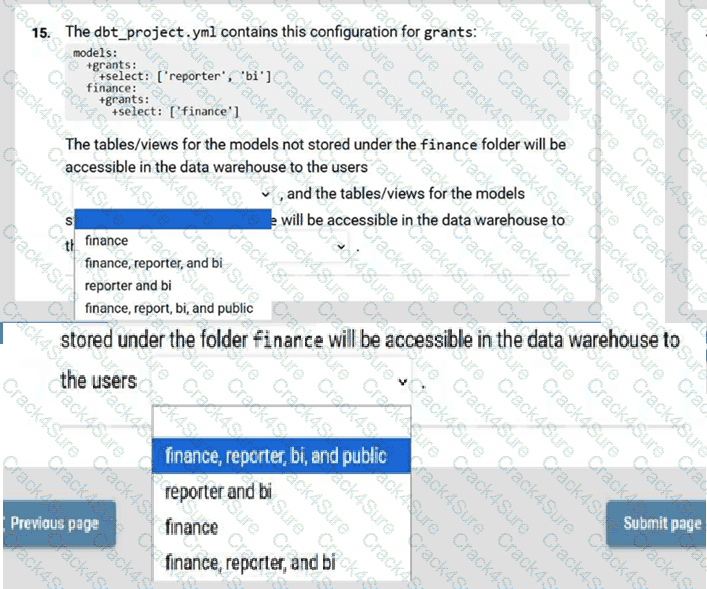
Which two configuration items can be defined under models: in your dbt_project.yml file?
Choose 2 options.
3 Months Free Update
3 Months Free Update
3 Months Free Update



TESTED 24 Sep 2026