Pre-Summer Special Sale - 70% Discount Offer - Ends in 0d 00h 00m 00s - Coupon code: spcl70

Practice Free PMI-ACP PMI Agile Certified Practitioner (PMI-ACP) Exam Questions Answers With Explanation

We at Crack4sure are committed to giving students who are preparing for the PMI PMI-ACP Exam the most current and reliable questions . To help people study, we've made some of our PMI Agile Certified Practitioner (PMI-ACP) exam materials available for free to everyone. You can take the Free PMI-ACP Practice Test as many times as you want. The answers to the practice questions are given, and each answer is explained.

Question # 6

A product owner with experience in a predictive approach wants the team to develop very detailed schedules and cost estimates for the next 10 sprints. What should the Scrum Master do?

A.

Suggest the product owner start by focusing on the next 2 sprints instead of 10.

B.

Spend the first few sprints to develop detailed schedules and budgets.

C.

Invite the product owner to the retrospective to explain the team ' s approach to schedule and budget.

D.

Explain that detailed project schedules and budgets are not artifacts in agile projects.

Question # 7

What should the team do?

A.

Plan for overtime, and include the effort as part of the estimation.

B.

Increase team velocity to deliver more story points.

C.

Identify the reason for over-commitment to the sprint and create an action plan for the following sprint.

D.

Add resources to assist with sprint execution.

Question # 8

What should the team do to effectively manage this?

A.

Rework the iteration scope to accommodate these requirements.

B.

Add these requirements into the product backlog for future consideration.

C.

Raise the discovery of these requirements as an issue, and escalate to management.

D.

Immediately start working on these requirements.

Question # 9

The coach on a new agile team notices that one team member is influencing most of the team ' s decisions. What should the coach do?

A.

Replace the team member with a more collaborative individual.

B.

Permit the team member to continue influencing because agile teams are self-organizing.

C.

Ask probing questions to other team members to encourage dissenting viewpoints.

D.

Intervene if the team ' s velocity drops.

Question # 10

What should the agile practitioner do?

A.

Select and implement collaboration tools to augment team interactions

B.

Provide each geographical area with their own product owner and divide the work between the teams

C.

Increase the number of requirements documents and ensure they are clearly communicated

D.

After several sprints, calculate velocity based on primary team location and use secondary team as reserve

Question # 11
A.

Small user stories

B.

Simple acceptance criteria

C.

Lean features

D.

Lean backlogs

Question # 12

A senior manager has asked an agile team to ensure that the data for the burndown charts are updated in real-time. However, the team is not comfortable with this approach as they think this is not productive.

What should the scrum master do?

A.

Ask the product owner to manage and share the metrics with appropriate stakeholders.

B.

Meet with requestors to agree and align on reporting requirements.

C.

Deny the request and explain the team ' s stance to the stakeholders.

D.

Work with the team to create the metrics requested by the stakeholders.

Question # 13
A.

Networking

B.

Social awareness

C.

Communication

D.

Leadership

Question # 14

Iterations last between a couple of weeks to a couple of months, with a preference for the shorter time. What is the goal for each iteration?

A.

Complete the assigned tasks.

B.

Deliver working software frequently.

C.

Demonstrate the software to the customer.

D.

Provide a high-level timeline.

Question # 15

A development team is working on the implementation of a human resources (HR) solution. The team has decided to work together with different business units to deliver value early and often.

Which agile values are being practiced in this scenario?

A.

The importance of customer-centric product development practices over product-centric approaches.

B.

Deliver working software often with a preference for shorter timescales and changing requirements

C.

The belief that contributions and interactions are more important to success than processes and tools.

D.

The best architectures, requirements, and designs emerge from self-organizing teams.

Question # 16

What should the Scrum Master advise the team to do?

A.

Implement the story since the team is running behind schedule.

B.

Create a spike to finalize the story ' s technical approach.

C.

Transfer the story to a Scrum team experienced in solving similar problems.

D.

Ask the product owner to reduce the story ' s priority and wait until more technical details are available.

Question # 17

As part of the organizational change, all project teams within the digital channel’s portfolio have been directed to move from 3-week iterations to 2-week iterations. The development team is frustrated as they think there will not be enough time to test. The product owner does not like this change as it will increase the number of ceremonies.

Which two actions should the scrum master take? (Choose two.)

A.

Proactively engage the resource managers to lead the team and provide the required support.

B.

Request the enterprise coach and human resources support the team with the transition.

C.

Document the pros and cons and review with stakeholders to determine the dependencies.

D.

Protect the team from disruptions and seek an exemption for status quo.

E.

Assess the impacts of the change and brainstorm potential solutions.

Question # 18

A Product Owner concludes that the majority of a project ' s value can be delivered by completing only the first half of the prioritized backlog.

What should the Product Owner do next?
A.

Remove the second half of the backlog, and communicate their decision in the next backlog grooming meeting

B.

Reprioritize backlog items to future iterations

C.

Work with the team to deploy the first half of the backlog to ensure that value is realized

D.

Meet with project stakeholders to review the backlog and determine if the scope should be adjusted

Question # 19

PMI-ACP question answer

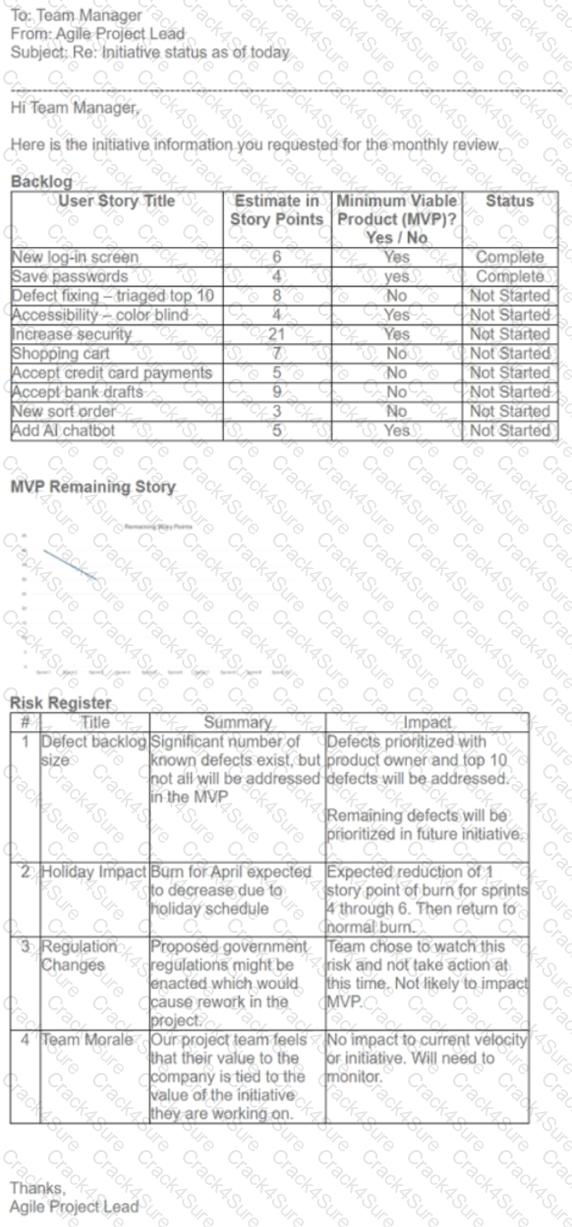
In a project to develop a supply-and-demand scenario planning tool, the team aims to streamline development and rapidly deliver features. Which approach best supports quick feature delivery while maintaining quality? (Refer to An Excerpt from the Quality Management Plan)

A.

Implementing a systematic approach to automate integration, testing, and deployment activities

B.

Increasing the frequency of stakeholder meetings to gather feedback on feature priorities

C.

Leveraging regular reviews, feedback loops, and lessons learned to adjust at key milestones

D.

Organizing training sessions for end users to ensure effective utilization of the planning tool

Question # 20

A diverse team can sometimes create misunderstandings and conflict, leading team members to isolate. How can an agile project manager promote effective communication and collaboration among team members with diverse backgrounds and perspectives?

A.

Reduce emotions by emphasizing areas of agreement rather than areas of difference.

B.

Create a shared vision for the team and use techniques to increase empathy and positive interaction.

C.

Coach the team to focus on areas of agreement and the company ' s profitability.

D.

Confront the team and follow the formal procedures as described in the project management plan.

Question # 21

During a backlog refinement meeting, a senior team member raises a concern about an epic sizing that requires the use of a new interface for a vendor product. The product owner acknowledges this as a risk. What should the product owner do now?

A.

Log the risk in the risk register, and share the information with impacted stakeholders at the next monthly review meeting.

B.

Create a spike story to determine what needs to be done to use the new interface.

C.

Lower the epic ' s priority so that it can be deferred, and analyze it during backlog refinement meetings.

D.

Move the work to the vendor, since they have better knowledge of interface implementation.

Question # 22

An agile coach has been hired to improve the performance and quality of developed software. The coach performed an analysis of the software and discovered an excessive number of escaped defects, leading to external failures.

How can the agile coach effectively address and correct defects in the software development process while maintaining predictability and keeping workloads within capacity?

A.

Work with the team to create explicit rules such as coding and quality standards and testing policies.

B.

Discipline the team members and institute status meetings with penalties for any future escaped defects.

C.

Hire more generalized specialists because the current team members cannot keep up with the pace.

D.

Apply work in process (WIP) limits so the developers are not pressured to release code that is problematic.

Question # 23

A project team member expresses frustration about the length of time it takes to make decisions for a complex project. Approvals need to happen at many levels in the company.

What should the team lead do to improve decision quality and reduce the time required to make decisions?

A.

Make sure the project owner is fully embedded into the project team so that they are readily available to make quick decisions.

B.

Establish collaborative behaviors among all members of the organization through a group decision-making process.

C.

Ensure all decisions are routed as quickly as possible to the project sponsor and have the rules of engagement visibly posted.

D.

Reduce the number of required approvals and expand the decision-control limits to the scrum master.

Question # 24

What should the project leader do?

A.

Assign the spike to another resource to continue research for the long-term solution

B.

Re-establish the spike; encourage experimentation and collaborate with the team

C.

Stop experimentation and negotiate the short-term solution with the customer

D.

Schedule a root-cause analysis with the development team on the main issues with the spike

Question # 25

In several recent agile team status meetings, there have been discussions about increases in costly bugs and late product deliveries, resulting in lower quality and higher costs. Team members feel they spend too much time in planning and process meetings, then feel rushed to complete their work.

How should the agile lead implement an effective and efficient solution?

A.

Review the quality assurance and control processes with the team to ensure that even new team members understand the service level agreement (SLA) made with the customer.

B.

Suggest the team commit to a 2-month trial using Kanban. Focus on delivering value to the customer using pull criteria before advancing work. The team will have planning meetings as needed with no special meetings about the process.

C.

Hire a consultant team to perform a root cause analysis, which will determine the fundamental issues from both perspectives, then meet with the team to determine the best method to get the project back on track.

D.

Work with the team to create a spike story for the next iteration to investigate the issue. Create a plan to get the project back on track and present it at the next status meeting to gain stakeholder acceptance.

Question # 26

What should the team have done to improve retrospective outcomes?

A.

Invited subject matter experts (SMEs)

B.

Conducted problem detection to determine root causes

C.

Measured and reported the outcome of improvement actions to the team

D.

Kept track of all current issues in a log and then reviewed their progress at the end of every iteration

Question # 27

The team is working to build a new Al model that will summarize and create presentation materials for executive leaders from external and internal content. The team believes there is value in increasing the scope of work as it will benefit the organization.

Which two actions should the product owner take first? (Choose two.)

A.

Determine the cost and resource requirements.

B.

Create a spike to determine the dependencies.

C.

Create a change request to formalize the requirements.

D.

Seek executive approval on the approach.

E.

Determine the purpose and value proposition on the approach.

Question # 28

What should the agile coach tell the team?

A.

Continuing to track velocity allows functional managers to assess whether or not the team is performing at the desired rate.

B.

The trends will show how the team performs against other Scrum teams in the organization.

C.

Tracking velocity will provide a baseline for the team to see how their continuous improvement efforts are working.

D.

Tracking velocity will document and communicate team health to the stakeholders.

Question # 29

An agile practitioner is working on a project to migrate data from computer systems to another location. To accomplish this task, they need to run four activities sequentially that different teams are performing. The teams are migrating two systems per day, but the agile practitioner thinks that three systems should be done per day.

What can be done to improve process efficiency?

A.

Use burndown charts to find gaps. delays, and constraints in the current process and develop a plan to reduce or remove them.

B.

Use value stream mapping to find gaps, delays, and constraints in the current process and develop a plan to reduce or remove them.

C.

Use Pareto analysis to find gaps, delays, and constraints in the current process and develop a plan to reduce or remove them.

D.

Use root cause analysis to find gaps, delays, and constraints in the current process and develop a plan to reduce or remove them.

Question # 30

An agile project team has team members with varying technical skills. Due to recent events that adversely impacted customer satisfaction, management mandated that Kaizen should be given more focus to ensure the quality in product delivery.

Kaizen is a prime concept of which agile practices?

A.

Standup meetings. Extreme Programming (XP), relative estimating

B.

Build quality in, visualize workflow, fail fast

C.

Standup meetings, retrospective meetings, continuous improvement

D.

Collaborate, regular builds, inspections

Question # 31

What should the project leader suggest?

A.

Develop and document a detailed architectural design; peer review with the development team and implement/test

B.

Develop the functional requirements of the solution first before any non-functional requirement, as they provide more customer value

C.

Discuss the integration requirement with the product owner and negotiate it to be lower on the backlog to focus on the minimal marketable feature

D.

Develop and test the implementation approach and demonstrate it at the next sprint review to collect feedback

Question # 32

A new project has been approved and is critical for an organization. The project sponsor has a limited budget, and the deadline to have all requirements meet the definition of done (DoD) is short.

Which approach should the agile practitioner take to facilitate the project ' s success?
A.

Set up weekly calls with the key stakeholders to participate in iteration reviews and release decisions.

B.

Analyze the impacts of these constraints on the project followed by a report sent to the sponsor to anticipate any risk of delays.

C.

Set up a meeting with the client to review the scope and timelines to manage expectations.

D.

Encourage the team to build increments and ensure the customer provides early feedback for a minimum viable product.

Question # 33
A.

Planning

B.

Daily Scrum

C.

Sprint Demo

D.

Retrospective

Question # 34

PMI-ACP question answer

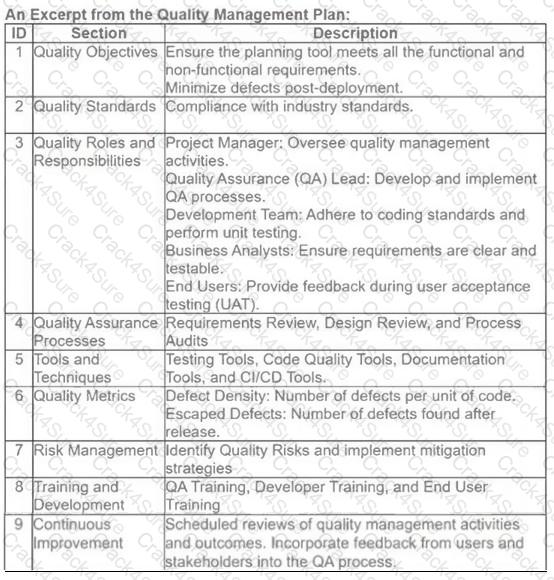
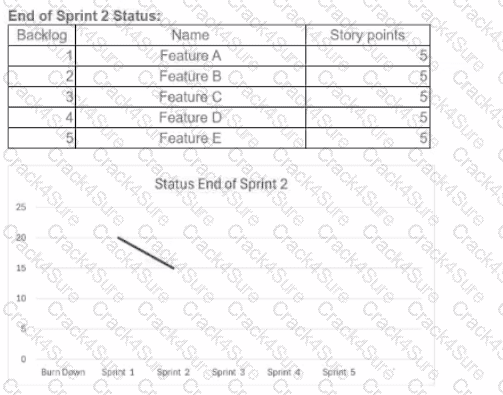
A project team ' s manager is responsible for delivering a specific initiative for the organization. They are preparing for a monthly meeting where the manager will present on the current state of this initiative. The agile project lead sends the manager the following email with the current initiative status (see Exhibit A).

How many sprints will be needed to complete the entire backlog?

A.

15

B.

16

C.

17

D.

18

Question # 35

What should the agile team do?

A.

Adhere to the new deadline and immediately advise the client that the schedule has been expedited.

B.

Advise the client that it is best to continue as planned rather than introduce unforeseen risks by expediting the schedule.

C.

Submit a change request to the client with a 50% increase in charges due to the new potential profit.

D.

Request additional resources to meet the expedited deadline and obtain training for the new resources.

Question # 36

What should the team have done to prevent this?

A.

Reprioritized requirements prior to committing to iteration work

B.

Ensured that requirements remained stable during the iteration cycle

C.

Had stakeholders focus on items created after the product backlog was initially built

D.

Worked on features rather than a set of components

Question # 37

A project team tasked with delivering a solution with extremely aggressive timelines is facing an issue with meeting their sprint velocity targets.

To address this issue and bring the project back on track, what action should the team take?

A.

Perform value stream analysis to eliminate the processes with wastage.

B.

Reevaluate the minimum viable product (MVP) deliverables to remove high-risk stories and meet timelines.

C.

Adjust the story points included in each sprint to represent the actual velocity.

D.

Include high-risk stories in earlier sprints to deliver incremental velocity.

Question # 38

A project team has a senior subject matter expert (SME) who is comfortable with data integration. The SME is not inclined to perform regression testing because the SME feels that performing regression testing is more of a junior duty.

What should the Scrum Master do?

A.

Explain to the SME the importance of being a team player, that the tasks are assigned by the Scrum Master, and work should not be refused.

B.

Acknowledge that the SME has a valid point from an efficiency point of view and will perform better staying as a specialist.

C.

Leverage a separate testing team altogether to assist with all testing to ensure consistent results.

D.

Explain to the team the importance of reducing team size by reducing specializations and bottlenecks and that every team member plays an equal part.

Question # 39

While planning, what prioritization factors need to be considered for a minimally marketable feature (MMF)?

A.

How much risk is needed to develop an MMF

B.

How much money the organization will earn or save by having the MMF

C.

How many stakeholders are influencing the MMF

D.

How much time does an organization need to develop an MMF

Question # 40

The project lead of an international team noticed that some members were hesitant to express their opinions and thoughts during the meetings. What should the project lead do to encourage the team to express themselves?

The project lead of an international team noticed that some members were hesitant to express their opinions and thoughts during the meetings. What should the project lead do to encourage the team to express themselves?

A.

Organize separate meetings with each individual team member.

B.

Create a safe environment for discussions during meetings.C Emphasize rules that need to be respected during meetings

C.

Allow team members to talk when they feel comfortable without any pressure.

Question # 41

A scrum team is working together virtually. One of the team members sends a daily email to the other team members listing impediments that they find. During retrospective meetings, the team member complains that their colleagues fail to take actions on the impediments.

How should the team address this issue?

A.

The team member that is complaining should talk individually with the scrum master to remove impediments.

B.

They should ask for more details about the impediments and then resolve them when the team has more time to investigate.

C.

The team member that is complaining should address the impediments in daily scrum, communicating them directly.

D.

Team members should state that they need to prioritize their work instead of responding to daily emails about impediments.

Question # 42

A graphic designer on an agile team does not attend most meetings. When asked the reason for not attending, the designer told the agile practitioner that the scrum master could represent them in meetings if needed. The team is frustrated and does not agree with this approach.

Which conflict resolution method would work best in this scenario?

A.

Avoidance

B.

Forcing

C.

Accommodation

D.

Collaborating

Question # 43

At an iteration review, the product owner indicated that the work delivered did not meet expectations. The project team is surprised.

How should this situation have been prevented?

A.

The team should have reviewed the definition of done prior to the iteration review.

B.

The testers should have ensured that test cases accurately reflected the product owner ' s expectations.

C.

The team should have conducted more demonstrations with the product owner during the iteration.

D.

The product owner should have provided clearer explanations during the planning meeting.

Question # 44

A software development team is working in an environment in which increased competition, demanding customer expectations, and new technological developments pose significant challenges.

How should the team plan improvements to their product?

A.

Follow the project schedule created at the start of the project.

B.

Hold regular retrospectives and have team members commit to specific actions.

C.

Allow team members to choose improvement items and trust their judgment.

D.

Encourage team members to write code that is tightly coupled together.

Question # 45

An Agile team has received several new features to be added to the product backlog. The team is struggling to provide a reasonable estimate for feature development due to a lack of experience.

How should an experienced Agile practitioner assist the team?

A.

Add a task to the product backlog to allow the team time to investigate and experiment prior to estimating.

B.

Add a task to the product backlog to allow the team to apply a wideband Delphi estimation technique.

C.

Add a task to the product backlog to allow the team to apply planning poker to estimate the effort.

D.

Add a task to the product backlog to allow the team to apply a three-point estimation technique.

Question # 46

An agile project manager is working on a project to develop a customer service website. The project manager is organizing a workshop to plan the next release: To add the feature of receiving and resolving customer complaints. Which two actions should the project manager ask the team members to take before the workshop? (Choose two.)

A.

Prepare an effort estimation for each story based on their technical expertise.

B.

Compile a list of ideas to improve the velocity of the team so they can plan more story points in the next sprint.

C.

Prepare a list of tasks required to accomplish the goal and the order in which they should be executed.

D.

Read and identify user stories from the backlog that will contribute to accomplishing the goal.

E.

Consider the possible risks of each selected user story and the value they add for the final user.

Question # 47

A manufacturing shop is using Kanban to plan, visualize workflow, and limit work in process (WIP). Which productivity key performance indicator (KPI) should the team lead be monitoring on a regular basis?

A.

Lead time

B.

Team velocity

C.

Burndown rate

D.

Earned value (EV)

Question # 48

Just before a scheduled product launch, the customer declined to accept the final deliverable after seeing the demo. What should the project manager do to prevent this in the future?

A.

Ensure the teams are working together daily throughout the product development and are keeping the team ' s progress up to date.

B.

Ensure there is an environment where team members feel comfortable sharing their ideas, concerns, and feedback.

C.

Ensure the customer is provided with regular project status updates and that the meeting minutes are well documented.

D.

Ensure the team is able to release new features and updates frequently so that customers can see the product and provide feedback.

Question # 49

An agile leader notices that a team member is becoming very quiet and disengaged in meetings. What should the agile leader do to identify team members ' personalities and motivators?

A.

Use the DISC framework with each team member.

B.

Use MoSCoW ratings to keep people engaged.

C.

Hire a SAFe coach to provide encouragement.

D.

Employ BDUF to help with providing structure to meetings.

Question # 50

An agile team had unexpected technical problems in a project and was not able to complete the deliverables on time. During the retrospective meeting, the team openly discussed the causes for these issues and what can be done to avoid similar situations in the future.

What agile values and principles did the team demonstrate?

A.

The team is being proactive by discussing how to better balance demands and capacity and make sure they have the right competencies.

B.

The team shows respect for one another by listening to everyone ' s opinions and valuing human interaction during face-to-face meetings.

C.

The team is providing one another with fast feedback to find those responsible for any mistakes so they can be avoided in the future.

D.

The team eliminates potential waste by discussing who should be responsible for future risk management by actively applying the pi an-do-check-act (PDCA) method.

Question # 51

What should the agile team do next?

A.

Ensure that the product owner reviews the acceptance criteria for delivered user stories.

B.

Augment the quality assurance and continuous integration processes for delivery.

C.

Approach the relevant developers and testers regarding quality issues in upcoming iterations.

D.

Ask the product owner to define the entire scope of delivery two to three iterations in advance.

Question # 52

Which agile practice would most significantly increase a team ' s velocity?

A.

Daily standups

B.

Iteration and release planning

C.

Training in areas of weakness

D.

Iteration

Question # 53

An organization is shifting to an agile delivery methodology. An agile project manager has been assigned to the transformation project.

What should the agile project manager do to ensure a high level of adoption?

A.

Focus on not just the " what, " but also the " how " of delivering projects.

B.

Ensure that there is buy-in from senior management to adopt agile.

C.

Identify strong product owners to ensure project teams are delivering value.

D.

Train the team on the fundamentals of the agile mindset and principles.

Question # 54

What agile tools can help the team address these issues?

A.

Information radiators and wireframes

B.

Information radiators and story maps

C.

Process flows and personas

D.

Personas and extreme characters

Question # 55

While reviewing the sprint burndown during a stand-up, the Scrum team identifies that they have fallen behind. Upon further discussion, they discover that some quality assurance (QA) team members were unable to use the new automation framework, which caused a bottleneck.

What should the Scrum team do?

A.

For upcoming sprints, have QA team members ensure that their respective skill sets are considered when accepting stories

B.

Have QA team members with the appropriate skill sets spend extra time to help the team succeed

C.

Ensure that QA team members who lack the appropriate skill sets sign up for training within the next few weeks

D.

Ask QA team members experienced with the new automation framework to cross-train the other QA members

Question # 56

What should the agile team lead do?

A.

Create a new team to deliver the dependencies, and bring team B under performance management.

B.

Conduct a vision-sharing session with the teams to communicate the project ' s overall goals.

C.

Swap team members from both teams so that deliveries are better supported.

D.

Discuss negotiating the delivery timelines with team A.

Question # 57

An agile lead is working on a project to build a new product that will bring substantial business value to a company. Company executives want to present the first release at an important industry fair the following month. The agile lead started the project the previous month, and the team planned the release to take 8 iterations. For the past 4 iterations, work has been performed as planned and on time. In the current iteration, however, one team member will be out for the remainder of the project. Without this team member, velocity would drop 30%.

What should the agile lead do to ensure the release will be on time for the fair?

A.

Reduce the scope of the release to meet the deadline.

B.

Deliver as many features as possible based on the new velocity.

C.

Extend the project timeline to accommodate the missing team member.

D.

Hire a new team member to replace the missing one.

Question # 58

What should the team do?

A.

Advise the product owner that the story will have to wait until the next sprint.

B.

Work extra hours to complete the story and satisfy the customer ' s requirements.

C.

Break down the story into smaller increments and negotiate other stories on the sprint backlog.

D.

Increase the length of the sprint to accommodate the story.

Question # 59

A development team and product owner disagree on a user story in the product backlog. What should the agile practitioner do?

A.

Have the development team follow the product owner ' s direction

B.

Openly challenge the product owner in an effort to poke holes in their approach

C.

Facilitate a conversation about the user story between the development team and the product owner

D.

Serve as a nonpartisan evaluator of each option, and provide direction to the development team and product owner

Question # 60

An executive sponsor asks a team when a specific feature will be ready for release. A team member states the feature will be ready by the end of release 3 because it is not a core feature. The team member directs the sponsor to an information radiator, where the sponsor sees several notes grouped by release numbers and posted on the wall.

What is the sponsor looking at?

A.

Project management plan

B.

Product backlog

C.

Gantt chart

D.

Product roadmap

Question # 61

An agile facilitator is helping a team. The team is taking too long in each daily coordination meeting, and the facilitator is beginning to view the time as unproductive.

What should the agile facilitator do to help the team?

A.

Reduce the number of participants in the daily coordination meeting so only one representative for each user story or area of expertise can participate each day.

B.

Change the structure of the daily coordination meetings so team members only comment on the blockers they face during the day.

C.

Let team members decide how to execute the meeting because they are self-organized and should know what works for them.

D.

Pay attention to the comments of each team member during the meeting and intervene every time they deviate from the objective of the meeting.

Question # 62
A.

The increase in velocity and cost

B.

A buffer in the sprint to mitigate unexpected risks

C.

Assigning extra points to each task to allow time for changes

D.

Stories describing infrastructure tasks and analysis tasks

Question # 63

A team worked with a customer to estimate all user stories for the must have features. During release planning sessions, the customer indicated they prefer 3-week iterations that begin on Thursdays and end on Wednesdays. The team spent several days determining which stories should be developed for iteration 0 and understanding the customer’s priorities for the remaining stories. The project sponsor attends the Friday meeting and requests a high-level estimate of when they can invite the chief executive officer (CEO) to a demonstration of the minimum viable product (MVP).

What should the team tell the sponsor at this point in the planning process?

A.

They do not have enough information to estimate a date range yet but can provide the number of 3-week iterations required.

B.

They can provide an anticipated date with the assumption that conditions will be ideal.

C.

They can provide a broad range but cannot realistically set a target release date until the team ' s velocity stabilizes.

D.

They will send an update when all of the stories are estimated and prioritized in the backlog.

Question # 64

An organization wants to execute a corporate website redesign project using Scrum. There is an experienced pool of agile team members from a previous project, as well as a pool of available internal team members with some Scrum background.

What should be considered when selecting the team?

A.

Review any reports of conflict between each of the team members over the last two years, and select only those with a track record of working well together.

B.

Ensure there is a balanced mix of people who are experts and members with broad experience based on the work to be performed and determine training needs.

C.

Ensure that none of the team members are geographically dispersed so that all team members can be colocated.

D.

Review each team member ' s contributions to the velocity of their previous projects and select the highest performers.

Question # 65

A customer has difficulty explaining how the highest priority feature will work. What should the agile project manager do?

A.

Create a time-boxed spike story to reduce the technical risk of the feature.

B.

Commence an iteration 0 for the customer and the team to investigate the feature.

C.

Facilitate the decomposition of the feature epic into more manageable user stories.

D.

Facilitate a just-in-time exploration of the functionality by the customer and the team.

Question # 66

What should the agile practitioner do?

A.

Ask the opinion of key stakeholders and the client to ensure the correct approach is being used

B.

Work with the team to use this approach and request a quality assurance iteration after every three iterations

C.

Propose to completely eliminate test automation, since this is a quality assurance function

D.

Suggest merging the quality assurance and delivery teams to enhance each iteration ' s test-automation levels and reduce redundancy

Question # 67

When working on a new product, what should an agile team do to ensure alignment with external stakeholders?

A.

Hold a kick-off meeting to assign roles.

B.

Review the project vision statement.

C.

Ask the product owner for a detailed product-specification document.

D.

Work with the Scrum Master to ensure that agile principles are followed.

Question # 68

One of the main stakeholders of a project is new to Scrum. The stakeholder asks what to expect in the sprint retrospective.

How should the product owner respond?

A.

Stakeholders have the opportunity to add features to the sprint.

B.

Team members determine if there are any impediments preventing them from meeting the sprint goal.

C.

The product owner explains which product backlog items have been done and which have not.

D.

Team members identify ways to improve and make plans to implement these improvements.

Question # 69

A client needs to release their product to market earlier than planned. They need to start receiving the expected revenue, according to their financial forecast, which will require completing the work left on all user stories in the backlog.

What should the project lead do to accommodate this request?

A.

Review the burn up chart to make predictions of how many iterations left are required to complete user stories left and make required adjustments to finish earlier.

B.

Review the burn down chart to make predictions of how many iterations left are required to complete user stories left and make required adjustments to finish earlier.

C.

Ensure the team focus on completing the current items in the backlog and do not accept any request for changes.

D.

Work with the product owner to launch a minimum viable product (MVP) and focus on completing only this portion of work by the new deadline.

Question # 70

How should this be handled?

A.

The story should be assigned eight story points as per the majority vote

B.

The story should be added to the backlog and reassessed later

C.

The story should be assigned points after a discussion with the fifth team member to see if a consensus can be reached

D.

The decision for the number of story points should be made by the customer

Question # 71

During sprint planning, the product owner wants the team to prioritize and deliver a number of features that have the highest business value. Due to technical dependencies, the team does not agree with the prioritization.

What should the project leader do?

A.

Encourage the product owner and team to reprioritize the features and select ones which can be delivered without any dependencies

B.

Encourage the team to continue with the current plan, do what they can, and carry forward the work not done to the next iteration

C.

Ensure the team captures the technical dependencies as issues within the backlog and prioritize based on value optimization

D.

Ensure that the required subject matter experts (SMEs) are engaged by the product owner to help with backlog prioritization

Question # 72

What should the agile practitioner do?

A.

Review established ground rules with the team

B.

Ask team members specific questions to identify the cause

C.

Encourage the team to continue working to maintain the iteration ' s schedule

D.

Meet with the product owner and stakeholders to discuss the issue

Question # 73

Midway through a sprint, the Scrum Master identifies that reassigning a certain task could help the team meet its sprint goals.

What should the Scrum Master do next?

A.

Alert the team that sprint goals might not be met and create an alternative plan

B.

Obtain team buy-in to perform modifications to the sprint backlog

C.

Have the sprint proceed as planned

D.

Ask the team to decide if the task should be reassigned

Question # 74

An agile team lead noticed their team’s velocity was slowing down. They did not deliver a working software during the last iteration and there have been miscommunications between team members.

What should the agile team lead do at the end of this iteration?

A.

Focus on performance in the retrospective, then present performance indices and validate with the team.

B.

Start using feedback loops in every sprint to reevaluate project and team performance.C Emphasize business requirements and investigate the pair-programming approach

C.

Run a spike at the end of the sprint to investigate the issue and reduce project risk.

Question # 75

What should the agile practitioner do?

A.

Regularly circulate an updated, detailed version of the project plan

B.

Frequently update the online project management office (PMO) repository site

C.

Invite the stakeholders to daily stand-ups

D.

Post a project board in an area where all can view it

Question # 76

While struggling to take ownership of delivery, an agile team fails to keep up with its sprint commitments.

What should the agile coach do?

A.

Work with the sponsor to develop team expectations

B.

Provide the customer with a list of deliverables and obtain agreement

C.

Encourage the team to more frequently interact with all stakeholders

D.

Work on finishing upfront product design rather than comprehensive documentation

Question # 77

During a review close to a product release, the customer spotted several features that will need to be changed. What caused this to happen?

A.

Reduced or improper customer collaboration.

B.

Reduced or improper product knowledge by the development team.

C.

Reduced or improper release planning.

D.

Reduced or improper product specification.

Question # 78

A team retrospective was going well until the team lead introduced the " define the next experiment " topic; then the discussion became an argument. A new team member feels strongly that the approach used on their previous team would improve this team ' s efficiency and effectiveness. The team lead is adamant that they remain with the current approach and the discussion dissolves into a circular argument.

A.

Remind the group that all input is welcome but dissension is not productive and suggest the group move on to another task more agreeable to everyone.

B.

Restate both stances, ask for details of both approaches, and create a chart of similarities and differences.

C.

Construct an Ishikawa diagram for each approach, and use the 5 Whys technique to determine the effectiveness of each approach.

D.

Interject and request this experiment be postponed for 2 months, so the new team member has time to observe the current approach.

Question # 79

What should the agile project leader do?

A.

Re-estimate the project.

B.

Finish the product as it was initially planned.

C.

Try to include as many changes as possible.

D.

Ask the product owner for approval to proceed.

Question # 80

What is the first thing an agile development team should do when planning an iteration?

A.

Assign the tasks to one team member.

B.

Separate the stories into tasks.

C.

Estimate the stories ' tasks.

D.

Help establish the next sprint ' s goal.

Question # 81

What could help eliminate misunderstandings?

A.

Agree on requirements with all stakeholders

B.

Begin planning every four iterations

C.

Consider previous sprint demo feedback when planning the next sprint

D.

Include the reasons for the project in the contract

Question # 82

What should the agile practitioner do?

A.

Work with the agile team and product owner to agree on the definition of done

B.

Ask the project sponsor to determine whether the product is completed

C.

Plan another review after the product has been tested

D.

Add testing to the backlog, and have the product owner reprioritize

Question # 83

During the high-level estimation for a project, the team contacted the product owner about the client’s requirements. The team is seeking guidance as their estimate is too big and there is a risk of not finishing the project in time.

What should the product owner do to help the team?

A.

Work with the client to ensure that the requirements are clear enough to allow a correct estimation and refine the backlog if needed.

B.

Assist the team with schedule planning to mitigate risks, including the possibility of crashing if needed.

C.

Implement clear measurements to control any deviation and therefore ensure the project ' s success per client requirements

D.

Recommend that the team skip requirements that are too complex and estimate them later through progressive elaboration.

Question # 84

During planning sessions, an agile practitioner notices that some team members do not share common ideas.

What should the agile practitioner do?

A.

Ask the team if they would like to adopt alternative techniques

B.

Create a team norms document to set participation guidelines

C.

Ask the Scrum Master to resolve the issue at the stand-up meeting

D.

Capture feedback during lessons learned at the end of the iteration

Question # 85

A project manager is leading a large agile project with multiple deliverables at each phase of completion. The project team has informed the project manager that the deliverables are completed per the team agreement.

Which agile practice should the project manager advise their team use to ensure deliverables are completed and ready for release?

A.

Requirements backlog and ready for release

B.

Acceptance criteria and release

C.

Definition of ready (DoR) and review

D.

Definition of done (DoD) and demonstrate

Question # 86

During an interview for an agile team lead role at a global company, a candidate is asked: “How do you ensure your project is aligned with the stakeholders’ priorities?”

How should the candidate respond?
A.

Engage the change management team to determine prioritization of the backlog.

B.

Allow the stakeholders to decide on the priority and build the backlog.

C.

The entire team should discuss and prioritize the backlog, factoring in stakeholder input.

D.

Only the agile team lead and team need to decide how to prioritize the project deliverables.

Question # 87
A.

Keep sprints short.

B.

Invite the stakeholder to the daily stand-ups.

C.

Ask the stakeholder for estimates for each user story.

D.

Schedule more demos during each sprint.

Question # 88

PMI-ACP question answer

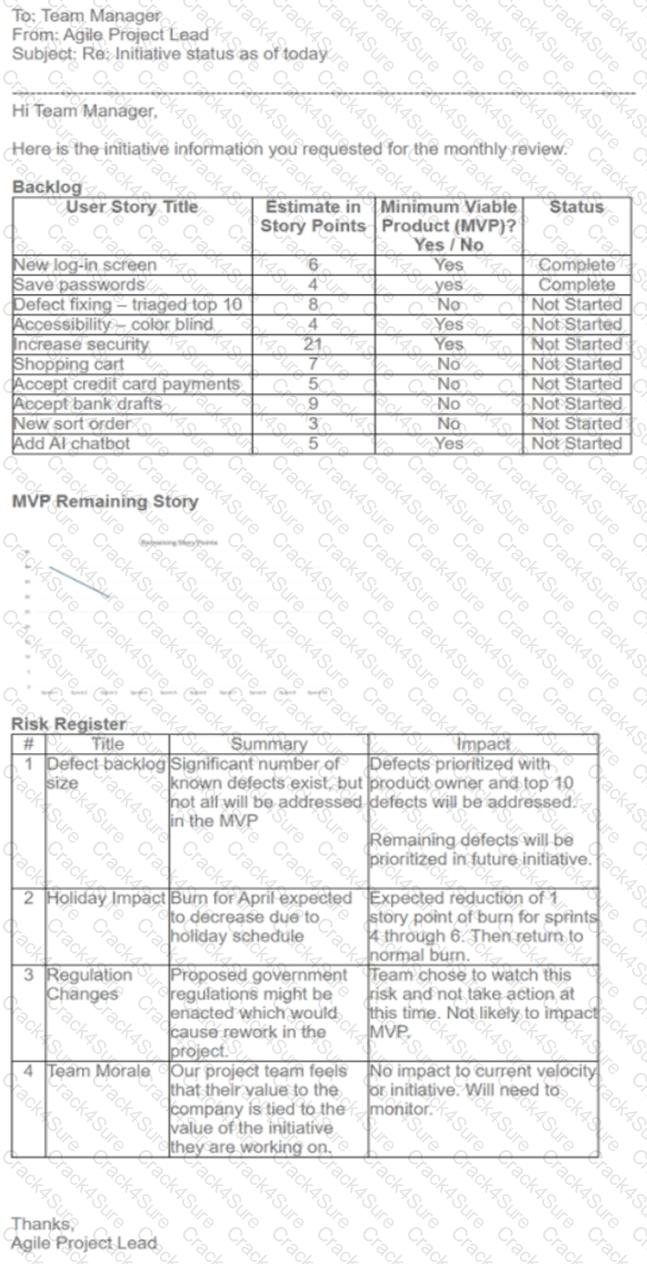
The manager of the team is responsible for delivering a specific initiative within the organization. They are preparing for the monthly project review meeting, where they will present the current state of this initiative. The agile project lead sends the manager the following email with the initiative ' s current status.

Which summaries are correct and will be presented during the monthly project review? (Refer to

the email and exhibits to the Team Manager)

A.

MVP has 25 remaining story points; MVP will complete at the end of sprint 8; with no otherdeviations, the entire backlog will complete at the end of sprint 15.

B.

MVP has 30 remaining story points; MVP will complete at the end of sprint 8; with no otherdeviations, the entire backlog will complete at the end of sprint 15.

C.

MVP has 25 remaining story points; MVP will complete at the end of sprint 9; with no otherdeviations, the entire backlog will complete at the end of sprint 16.

D.

MVP has 30 remaining story points; MVP will complete at the end of sprint 9; with no otherdeviations, the entire backlog will complete at the end of sprint 16.

Question # 89

During refinement, the team tester has a question about part of the acceptance criteria for a given user story. Who should clarify the acceptance criteria?

A.

The sponsor, since they understand the business value.

B.

The Scrum Master, since they coordinate with the team and define the acceptance criteria.

C.

The Product Owner, since their vision is the basis for the acceptance criteria.

D.

The developer, since they write the code that would be tested.

Question # 90

An agile team has been given a complex project with a basic set of requirements which need further elaboration and review. How should the team iteratively build out the backlog of requirements with the stakeholders?

A.

Conduct a requirements gathering workshop.

B.

Deliver the basic requirements iteratively.

C.

Have the product owner fill out the requirements backlog.

D.

Have the stakeholders fill out the backlog before starting the project.

Question # 91

What should the Scrum Master do?

A.

Engage the team to determine the sprint velocity based on previous agile projects.

B.

Average the sprint velocity based on input from team members

C.

Share the sprint velocity obtained from the sponsor with the team

D.

Run multiple sprints before determining the sprint velocity with the team

Question # 92

An organization wants to increase value delivery in its agile projects.

What should the agile teams do?

A.

Perform analysis and development work, but no testing because that should be managed by another specialized team.

B.

Master available technology and tools to provide informative dashboards to the stakeholders.

C.

Work with product owners and turn product backlog items into potentially shippable product increments.

D.

Complete projects by their deadlines and share the budgets upfront with project sponsors.

Question # 93

Over the last two sprints, a number of potential problems have threatened the team ' s ability to hit the targeted release date.

What should the agile practitioner do?

A.

Deal with the issues in a retrospective if they ever come up again.

B.

Create a task board to track issues when they appear.

C.

Identify and monitor issues through a risk burndown chart.

D.

Create an issue log as an information radiator and monitor.

Question # 94

What should the agile practitioner do?

A.

Complete the test cases before creating the story in the backlog

B.

Define the detailed business requirements so that the team can continue with development

C.

Define the user stories with just enough detail so the team can collaborate continuously

D.

Ensure the acceptance criteria includes testing scenarios, so the team can do thorough testing

Question # 95

A project team realizes that an important task on the iteration backlog will take more time than originally estimated.

What should the project team do?

A.

Continue working on the task until it is completed

B.

Remove the task owner from the project team

C.

Add resources to reduce time to task completion

D.

Stop working on the task and include it in the next iteration

Question # 96

During team meetings, the team often struggles with making decisions about their technical approach.

What should be done to improve the quality and timeliness of decisions?

A.

Work with the team to improve collaboration by fostering group decision-making and conflict resolution techniques.

B.

Promote team discussion but give the Product Owner the ultimate decision-making authority.

C.

Assign individual team members as decision owners for each key decision to avoid conflict.

D.

Identify team members that demonstrate servant leadership qualities to facilitate discussion and make decisions.

Question # 97

The transition of a monthly news publication from paper to digital is planned to start in the next few weeks. There is a debate between the product owner and the development team about the initial features to be made available and the first five stages of implementation.

What should the scrum master do to address this situation?

A.

Request more clarification from the client relations team.

B.

Ask the team to define the minimum marketable feature

C.

Tell the team to proceed with coding the items as currently defined.

D.

Encourage open discussions to help the team reach agreement

Question # 98

An agile team is preparing a release plan for a project. What information will the team need to complete this plan?

A.

Amount of work needed to complete a single user story

B.

Amount of work that can be accomplished by each team member

C.

Amount of work that can be accomplished in an iteration

D.

Amount of work that can be accomplished by the entire team

Question # 99

During sprint retrospectives, some team members are very vocal and tend to dominate the conversation, while others are more reserved and less likely to participate. What should the Scrum Master do?

A.

Encourage all team members to participate, and have them type their retrospective feedback into the agile lifecycle management tool.

B.

Ask more specific questions during the retrospectives.

C.

Use retrospective techniques, such as silent writing, clustering, and dot voting to field feedback prior to discussion by the team.

D.

Ask team members to email feedback that can be summarized in a spreadsheet for the team.

Question # 100

What was the determining factor?

A.

Size and priority

B.

Minimum marketable features

C.

Release plan

D.

Sprint mapping

Question # 101
A.

Establish a common vision and success criteria and involve all the stakeholders in the iteration reviews.

B.

Invite stakeholders for the iteration reviews but do not include new stakeholders which may limit project success.

C.

Involve all the stakeholders in iteration reviews but do not entertain all expectations of all stakeholders.

D.

Communicate issues to all stakeholders via email and only communicate risks to internal stakeholders.

Question # 102

What should the product owner have done differently?

A.

Demonstrated only the completed stories and seek stakeholder feedback

B.

Presented the budget situation and review the cost variance

C.

Reviewed the test results to gain confidence from the stakeholders

D.

Presented a demo of all the stories including the work in progress stories

Question # 103

A scrum master is 6 days into a 10-day iteration. A customer representative approaches the scrum master and asks whether they can access the latest update on the project.

Which action should the scrum master take?

A.

Share the information radiator.

B.

Email the latest release plan.

C.

Invite them to the next retrospective.

D.

Send the latest project report.

Question # 104

A development team determined the first release of a product should focus on delivering a minimally viable version of the solution. What is the most important reason the team decided to do this?

A.

To produce a fast return on investment

B.

To reduce risk as quickly as possible

C.

To gain competitive advantage as soon as possible

D.

To maintain visibility with project stakeholders

Question # 105

What can an agile practitioner conclude about team A and team B ' s estimates?

A.

Team B has underestimated scope compared to team A.

B.

Team A is more confident in delivering velocity than team B.

C.

Both teams need to indicate their proposed technology before the estimates can be analyzed.

D.

Both teams have estimated the project to be of same size.

Question # 106

What should the agile coach do?

A.

Work with the team to determine points at which to celebrate its work.

B.

Provide the team with a break by scheduling a team event.

C.

Have the team increase work in progress (WIP) levels to more quickly complete the flow.

D.

Rejuvenate the team by temporarily reducing WIP levels.

Question # 107

Two similar stories A and B are estimated at 3 story points. Story C is estimated at 8 points. After an iteration in which A and C were completed, it is found that story A took much longer than story C.

What should the agile practitioner do?

A.

Assign story B more than 8 story points to provide a better estimate

B.

Add points to story B’s iteration to account for the error but keep story B at 3 points

C.

Assign more resources to story B to bring it in line with the estimate

D.

Reestimate all stories including values for A, B, and C

Question # 108

A Kanban team is struggling to prioritize and determine which tasks to handle first according to value.

What should the team do to improve this situation?

A.

Involve their product owner.

B.

Review their work in progress (WIP) limits.

C.

Use class of service.

D.

Measure their lead time.

Question # 109
A.

Parametric

B.

One-to-one comparison

C.

Affinity

D.

Planning poker

Question # 110

A scrum master is working with a team on a complex software project that is scheduled to run for 2 years with a series of product releases. The scrum master is responsible for planning the project for the next 6 months and has advised planning the project up front.

What should the scrum master do?

A.

Add the releases into a roadmap with milestones and activities.

B.

Identity dedicated tasks and activities with regular feedback loops.

C.

Deliver in small and continuous iterative releases.

D.

Identify the requirements ' schedule within set time scales.

Question # 111

During a current sprint, a team member asks permission from the Scrum Master to investigate an alternative design approach.

What should the Scrum Master do?
A.

Discourage the team member from deviating from the plan and document the request during the retrospective

B.

Encourage the team member to research the issue and present the findings during the retrospective

C.

Discourage the team member from using experimentation/spikes unless it is fully developed and accounts for a variety of use cases

D.

Encourage the team member to use experimentation/spikes for continuous improvement and help the team understand why it is important

Question # 112

PMI-ACP question answer

Case Study

An agile project lead for a company is leading a sales team who has committed to delivering new product functionality to the customer at the end of five sprints. The agile project lead performed initial planning with the team and with the team ' s support has committed to the scope and deadline.

Check in with the project in three stages to answer the associated questions.

How do two additional features and more story points added by the product owner impact the team ' s progress and ability to complete work within the iteration, considering the burndown rate of the team has not changed? (Refer to the Case Study and End of Sprint 3 Exhibit)

A.

The scope of the items in the backlog has been increased to reflect an increase in velocity.

B.

The backlog has been increased and the velocity of the project may no longer be on track.

C.

The team has committed to additional work added to the backlog and will increase velocity.

D.

The team did not complete the backlog items at the same velocity due to external issues

Question # 113

The amount of information captured in the project ' s defects is varying within the development team. Team members are becoming frustrated with the defect quality inconsistencies and the frequent clarification required.

What should be done to address the issue?

A.

Stop the current iteration to discuss defect quality issues and explore solutions.

B.

Discuss and explore solutions in the next planning meeting and take corrective actions as required.

C.

Generate insights at the next retrospective and adjust processes as decided by the team.

D.

Assign corrective actions to the backlog for the team to identify the mandatory defect information.

Question # 114

The product owner working on an agile software development project has brought all the Scrum team members together for the first sprint planning meeting. The team has read the user stories and has provided estimates to complete these user stories. The product owner plans to empower the team to get the work done.

What is this an example of?

A.

Emotional intelligence

B.

Two-way communication

C.

Bipartisan agreement

D.

Reciprocal communication

Question # 115

A project has several features that will deliver immediate customer value. The product owner needs to determine which features to include in the upcoming iteration.

What should the product owner have the customer review and approve?

A.

Work breakdown structure

B.

Description of all features ' functions and an estimate of their cost

C.

Priority list of desired features and functions

D.

Comprehensive schedule of immediate deliverables

Question # 116

One of the overseas stakeholders on an agile project has not been actively involved in the project ' s development. What would be the first step to reengage the stakeholder?

A.

Increase the frequency of emails and/or try to call the stakeholder.

B.

Remind the stakeholder of their obligation to engage in the project.

C.

Talk to the stakeholder ' s superior so they can offer coaching and guidance on project involvement.

D.

Set up a meeting with the stakeholder to modify the working agreement and ensure future engagement.

Question # 117

On a complex project with a large degree of uncertainty, the team’s velocity is declining. Upon testing, it is discovered that many of the work items reported as complete are not meeting the stakeholders ' requirements.

Which of the following could help resolve the incomplete work?

A.

Conduct a spike so that the team can focus on defect repair without the distraction of new work items.

B.

Create a burndown chart to ensure the team understands the variance between the current and target velocity.

C.

Work with the Product Owner to reduce the complexity of the work so that the team can improve quality.

D.

Work with the team to ensure that acceptance criteria is being properly defined and understood.

Question # 118

An agile team is working on refining project requirements. Due to new dependencies uncovered in every working session, the team is unable to complete the detailed solution requirements. Instead of trying to complete requirements, what should the team do to work collaboratively to identify and prioritize the most important requirements and adapt to changes as needed?

A.

Report this as a blocker and ask senior management to provide the right subject matter experts (SMEs) until all the outstanding issues can be dosed.

B.

Identify the key business stakeholders and invite them to day-long sessions until all the dependencies and outstanding issues can be closed.

C.

Identify the key dependencies that need to be resolved in order of priority level so the user stories can meet the definition of ready (DoR) criteria.

D.

Report this as a blocker and ensure the product owner is able to deprioritize the issues so the user stories can meet the definition of ready (DoR) criteria.

Question # 119

During a sprint, the team encounters a technical problem that becomes an impediment to completing two stories.

What should the Scrum Master do?

A.

Ask the lead developer to identify a solution, and then share the details with the team

B.

Ask a technical manager or architect to determine a solution to the problem

C.

Work with the product owner to add a spike to the next sprint to identify a solution

D.

Create a collaborative team environment so that the team can explore a solution together

Question # 120

During the fourth sprint retrospective for an IT project, the team members develop a series of actions to improve problem solving in the next sprint. However, many team members are concerned that these actions will not be implemented, since there was no follow-up from the last retrospective meeting.

What should the Scrum Master do to improve team commitment to the recommendations from the retrospective meeting?

A.

Lead the team and help them to constantly improve the processes in the project.

B.

Be aggressive when working with the team to identify the root cause of the problems.

C.

Ensure each team member follows through all the improvement actions.

D.

Perform as a servant leader and let the team resolve the impediments of the project themselves.

Question # 121

A team ' s technical lead believes that manual testing tasks should be conducted by junior team members below their level. The junior team members think it is unfair and refuse the tasks.

What should the Scrum Master do?

A.

Tell the technical lead to do the testing

B.

Facilitate an open and focused team discussion that reinforces team agreements

C.

Ask the team manager to advise the technical lead that all tasks are important

D.

Encourage the team to take ownership of the delivery

Question # 122

A globally distributed project team is using email and phone calls as the only way to share information. Delays in resolving issues often occur due to misinterpreted communications, leading to a lower team velocity.

What steps should the project leader take to improve knowledge sharing?

A.

Meet individually with each team member to identify the issues and relay information to the remaining members through status reports.

B.

Establish a live video feed between the dispersed teams to enable spontaneous engagement and collaboration on issues.

C.

Request that the customer co-locate the team to overcome the communication issues, as this is the only method to ensure agility.

D.

Inform the customer of the challenges and lower velocity of the project to accommodate for the slower delivery pace.

Question # 123

An agile leader has been assigned to a project that involves significant technical complexity. What should the agile leader do to set the project up for success?

A.

Address this impediment by obtaining suitable training for the team.

B.

Address the risks resulting from complexity within sprint zero.

C.

Facilitate team brainstorming of the risks resulting from complexity for the risk register.

D.

Motivate the team to try new technical approaches.

Question # 124

During a team meeting, members who are subject matter experts (SMEs) mention that they are continuously working on repetitive tasks which has lowered motivation.

What should the agile practitioner do?

A.

Organize a team-building activity to improve team morale

B.

Have team members work in pairs to learn from each other and develop new skills

C.

Ask team members to perform a value stream analysis of their activities

D.

Add more resources to the team to help with the tasks

Question # 125

An agile team is having a meeting with a customer to formulate the product requirements for the next iteration. The outcome of the meeting is a set of clear and detailed requirements.

What should the team do next?

A.

Run automated tests on the legacy functionality.

B.

Ask the customer to write tests that will be used to know when a story has been correctly developed.

C.

Start coding on the selected user stories to meet the requirements.

D.

Write tests that will be used to know when a story has been correctly developed.

Question # 126

How should the project team address this issue?

A.

Suggest pair programming during the retrospective.

B.

Ask the product owner to re-prioritize the user stories at the next retrospective.

C.

Re-estimate the story points with team members at the next iteration planning meeting.

D.

Assign less complex user stories to the inexperienced software engineer at the next iteration planning meeting.

Question # 127

A project team ' s standups often run over the allotted time as members attempt to resolve issues. With a large team, this is leading to productivity impacts and bringing complaints from some members that the meetings are wasting their time when they are not directly involved in an issue’s resolution.

How can the project leader help to manage the team ' s time?

A.

Set up individual status meetings and find ways to make sure issues are resolved in advance so that time is not wasted for all team members during the standups

B.

Add time to the standups to accommodate issue-resolution discussions so that everyone is up to date on the decisions made

C.

Change the standups to weekly status meetings with a longer duration to allow team members to resolve issues collaboratively

D.

Ask team members to raise issues during standups and then discuss resolution options with specific members in separate conversations

Question # 128

A global subscription-based service is pursuing enterprise agility across digital product development teams. Product teams release updates frequently, but customer usage data and support trends are reviewed only at the end of each quarter. As a result, several low-adoption features continue to receive investment while customer churn gradually increases. Leadership wants the product teams to respond more quickly to changing customer behavior.

What should the agile practitioner recommend?
A.

Schedule monthly executive reviews to assess customer usage and feedback to support investment decisions.

B.

Integrate customer usage analytics into feature prioritization processes to adjust investment decisions.

C.

Delegate feature prioritization decisions to regional business managers based on customer usage analytics.

D.

Increase the number of features delivered each quarter to drive customer usage and improve overall satisfaction.

Question # 129

PMI-ACP question answer

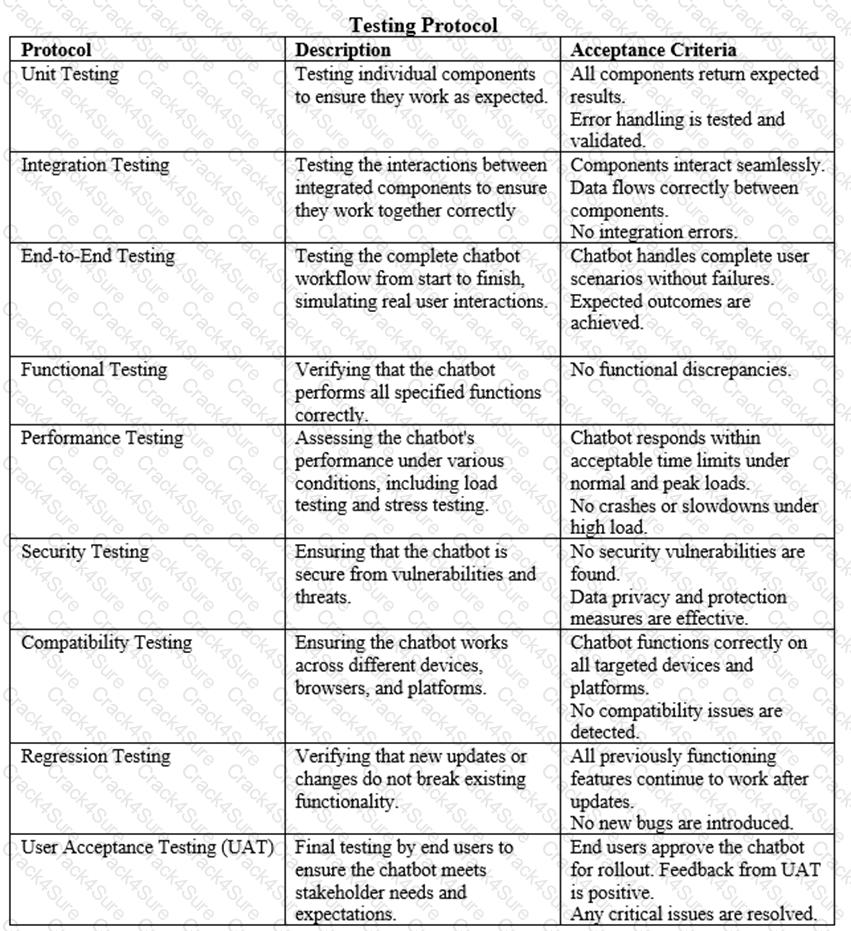
A scrum master is overseeing the launch of a chatbot for the service desk. Complaints come up post-release about edge case responses to queries. After analyzing the issues, the business decision was made to take the chatbot offline, resulting in workflow disruptions and risking the reputation.

How could this situation have been avoided? (Refer to Testing Protocol Table)

A.

Conduct user acceptance testing to ensure the chatbot meets stakeholder needs and expectations.

B.

Perform integration testing to minimize any bugs between the chatbot components.

C.

Perform functional testing to verify the chatbot performs the reguired functions.

D.

Conduct regression testing to ensure all previously functioning chatbot features continue to work after updates.

Question # 130

What should the agile team do?

A.

Discuss the efficiency at the next iteration retrospective

B.

Review the process value stream to determine potential improvements

C.

Review the value the customer receives from the user story to determine backlog priority

D.

Discuss the performance of the solution at the next sprint review

Question # 131

What should the agile team do?

A.

Demand frequent product reviews by the product owner

B.

Continuously work with the product owner to do backlog refinement and product reviews

C.

Have the product owner provide detailed requirement specifications to ensure the proper features are delivered

D.

During the planning session, ensure the team is committed to deliver within the specifications

Question # 132

How can this issue be resolved?

A.

Break down the feature into smaller parts, and commit to completing the minimum viable product.

B.

Complete the iteration to which they have already committed, and include the feature in the next release.

C.

Change the planned features to include only the vitally important one.

D.

Extend the iteration to complete the feature.

Question # 133

Several team members are new to agile and there is a lot of confusion. It seems everyone is coming in with different experiences and following their own agendas. The scrum master decided to hold a presentation on core agile principles and values.

What should the scrum master emphasize to the team during the presentation?

A.

The value of agile ceremonies and methods

B.

Performance and chain of command

C.

Product deliverables, procedures and features

D.

Collaboration, value delivery and shared mindset

Question # 134

Trend analysis shows that velocity is significantly higher than predicted and the release can be completed one month ahead of schedule. The team recommends changing the end date to reflect this.

What should the agile practitioner do?

A.

Jointly meet with the team and product owner to discuss options and determine the end date

B.

Announce that the team has exceeded the predicted velocity and that the end date will be earlier than planned

C.

Ask the product owner to include additional features in the product backlog, then replan subsequent iterations

D.

Ask the team to decrease velocity to meet contractual obligations and document this decision

Question # 135

A new Scrum team is struggling with the various ceremonies of Scrum. Among other things, the product owner and stakeholders find the technical architecture and design presentations during sprint reviews less than informative.

What should the team do?

A.

Refocus the sprint review meetings to demonstrate working software and seek feedback on the product.

B.

Reach out to other, more experienced teams to seek input as to how to present the technical details in a more informative manner.

C.

Explain the importance of the technical architecture and design presentations and improve the presentation format.

D.

Invite technical managers and architects who will be a more appropriate audience to their sprint reviews.

Question # 136

Several new stakeholders are concerned about being asked to review a product demo before it is complete. How should the agile coach explain to the stakeholders the value of working this way?

A.

The product owner may act as the stakeholders ' proxy at the demo and that the stakeholders do not need to be directly involved with the team.

B.

The demo will show whether or not the team understands the level of effort required to complete the project.

C.

The stakeholders will learn whether or not the implementation has worked by getting immediate feedback so they can correct their assumptions for the next sprint.

D.

The stakeholders will be better positioned to evaluate whether or not the resources expended by the organization are worthwhile.

Question # 137

An agile coach is working on a digital transformation project. The project team is in the middle of a 5-week sprint. The agile coach notices constant arguing among team members on what should be the preferred technical approach to solve a current business problem. What can the agile coach do to promote collaboration and consensus-building among team members?

A.

Work with team members to resolve the issue.

B.

Escalate the issue to the product owner.

C.

Allow team members to resolve the issue.

D.

Escalate the issue to senior management.

Question # 138

A project team is working with an enterprise agile center of excellence (CoE) to transition to a Scaled Agile Framework (SAFe). Many of the team members are not familiar with the new methodology and are worried that it will lead to more work and scrutiny.

What should the agile team lead do to help ensure a smooth transition?

A.

Set up lunch-and-learn sessions with the team to provide overviews about the new way of working.

B.

Encourage knowledge sharing and transparency among the working team.

C.

Request the enterprise coach to help the team through the process

D.

Discuss with the team what will change and when and establish a process to address concerns.

Question # 139

A team member on a self-directed team is concerned that a feature the customer wants is outside of what the team will be able to deliver. What should the team member do next?

A.

Escalate the concern to the project sponsor for necessary action

B.

Adjust the feature to make it work as needed

C.

Work directly with the customer to arrive at a suitable compromise

D.

Log this into the risk register and inform the team at the next standup meeting

Question # 140

What should the agile team lead do?

A.

Ask the team to conduct research to find a viable solution.

B.

Select a better technology for team implementation.

C.

Obtain customer input on their technology requirements.

D.

Consult the product owner about their non-functional requirements.

Question # 141

How should the agile practitioner address this?

A.

Implement a burnup chart and add the issue resolution as a task to the product backlog for the customer to prioritize.

B.

Add the issue to the Kanban board and assign it to the team member who has made the most progress on resolving it.

C.

Conduct a root-cause analysis on the issue and identify related risks and risk response owners at the next retrospective.

D.

Document all project issues in a common space and ask the team members to decide on task allocation principles.

Question # 142

A new project is scheduled to begin next month. The project manager has had plenty of time to review and plan all the activities and has adopted the best approach for the project and the organization.

Which action did the project manager most likely take when choosing the approach?

A.

They most likely used a process that was successfully used for other projects; what has worked before is less likely to fail.

B.

They most likely discussed the best approach for this project with the team and will adapt and tailor the approach periodically by reviewing and verifying the scope with the customer.

C.

They most likely requested an increase in the management reserve; this will help the project manager to be more flexible during change requests and risk response activities.

D.

They most likely implemented a predictive approach; this approach might limit the freedom of making changes but secures the project from unknown risks.

Question # 143

There is a debate within the organization on whether projects need to be agile or waterfall. Some agile terms and principles are understood differently by the key stakeholders and this delays the decision-making process.

How should the scrum master proceed?

A.

Allow stakeholders to discuss without the scrum master ' s intervention.

B.

Recommend an external facilitator as no one in the organization is able to eliminate this roadblock.

C.

Facilitate a face-to-face discussion and have stakeholders agree to shift to agile for future projects.

D.

Organize training sessions to create awareness around the agile values for stakeholders.

Question # 144

The product owner is present at the sprint review meeting and states that an estimation for the end of the project must be shared with the company’s steering committee. The scrum master declares that the team reached an average velocity of 40 story points per sprint, considering a biweekly iteration. The team members predict that there are 240 story points remaining.

What is the estimated project conclusion?

A.

Twelve months

B.

Three months

C.

Six months

D.

Two months

PMI-ACP PDF

$33

$109.99

3 Months Free Update

  • Printable Format
  • Value of Money
  • 100% Pass Assurance
  • Verified Answers
  • Researched by Industry Experts
  • Based on Real Exams Scenarios
  • 100% Real Questions

PMI-ACP PDF + Testing Engine

$52.8

$175.99

3 Months Free Update

  • Exam Name: PMI Agile Certified Practitioner (PMI-ACP)
  • Last Update: May 25, 2026
  • Questions and Answers: 481
  • Free Real Questions Demo
  • Recommended by Industry Experts
  • Best Economical Package
  • Immediate Access

PMI-ACP Engine

$39.6

$131.99

3 Months Free Update

  • Best Testing Engine
  • One Click installation
  • Recommended by Teachers
  • Easy to use
  • 3 Modes of Learning
  • State of Art Technology
  • 100% Real Questions included