Crack4sure Logo

We at Crack4sure are committed to giving students who are preparing for the iSQI CTAL-TA_V4.0 Exam the most current and reliable questions . To help people study, we've made some of our ISTQB Certified Tester Advanced Level Test Analyst (CTAL-TA v4.0) exam materials available for free to everyone. You can take the Free CTAL-TA_V4.0 Practice Test as many times as you want. The answers to the practice questions are given, and each answer is explained.
How does using a test model to automate test design help reduce maintenance costs?
A technology company, TechSoft, has just finished the development phase of a new module in its Pro Task project-management mobile application. The new module—“Notifications and alerts”—enables users to receive notifications regarding the status of their tasks and messages. Its functionality includes configuring different notification types (email, SMS, push), notification frequency, and customizing notifications based on the user ' s role.
Because of the many possible setting combinations and varied usage scenarios, the project team has decided to perform exploratory testing, focusing on verifying notification functionality in an environment that replicates the end-user environment as closely as possible.
Tech Soft has software for designing tests that meet combinatorial coverage criteria, such as pairwise coverage. It also has the latest version of a test management tool.
As a test analyst, you have been asked to prepare a test charter for exploratory testing.
Which TWO pieces of information should be included in the charter?
Choose two
You are assigned to an Agile team as a Test Analyst. In most ways, the team seems to be working well. Iteration planning goes smoothly because the user stories are good quality. Most defects that are found by testing are fixed in the same iteration and those that do go live are not causing significant dissatisfaction amongst stakeholders. However, the team is unhappy because the Defect Removal Efficiency rate, measured for each iteration, is less than 80%.
What would be the MOST effective contribution by you as a TA, to improve the situation?
You are designing test cases based on this use case:
Use case: logging in to the online banking system
1. The user opens the banking application.
2. The system displays the login page.
3. The user enters their username and password.
4. The user clicks the “Login” button.
5. The system verifies the username and password in the database.
6. The system starts the multi-factor authentication (MFA) procedure.
7. The user undergoes MFA verification.
8. The system logs the user in and redirects them to the welcome screen.
Alternative flows:
3A: The user clicks the “Forgot Password” button. The system sends an e-mail containing a link to reset the password and returns to step 2.
5A: Incorrect password. The system displays the message “Incorrect password”, and, after the user closes the message window, returns to step 3.
Exceptions:
2A: The system is unavailable because of maintenance work. The system displays the message “Maintenance work in progress; try later” and the login process ends.
7A: MFA verification error. The system displays the message “MFA verification failed” and the login process ends.
The test strategy requires coverage of the main scenario, alternative flows, and exceptions for each use case. The strategy permits testing multiple alternative flows in one test case. Each exception must be tested in a separate test case, although a test case can contain alternative flows.
What is the MINIMUM number of test cases that achieves this coverage?
What is one example of a risk related to automated test design?
You are developing a mobile application for the iPhone. Users have expressed dissatisfaction with earlier versions of the product because those versions only worked on the latest version of the operating system. This time, you want to ensure that older operating systems—going back 10 versions—will be supported by your application. What type of testing are you performing?
Your project is developing an application to generate quotes for motor insurance. The calculation requires a wide range of input data and a reliable model of it has been built in a spreadsheet. There will not be enough time to get adequate functional correctness coverage from the base choice or pairwise techniques, so you have decided to do some random testing based on a probability distribution of variable values that is weighted towards their business criticality.
Which limitation of random testing should you be MOST concerned about?
You intend to test a computer game across several configurations. A configuration includes:
operating system (2 possible values: Windows 10, Windows 11)
browser (3 possible values: Edge, Chrome, Firefox)
RAM type (3 possible values: 16 GB, 32 GB, 64 GB)
You apply pairwise testing. So far, you have designed these test cases:
TC1: Windows 10, Edge, 64 GB -
TC2: Windows 11, Chrome, 32 GB -
TC3: Windows 10, Firefox, 64 GB -
TC4: Windows 10, Firefox, 16 GB -
TC5: Windows 11, Chrome, 64 GB -
TC6: Windows 11, Edge, 32 GB -
What is the MINIMUM number of test cases that must be added to the existing six test cases so that the resulting test set attains 100% pairwise coverage?
Which statement accurately characterizes high-level and low-level test cases?
You are working on an Agile project to develop a web-based online dating service that will allow members of the service to enter their profile, meet people who would be a good match for them, arrange social events with those people and to block people with whom they do not want contact.
Functional correctness, usability, performance and security are all important but the major concern for the stakeholders is data protection. Two environments are available for testing: the regular one is similar to the development environment, the other is a pre-production environment which is configured to become the live system when operation begins, but has currently been loaded with a representative volume of artificial profiles.
The features for member profile entry have been delivered and tested. The current iteration will deliver profile matching, which will be done on-demand in response to a request from a member to see matching profiles in their browser. The tests for these user stories’ acceptance criteria will be aimed primarily at functional correctness and will be scripted. Performance testing and security testing will be done by external specialists when the functionality is stable.
The other TAs in the team are on sick leave and only have time for one exploratory test session before the end of the iteration. What is the MOST appropriate test charter in these circumstances?
Your organization is implementing a food-ordering application that is intended to have an intuitive user interface (easy navigation and fast search) and to offer functions such as:
personalization of the order (the ability to modify ingredients and add comments for the restaurant)
verification of order correctness before it is sent
real-time order tracking
viewing order history
Management has decided to test the requirements listed above with a checklist and has asked you to prepare one. Consider the following four checklists.
Checklist 1 -
[ ] Does the system reject an order with an incorrect zip code?
[ ] Does the system reject an order with an unfilled mandatory field?
Checklist 2 -
The interface allows the user to easily navigate the application (YES / NO / PARTIALLY)
The search function allows the user to quickly search for restaurants (YES / NO / PARTIALLY)
Checklist 3 -
[ ] Is the time from order placement to order confirmation less than 10s?
[ ] Is the user interface free of grammatical errors?
Checklist 4 -
The application works properly on the Android operating system (YES / NO)
The application works properly on the iOS operating system (YES / NO)
Which of the following is an example of a read-do checklist that is useful for testing the application described in the scenario?
You are a test analyst on a project developing a multiplayer computer game in which players can cooperate or compete while communicating over a network. The game will also support players purchasing and exchanging various artifacts for use during gameplay.
Your organization expects the game to be a success and likely to be bought by tens of thousands of players worldwide. The following excerpt is from the risk analysis performed for this product:
Incompatibility when operating on different devices and hardware configurations
User-interface issues at different screen resolutions
Unpredictable player behavior causing crashes
Weak security mechanisms against fraudsters
Which test technique would be the BEST choice to mitigate these risks?
You are developing test cases for an application which performs complex calculations and have decided to model these calculations on a spreadsheet, to determine expected results from inputs.
Which solution to the test oracle problem BEST describes the approach you are using?
You are working with a team of testers who have varying degrees of experience with testing and with the domain. You want to assign test charters to each of them to guide their session-based testing. What is the best approach when designing these test charters?
A credit risk scoring system accepts two integer inputs, L and E, representing credit scores calculated by two independent systems. The system assesses credit risk using the following business logic:
IF L > = 50 OR E > = 50 THEN the risk is high
IF L < = 49 AND E < = 49 THEN the risk is low
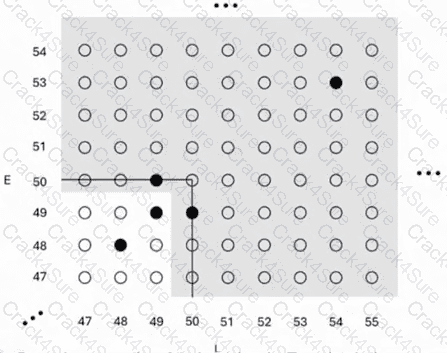
The figure displays a section of the input domain. Points in the gray area are part of the “high risk” equivalence partition, and points outside it are part of the “low risk” equivalence partition. The lines indicate the closed boundary of the “high risk” equivalence partition.
You use domain-based testing to verify the correct implementation of the above requirement. The test set contains the five black points in the figure: (L=48, E=48), (L=49, E=49), (L=49, E=50), (L=50, E=49), and (L=54, E=53).
What level of RELIABLE domain coverage does this set of test points achieve?
You are a test analyst on a project developing a critical system—an air traffic management application that supports controllers in monitoring, planning, and managing flights in real time. The application aims to improve flight safety, airspace management, and route optimization, while considering changing factors such as weather conditions, alternate routes, flight priorities, and dynamic schedule changes.
In a discussion with the system architect, you learn that the application must handle many different combinations of variables, such as flight type, weather conditions, flight priority, or current airspace status. When speaking with air traffic controllers, you learn that the application performs complex operations that not only process data but also generate data from existing information. For example, when weather conditions change, the flight route is recalculated dynamically and the system automatically adjusts the route. This makes certain data dependencies difficult to understand and predict directly.
Based on this scenario, which TWO test techniques are best suited for this project?
Choose two
Which of the following is a problem associated with random testing?
You are testing an application that has a large combination of conditions to be tested. The conditions should not interact, but the various combinations still need to be tested. Unfortunately, you are significantly time constrained and will not have time to test all combinations. What testing technique would be useful in this situation?
Your company, which specializes in medical software, has designed an application for use on smartphones and tablets, that calculates a person’s BMI (Body Mass Index). How can a test analyst BEST contribute to adaptability testing for this application?
A traceability matrix that shows the relationship between the requirements and the test cases is a way to help determine which of the following?
The following decision table shows the rules for sending a package. Same day delivery will not be provided for big packages. All combinations of same day delivery and international destination have been removed as they are infeasible.
Id
Conditions
1
2
3
4
5
6
7
8
9
10
11
12
Infeasible
C1
Size, Small / Average / Big
S
S
S
S
A
A
A
A
B
B
B
B
-
C2
High value. Yes / No
y
y
n
n
y
y
n
n
y
y
n
n
-
C3
Same Day wanted. Yes / No
Y
N
Y
N
Y
N
Y
N
N/A
N/A
N/A
N/A
Y
C4
International, Yes / No
N
N
N
N
N
N
N
N
N
N
N
N
Y
Actions
A1
Charge Extra %
0
0
0
0
10
10
10
10
20
20
20
20
A2
Provide insurance
X
X
X
X
X
X
X
X
A3
Deliver Same Day
X
X
X
X
How many columns will the table have after all possible minimization has been performed?
How does Orthogonal Defect Classification (ODC) work together with Root Cause Analysis (RCA)?
Your organization has been conducting detailed requirements reviews, but a problem has emerged: the author of the requirements becomes defensive during these reviews. On a couple of occasions, the author felt personally targeted and left the meeting very upset.
What type of review could you implement to help de-personalize the reviews?
You are a TA in the development of a road traffic control application, which will be installed at busy road junctions, to control the operation of traffic signal lights according to sensors that detect traffic volume. This safety-critical project is still in the early stages of test planning and the project schedule is tight.
The Test Manager has asked you if crowd testing should be included in the project’s test strategy. You do NOT think it should. Which limitation of crowd testing MOST influences your view?
A route-finding application takes a starting point, an ending point, and a map containing information about one-way streets as inputs. It returns the length, in meters, of the shortest possible route.
You want to verify this system’s correctness with metamorphic testing using these two metamorphic relations:
MR1: For a route from point A to point B, changing one or more one-way streets to two-way streets cannot increase the route length.
MR2: For a map and points A, B, and C, the route length from A to C cannot exceed the combined lengths of the routes from A to B and from B to C.
You have two source test cases:
TC1: Start: P1, end: P2, one-way streets: S1, S2, S3. Result: route length = 1680 m.
TC2: Start: P2, end: P3, one-way streets: S1, S2, S3. Result: route length = 400 m.
Which test case exposes a system failure caused by violating metamorphic relation MR1 or MR2?
During which activity does a test analyst identify the test conditions?
You are applying simplified coverage for domain testing. The equation under test is as follows:
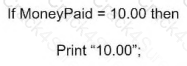
Which set of values for x must be tested to obtain 100% simplified coverage?
Which of the following is an example of a test-environment requirement for an online store?
You are designing test cases from the following state-transition diagram.
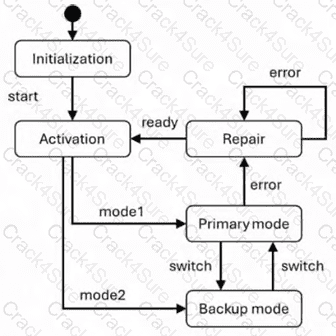
So far, the only test case designed is:
TC1: start, mode1, error, error, ready, mode1, switch, switch, switch, switch.
You use the ROUND-TRIP coverage approach. What round-trip coverage is achieved by this test case?
A system will be developed to support the administration of table-tennis tournaments. The following requirements for the enrolment of entrants have been provided:
R1. High. The administrator shall be able to enter the entrant ' s name, address, phone number/s (mobile and/or home), email and social media handles. Validation rules for these data items are provided separately.
R2. High. The administrator shall be able to enter the entrant’s current world ranking (up to 250) and their relationship with the tournament sponsors (i.e. clothing / equipment / endorsement).
R3. High. The administrator shall be able to enter the entrant’s attendance history at previous events (i.e. finalist / played / withdrew during event / withdrew before event).
R4. Medium. From the entrant’s address the system shall derive whether or not the entrant lives locally and, on the basis of that combined with other rules that are provided separately, shall suggest how much of the tournament’s overall prize fund should be offered to the entrant as their individual attendance fee.
R5. Low. The administrator should be able to change the suggested attendance fee and the system should then deduct this from the remaining prize fund balance accordingly.
You have been asked to review the requirements using perspective-based reading, from your viewpoint as the TA who will be writing functional correctness system test cases. Assume that the other rules referred to by requirements R1 and R4 have been reviewed and are satisfactorily testable. Which conclusion would you reach?
You are your employer’s most experienced TA. The organisation performs root cause analysis (RCA) thoroughly, but infrequently and only on individual defects that went live at the highest of the five Severity levels.
After six months of live operation for one system, particular concern has been expressed about the volume of usability and security defects and there is a strong desire to reduce their quantities. You have recommended adding product quality characteristics, per ISO 25010, to the defect report template.
How might this recommendation support RCA?
You are testing an ATM application. The existing solution has been in production for several years, and it always required users to return to the menu between transaction types. A new requirement has just been introduced allowing users to go directly from Deposit to Withdraw. You have found the following state diagram in the requirements documentation:
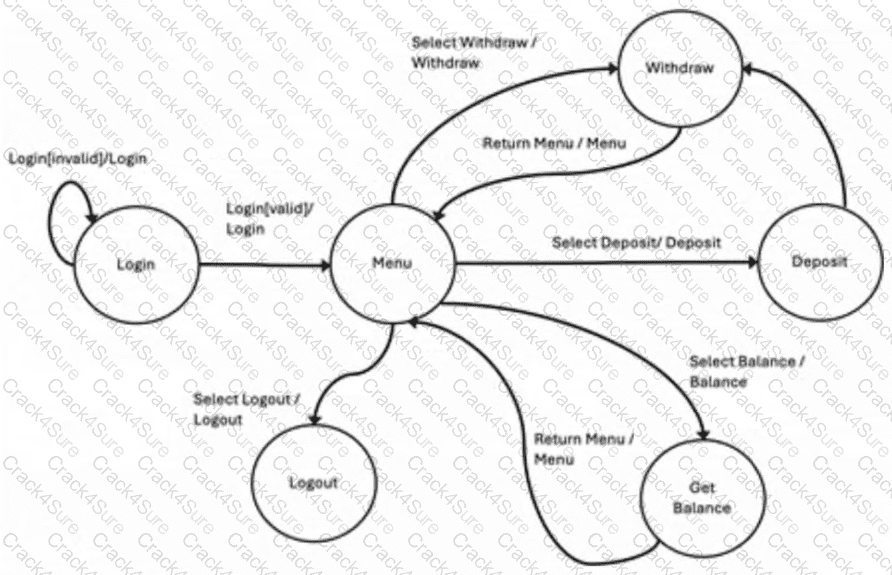
Given this change in requirements, there is an error in the diagram that could lead to an incorrect implementation of the software. What is that error?
The following table shows the software areas covered by the test cases.
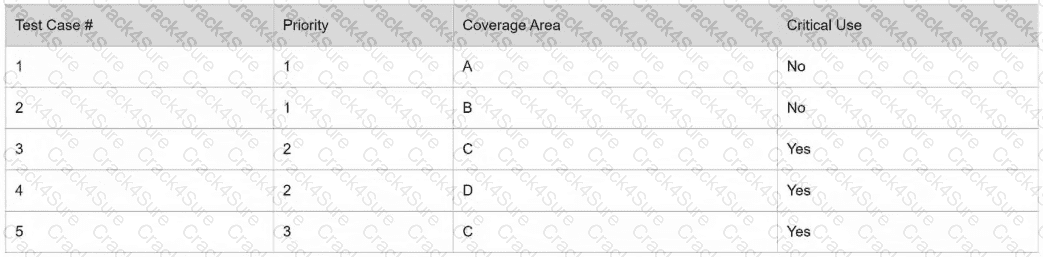
You want to use impact analysis to focus testing. Research shows that areas A, C, and D were affected by this change. Based on this information, which test cases should be run, and in what order?
A simple DVD player is described in the following state transition diagram:
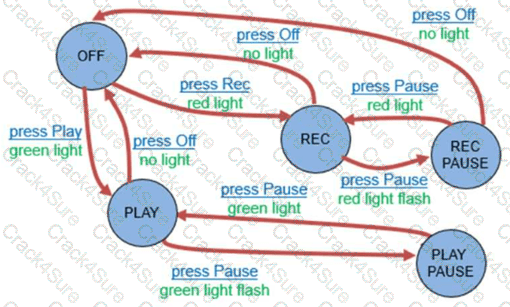
All round trips are feasible, even those that do not start at OFF. How many test cases will be needed for complete round-trip coverage?
3 Months Free Update
3 Months Free Update
3 Months Free Update



TESTED 29 Nov 2026